
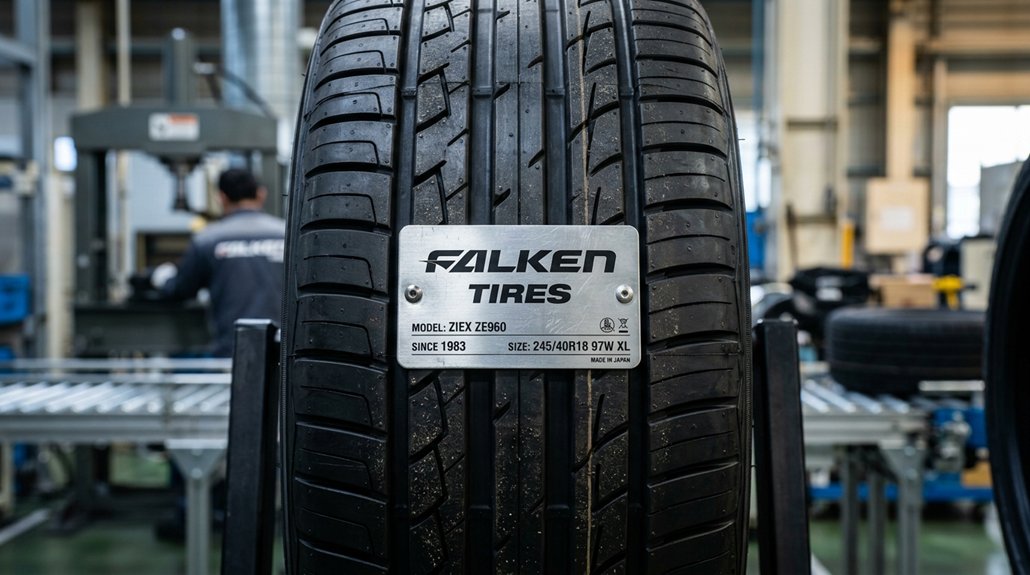
I suspect you didn’t know that Falken’s last U.S. factory in Buffalo, New York, shut its doors for good in early 2025, leaving zero domestic mass production behind.
That’s a major shift for a brand many drivers still assume is built locally.
What replaced that facility, and how this affects your next tire purchase, demands closer examination.
Where Are Falken Tires Made Right Now?
The production backdrop for Falken tires has shifted considerably in recent years, and I’ll walk you through where these tires originate today.
Current Manufacturing Footprint
Falken manufacturing in North America has undergone substantial restructuring. The Albany, Georgia facility, rebranded from Buffalo, NY under Sumitomo Rubber USA, produced Falken tires from 2016 until its 2025 closure, eliminating domestic production capacity. Presently, Falken relies on Sumitomo Rubber Industries’ global manufacturing network, with tire lines and models originating from varied international locations based on specifications and demand.
Falken’s Albany, Georgia plant closed in 2025, ending all domestic tire production and shifting manufacturing entirely to Sumitomo Rubber Industries’ global facilities.
North American Distribution Infrastructure
Despite production changes, Falken maintains strong North American operations through distribution centers in California, Illinois, Florida, New Jersey, and Texas. These warehouses keep regional supply flowing, though manufacturing itself has moved offshore within SRI’s corporate framework.
Where Did Falken Originate as a Japanese Tire Brand?
Origins trace back to 1983, when Falken emerged as a high-performance tire brand under Ohtsu Rubber & Tire in Japan, establishing its foundation in a market already dominated by established manufacturers.
Understanding Falken origin as a Japanese brand requires examining its strategic evolution. The company launched in North America in 1985 and Europe in 1988, expanding its tire manufacturing origins globally while maintaining Japanese engineering standards.
When Sumitomo Rubber Industries acquired Ohtsu Tire & Rubber in 2003, Falken became part of a larger corporate family, yet its identity remained rooted in ultra-high-performance development.
The brand’s early motorsports involvement in the 1990s reinforced this Japanese brand heritage, distinguishing Falken from competitors. For enthusiasts seeking authentic performance lineage, recognizing these tire manufacturing origins matters; your vehicle’s connection to Japan’s rigorous engineering tradition begins with understanding where Falken actually started.
Are Any Falken Tires Still Made in the USA?
Where exactly does Falken stand on American soil in 2025? I’ve examined the evidence, and the conclusion is stark: U.S. production of Falken tires has ceased, at least at any meaningful scale.
The Buffalo plant, which represented Falken’s most significant American manufacturing footprint from 2016 until 2025, no longer operates. This facility, inherited from Goodyear and rebranded under Sumitomo Rubber USA, was the backbone of domestic Falken tire assembly; that’s now history.
Current American Operations
Regional distribution persists through warehouses in Ontario (California), Illinois, Florida, New Jersey, and Texas. No confirmed ongoing Asia manufacturing replacement stateside.
The Manufacturing Reality
Sumitomo Rubber Industries, Falken’s parent company, has consolidated tire production within its Asia manufacturing network. Despite American distribution infrastructure, active confirmation of any Falken tire lines currently produced domestically remains absent.
Why Did Falken Close Its Buffalo, New York Factory?
Why exactly did Falken shutter its Buffalo facility after nearly a decade of operation? The Buffank plant, which began producing Falken tires in 2016 under the Sumitomo Rubber USA rebrand following the 2015 dissolution of the Sumitomo-Goodyear partnership, ceased operations in 2025.
This factory closure stemmed from restructuring within Sumitomo Rubber Industries’ global manufacturing network. While no detailed public explanation accompanied the announcement, corporate documents indicate the shift consolidated Falken production into other facilities within the SRI portfolio.
For enthusiasts tracking domestic manufacturing, this development marks a significant transition: the Buffalo site represented Falken’s primary, and ultimately final, U.S. production location for passenger tires. Understanding this restructuring context helps explain why domestic Falken manufacturing concluded without replacement capacity.
Where Does Sumitomo Rubber Industries Build Falken Tires Today?
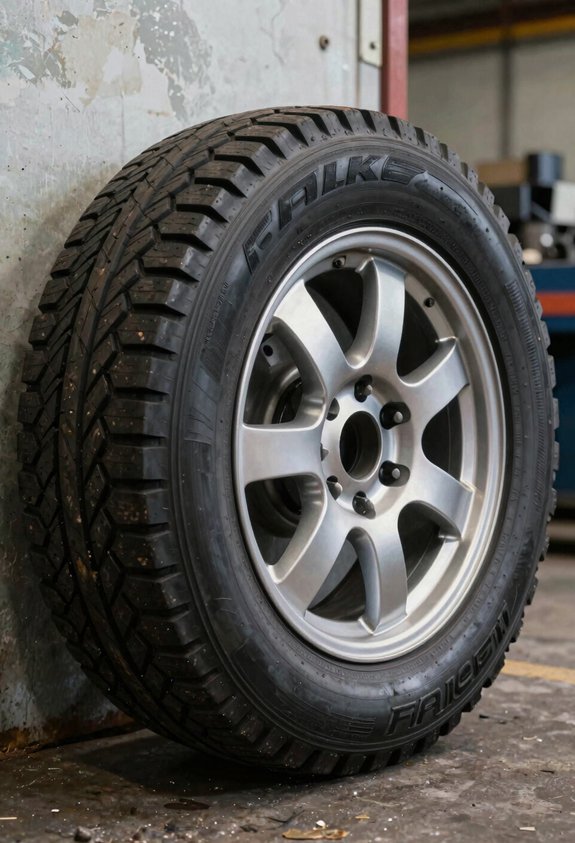
Currently, Sumitomo Rubber Industries manufactures Falken tires through a globally distributed network of facilities that I’ll map out for you, since understanding your tire’s origin affects everything from availability to regulatory compliance.
Global Manufacturing Footprint
Falken tires manufacturing occurs across multiple continents under SRI’s integrated supply network. You’re getting tires produced in Japan, various Asian facilities, and additional plants worldwide, each serving regional demand through localized production and cross-border logistics.
North American Operations
Your Falken tires originate from Sumitomo Rubber USA’s remaining infrastructure, with North American operations headquartered in Rancho Cucamonga, California. Distribution centers in Illinois, Florida, New Jersey, and Texas help maintain regional availability. Note: the Buffalo, NY plant closed in 2025, consolidating U.S. production elsewhere.
Supply Chain Considerations
Sumitomo Rubber Industries uses this global network to supply Falken tires across North America, Europe, and Asia, meaning your specific tire’s origin depends on model, size, and regional demand patterns.
How Does Falken Distribute Tires Across North America?
- Ontario, California facility serves West Coast demand
- Illinois hub covers Midwest supply chains
- Florida center addresses Southeast markets
- New Jersey location handles Northeast distribution
- Texas facility supports Southwest regional needs
This coordinated system connects Falken tires manufacturing/global operations to approved dealers and performance retailers. Sumitomo Rubber USA oversees these operations, integrating logistics from former Dunlop/Tire Corporation channels. Whether you’re seeking motorsport-developed compounds or daily driver options, this network keeps products available. Note: Verify dealer authorization before purchase, as unauthorized sellers may compromise warranty coverage and safety assurances.
Do Falken’s Different Factories Specialize in Specific Tire Types?
I want to examine whether Falken’s global production network follows a pattern of factory specializations, where specific facilities concentrate on particular tire categories rather than maintaining identical, interchangeable operations across all plants. Given that Sumitomo Rubber Industries oversees manufacturing in multiple regions, including the now-closed Buffalo facility and ongoing international locations, understanding how production aligns with tire types requires analyzing both historical assignments and current regional strategies.
This matters because consumers seeking performance, all-terrain, or touring tires may find that origin affects availability, lead times, and even compound formulations tailored to regional market demands.
Factory Specializations
Whether you’re selecting tires for high-performance driving, all-terrain applications, or everyday commuting, you’ll want to understand how Falken’s manufacturing footprint shapes what rolls off each production line.
In my analysis of Falken tire manufacturing, I’ve found that explicit factory specialization remains largely undocumented, though patterns emerge within Sumitomo Rubber Industries’ global network. The Buffalo, NY plant (operational 2016–2025) demonstrated SRI’s capacity to adapt domestic facilities for Falken production, while Japanese and other international plants maintain legacy capabilities.
What we know about production alignment:
- AZENIS performance tires likely draw on Japan’s technical expertise
- Wildpeak all-terrain variants may rely on specialized compound facilities
- Ziex touring lines probably distribute across multiple plants
- Sumitomo Rubber Industries integrates Ohtsu lineage technologies
- North American distribution centers (Ontario, Illinois, Florida, New Jersey, Texas) coordinate output without confirming origin-specific builds
Until SRI publishes detailed factory specialization breakdowns, I recommend verifying tire sidewall markings for production source.
Global Production
| Region | Primary Function | Key Operational Notes |
|---|---|---|
| North America | Distribution & former manufacturing | Buffalo, NY plant (closed 2025); warehouses in CA, IL, FL, NJ, TX |
| Asia-Pacific | Core SRI production | Main UHP and motorsport tire sourcing |
| Integrated Supply Nodes | Cross-brand logistics | Rancho Cucamonga, CA HQ links Dunlop/Tire operations |
I emphasize this: over-reliance on any single node risks shortages. Falken’s regional manufacturing model mitigates this, though you should verify current plant status, as facilities like Buffalo’s closure reshape capacity.
Motorsport-derived products, requiring precise compounds, benefit from SRI’s distributed expertise; do not assume all plants handle identical specifications.
Does It Matter Which Country Made Your Falken Tires?
Why should I care where my Falken tires were manufactured? Falken’s manufacturing footprint spans multiple countries, and your specific tire’s country of origin doesn’t dictate its quality or performance capabilities. I’ve examined how global production works for this brand, and here’s what actually matters:
Falken’s manufacturing footprint includes facilities across regions, maintaining consistent standards regardless of location. Global production networks share technology, so your tire benefits from the same R&D regardless of where it’s molded.
Country of origin variations exist, but Falken’s motorsports programs and Sumitomo Rubber Industries’ oversight keep quality control unified. Historical shifts, like the Buffalo plant closure, demonstrate adaptability rather than compromise.
Specific models, ZE912, AZENIS lines, perform identically across production sites.
You’re buying into a global standard, not a geographic lottery.
How Can You Check Where Your Falken Tires Were Manufactured?
Locating your tire’s manufacturing origin requires examining a standardized coding system embedded directly in the rubber itself.
Understanding the DOT Code
Every Falken tire carries a DOT code, mandated by federal regulation, embossed on the sidewall near the rim. This alphanumeric string, typically 10-12 characters, contains critical manufacturing data. The first two characters identify the production plant; for instance, Falken’s former Buffalo, NY facility had its own unique plant code within this system.
Decoding Manufacturing Specifics
Beyond the plant identifier, positions three and four denote tire size, while the final four digits (week and year) reveal when tire manufacturing concluded. A code ending in “3519” indicates production during the 35th week of 2019. Cross-referencing your DOT code with Sumitomo Rubber Industries’ official plant registry confirms exact origins, though you’ll want to verify current facility status, as that Buffalo plant closed in 2025.
Why Did Falken’s Manufacturing Change After the Goodyear Split?
This transition delivered distinct advantages for Falken enthusiasts seeking authentic Japanese-engineered products manufactured within North American borders:
- Elimination of competitor-controlled production dependencies
- Direct SRI oversight of quality assurance protocols
- Streamlined supply chains reducing market lag times
- Consolidated R&D alignment with global Falken standards
- Enhanced traceability for warranty and service support
However, by 2025, the Buffalo closure signals continued volatility in localized Falken manufacturing arrangements.
How Does Falken’s Factory Network Compare to Other Tire Brands?
How does one tire company’s scattered production footprint stack up against rivals with more centralized operations? I notice Falken’s approach differs markedly from competitors who consolidate manufacturing in single flagship factories, and this distinction matters when you’re selecting tires that align with your priorities.
North American Production
My analysis shows Falken maintained regionalized plants like the Buffalo facility, operating 2016–2025, alongside distribution centers, creating a dispersed domestic footprint rather than concentrated output.
Global Manufacturing Network
I trace Falken’s global manufacturing network through Sumitomo Rubber Industries’ strategy, with production spanning Japanese facilities and other international sites, yielding imported tires supplementing domestic sources.
Regionalized Plants Versus Centralization
I caution that this regionalized model involves historical plant shifts, dissolved partnerships, and blended supply chains, whereas centralized rivals offer streamlined traceability but potentially less market adaptability; trade-offs demanding your careful evaluation.
Which Future Factories Will Expand Falken Production?
I need to examine where Falken production will expand, considering Sumitomo Rubber Industries’ global manufacturing strategy alongside the 2025 closure of their Buffalo facility, which had produced Falken tires since 2016 after rebranding to Sumitomo Rubber USA.
While no new plant locations have been confirmed publicly, the company’s established network, including distribution centers in Ontario, California, and warehouses across Illinois, Florida, New Jersey, and Texas, suggests expansion will likely use existing regional infrastructure rather than immediate greenfield construction.
You should monitor Sumitomo’s capital announcements closely, as their post-2015 independence from Goodyear and continued global footprint position them to shift capacity across facilities in Japan, where Falken originated in 1983, and other international sites under their direct control.
Sumitomo Rubber Expansion
Where exactly will Falken tire production expand under Sumitomo Rubber’s growing manufacturing footprint? I’m examining Sumitomo Rubber USA’s strategic trajectory, particularly how their manufacturing facilities will accommodate AZENIS ZIEX expansion across North American and Asian markets.
Following the 2015 Goodyear-Falken joint venture dissolution, Sumitomo Rubber Industries accelerated direct control over Falken production coordination, using global capacity for ultra-high-performance and all-terrain lines. Their acquisition-driven growth strategy, originating from the 2003 Ohtsu Tire & Rubber purchase, established foundational infrastructure that now supports targeted line expansion.
Critical Expansion Considerations:
- North American facility upgrades prioritizing AZENIS ultra-high-performance capacity
- Asian plant modernization for ZIEX touring tire production scaling
- Manufacturing facilities integration post-Buffalo operations transition
- Sumitomo Rubber USA distribution network optimization for domestic market penetration
- Overseas capacity coordination guaranteeing global supply chain resilience
Strategic positioning demands precise timing, as capacity constraints may affect regional availability.
Buffalo Plant Closure
We’re watching whether expanded Asian or other regional plants absorb North American demand. Historically, the 2015 Goodyear partnership dissolution already reshuffled Falken’s supply chain; now we’re seeing consolidation without immediate U.S. manufacturing replacement. Monitor availability through authorized dealers.
Global Manufacturing Strategy
- Asia-Pacific facilities increasing UHP tire output for performance segments
- European plants expanding all-terrain capacity for growing SUV markets
- Emerging factory investments in Southeast Asia targeting cost efficiency
- Partner plant integrations utilizing existing SRI infrastructure
- North American distribution hubs maintaining market presence without domestic manufacturing
This decentralized approach, which SRI developed after dissolving the Dunlop-Goodyear partnership in 2015, means you’re getting tires from optimized sources rather than centralized, vulnerable supply chains.
Where Are Falken’s Racing and UHP Tires Built?
What this means for you: Falken racing tires for competition use, alongside street-legal UHP tires (Ziex, AZENIS lines), undergo motorsport-derived tuning before SRI-affiliated production. These aren’t mass-market commodities; they’re built to stringent specifications, tested extensively, then distributed regionally.
The supply structure adapts, but the performance mandate, evidenced by endurance racing validation, persists.