

Tire rotation isn’t optional maintenance; it’s what keeps your tread wear even, your handling predictable, and your warranty intact. I’ll walk you through exactly when to do it, which pattern your drivetrain demands, and the warning signs you’ve waited too long.
Most drivers get this wrong, and the cost shows up in premature replacements or worse. Here’s what you need to know before your next service interval passes.
What Mileage to Rotate Tires (and When to Adjust It)

How often should you rotate your tires? I follow a tire rotation interval of 5,000 to 7,000 miles, or roughly every six months, whichever arrives first; this mileage aligns with many manufacturer guidelines and fits neatly into most maintenance schedules.
If you’re driving an SUV, crossover, or all-wheel drive vehicle, I’d push you toward the 5,000–7,500 mile range, while EVs with their higher torque demand closer to 5,000–6,000 miles. Spot an uneven wear pattern? Don’t wait—rotate sooner to prevent accelerated degradation.
Aggressive or all-terrain tires require even more vigilance, needing rotation every 3,000–5,000 miles. Above all, I’ll always tell you: consult your manual’s manufacturer guidelines, since some warranties demand strict adherence, and deviating risks costly consequences.
Why Front-Wheel Drive Needs More Frequent Tire Rotation

Where does accelerated tire wear originate in a front-wheel drive vehicle? It starts at the front axle, where your front tires shoulder steering, braking, and propulsion simultaneously, triple-duty that rear tires never face.
Accelerated tire wear in front-wheel drive vehicles originates at the front axle, where tires endure steering, braking, and propulsion simultaneously.
Why FWD Demands Tighter Rotation Schedules
- Front tires wear 2–3× faster than rears in front-wheel drive configurations because combined lateral, longitudinal, and torsional loads degrade tread compound aggressively.
- The standard rotation interval drops to 5,000–7,000 miles (or six months) for FWD platforms, versus longer spans for RWD or AWD alternatives; whichever threshold you hit first governs your service timing.
- Front-to-rear crossing (rears moving forward, fronts shifting rearward diagonally) redistributes workload, preventing the accelerated shoulder erosion and feathering that unbalanced FWD systems develop.
Maintaining wear balance through disciplined rotation preserves tread life across all four positions, rather than sacrificing half your rubber prematurely. Skip intervals, and you’ll sacrifice wet-braking performance and cornering confidence when you need it most.
Why Electric Vehicles Need Faster Tire Rotation Schedules
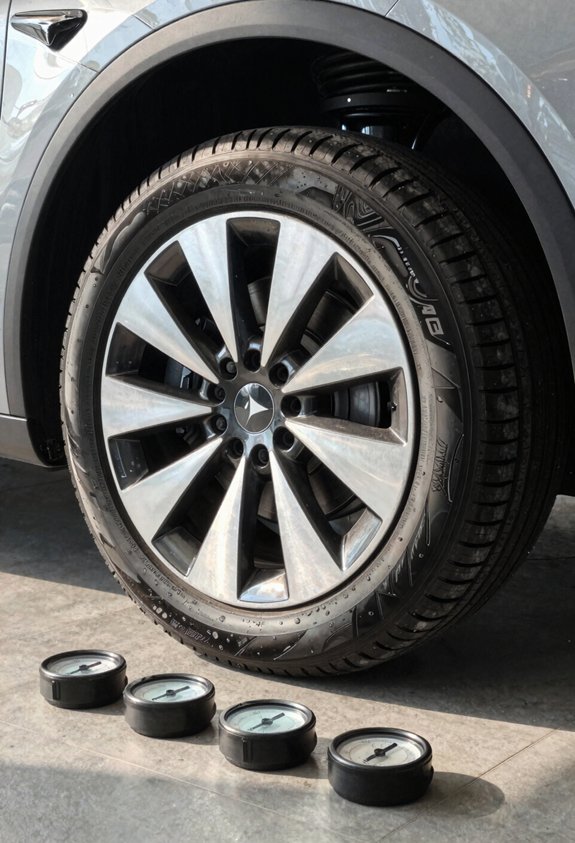
Although conventional tire wisdom might lead you to assume all vehicles share similar maintenance calendars, electric vehicles impose fundamentally different demands on their tires that compress rotation intervals dramatically.
Understanding EV Tire Stress Factors
EV tires face accelerated tread wear from two primary forces: instantaneous torque delivery and substantial battery weight. Unlike internal combustion engines, electric motors generate maximum torque immediately, concentrating destructive friction on driven axles. This mechanical reality demands tire rotation every 5,000–6,000 miles, roughly twice the conventional interval, to distribute wear evenly across all positions.
Consequences of Delayed EV Maintenance
Neglecting this compressed schedule risks uneven tread wear, compromised handling stability, and reduced driving range from increased rolling resistance. Proper EV maintenance during rotation, alignment verification, balance correction, and TPMS recalibration, counteracts unique wear patterns. Your diligence preserves tire longevity and maintains the precise road contact your electric vehicle requires for optimal efficiency.
Which Tire Rotation Pattern Fits Your Vehicle

I’ll walk you through three critical factors that determine your rotation pattern. Your vehicle’s drive layout dictates whether you’ll use Rearward Cross, Forward Cross, or X-Pattern configurations. Directional tires impose strict side-specific rules that prohibit crossing. And if you’ve got a matching full-size spare, you’ll need to integrate it using specialized five-tire patterns.
Drive Layout Patterns
How you rotate your tires isn’t arbitrary; it’s dictated by which wheels deliver power to the road, and getting this wrong accelerates wear or compromises handling.
Front-Wheel Drive (FWD)
I recommend Front-to-Rear or Forward Cross patterns: front tires move straight back, while rear tires cross to opposite front positions.
Rear-Wheel Drive (RWD)
I use Rearward Cross, moving rear tires straight forward and crossing front tires to opposite rear positions.
All-Wheel Drive
For AWD/4WD systems, I use the Crisscross/X-pattern, promoting balanced wear across all positions.
Tire Type Considerations
Directional tires limit me to front-to-rear rotation on the same side; they cannot cross. Non-directional tires permit flexible cross-pattern options, accommodating more rotation strategies for optimal longevity.
Directional Tire Rules
Three distinct constraints govern how I’ll rotate your tires when directionality enters the equation, and ignoring even one risks compromising both tread life and wet-weather performance. Directional tires feature tread patterns engineered to channel water in a specific direction, meaning they cannot cross sides during rotation; that’s the first rule you must internalize.
When your vehicle uses uniform sizes, I’ll move tires front-to-rear on the same side, preserving that critical side-to-side placement. However, if front/rear sizes differ, you’re looking at a more complex scenario where dismounting and remounting becomes necessary, or rotation may prove impossible without specialized equipment.
| Constraint | Implication for Your Rotation |
|---|---|
| Tread pattern directionality | Tires must remain on original side of vehicle |
| Uniform tire sizes | Front-to-rear movement only; no crossing |
| Staggered front/rear sizes | Requires remounting or professional service |
| Wheel asymmetry | May prevent rotation entirely |
| Manufacturer specifications | Always supersede general guidance |
I’ve seen too many owners assume directional tires rotation rules mirror standard patterns, only to discover hydroplaning risks later. Your owner’s manual contains the definitive guidance for your specific fitment, and I’ll always verify against those pages before touching your wheels.
Spare Tire Options
Once I’ve handled your directional tires and confirmed the tread patterns are running true, I’ll turn my attention to whether your spare deserves a seat at the rotation table; not every vehicle qualifies, and shoehorning in a mismatched fifth wheel creates more problems than it solves.
Five-Tire Rotation Eligibility
I include your spare tire only when it matches your non-directional tires in size, tread, and condition, and I verify proper spare tire inflation; a neglected, underinflated spare renders the entire exercise pointless.
Matching Pattern to Drivetrain
| Vehicle Type | Rotation Pattern |
|---|---|
| Front-wheel drive | Forward cross (Figure F) |
| Rear/4-wheel drive | Rearward cross (Figure G) |
A full-size spare in a five-tire rotation helps all tires wear evenly, extending service life while keeping your spare road-ready when you need it.
When to Rotate Your Spare Tire Into the Mix

Where exactly your spare tire fits into the rotation schedule depends on several critical factors I’ll walk you through. I include my spare tire in the rotation pattern only when it’s a full-size, non-directional tire that matches with identical tire size and proper tread condition.
For front-wheel-drive vehicles, I bring the spare into the mix using the forward cross pattern, moving tires in an X-shaped sequence. For rear-wheel or four-wheel drive, I apply the rearward cross pattern instead. Integrating your spare promotes optimal wear distribution across all five tires, extending longevity and making certain you’ll have a road-ready spare when emergencies strike.
However, if your spare differs in type, size, or condition, I rotate only the four matching tires and reserve the incompatible spare for temporary emergency use.
Why Directional Tires Limit Your Rotation Options
Directional tires feature a tread pattern designed to rotate in a single direction, which means I can’t simply move them to the opposite side of your vehicle without remounting them on the wheel. This same-side requirement restricts me to front-to-rear rotations only, eliminating the cross-pattern options available with non-directional tires.
If your directional setup also uses staggered sizes, I’m left with even fewer rotation patterns, and you’ll want to consult your owner’s manual or a professional to avoid drivetrain stress or uneven wear.
Tread Pattern Design
Because tread pattern design fundamentally dictates how a tire interacts with the road surface, I need to explain why directional tires impose strict constraints on your rotation options.
Directional tires feature a V-shaped tread pattern engineered to channel water outward and maintain grip. This specialized construction demands unidirectional rotation. Unlike standard tires, these cannot accommodate cross-rotation methods that swap left and right positions.
Critical Limitations of Directional Tire Rotation:
- Rotation patterns are restricted to front-to-rear movement on identical sides only
- Cross-rotation between left and right sides permanently compromises wet-weather performance
- Arrow markings on sidewalls must align with wheel rotation direction, requiring careful mounting verification
- Mixed tire configurations (directional paired with non-directional) require professional assessment per your vehicle manual
Always consult your vehicle manual before attempting any rotation patterns with directional tires.
Same-Side Requirement
The V-shaped grooves I described earlier create a fundamental constraint you’ll need to work around: once mounted, these tires can’t simply swap from your left side to your right side without completely reversing their intended function.
Why Same-Side Matters
Directional tires demand strict adherence to same-side positioning. Unlike standard tires, these cannot undergo cross-axle rotation; moving from left-front to right-rear would invert their groove orientation, compromising water evacuation and grip. Your rotation pattern must follow front-to-back movement exclusively.
Finding Your Specific Rules
Your owner’s manual contains definitive guidance on directional tire protocols. Some manufacturers permit remounting for side-to-side swaps, though this requires professional dismounting. Tire sidewall arrows indicate proper rotational direction; never ignore these indicators.
Consequences of Non-Compliance
Attempting unauthorized rotation across sides voids performance guarantees. Directional tires rely on precise groove alignment; reversing travel direction accelerates uneven wear and reduces wet-weather safety margins substantially.
How to Rotate Your Tires at Home (Step by Step)
Rotating your tires at home demands proper preparation, specific tools, and strict adherence to safety protocols. Before you begin, gather a hydraulic floor jack rated for your vehicle’s weight, two or more jack stands (never relying on a jack alone), a lug wrench or impact wrench with appropriate sockets, and a torque wrench for final tightening.
Here’s my step by step tire rotation process:
- Loosen lug nuts slightly before jacking, then lift on level ground and secure with jack stands before removing wheels.
- Select your pattern: use rearward cross for RWD vehicles or consult your owner’s manual for the recommended method.
- Reposition tires according to your chosen pattern, including the full-size spare if doing a five-tire rotation.
- Tighten lug nuts in a star sequence, lower the vehicle, and recheck torque after driving briefly.
How Long Does Tire Rotation Actually Take?
Just how much of your afternoon disappears into a proper tire rotation? I can tell you that tire rotation typically demands 15–30 minutes of your time, though several service factors stretch or compress that window.
When lug nuts cooperate and wheels lift freely, you’ll watch technicians work efficiently; however, seized fasteners or specialty rims (think aftermarket alloys or oversized truck wheels) extend duration beyond standard estimates. Directional tires requiring cross-pattern swaps, or staggered setups needing side-to-side exchanges, add complexity that shops must navigate carefully.
Many drivers wisely bundle this service with oil changes, creating streamlined maintenance visit schedules that respect busy calendars. If you request thorough inspections, air-pressure verification, tread-depth measurement, or alignment checks, expect modest additions to your how long calculation, making certain nothing critical escapes attention.
How to Tell Your Tires Need Rotation Now
How can you tell when your tires are silently pleading for rotation? I inspect mine regularly, because catching issues early keeps our driving community safe.
Four Clear Indicators Rotation Is Due
- I scan for uneven tread wear: when my front tires show more wear than my rear tires (common in front-wheel-drive), or any tire develops cupping, I know rotation can’t wait.
- I measure tread depth with a gauge; if my front tires and rear tires differ by more than 2/32 inch, I rotate promptly.
- I track my rotation interval. Even if wear looks uniform, I follow the 5,000–7,000 mile schedule.
- I watch for rapid axle wear, feathering patterns, or vibration, which override any mileage-based rotation interval and demand immediate attention.
Warning Signs You Delayed Tire Rotation Too Long
If you’ve pushed past your rotation interval, you’ll likely spot uneven tread wear first, perhaps your front tires on a FWD vehicle have worn to 5/32″ while your rears still hold 8/32″, or you might notice cupping, feathering, or any pattern where depths fall outside a uniform range across all four tires (ideally within 2/32″ of each other).
Another telltale indicator is a vibration while driving, especially one that develops or worsens after just a few miles, since imbalanced wear creates uneven mass distribution that transfers through the suspension. I’ve seen both issues escalate from minor annoyances into compromised handling and safety hazards, so catching them early matters.
Uneven Tread Wear
Bearing in mind that tires degrade at uneven rates depending on their position, axle load, and steering demands, I’ve found that neglecting rotation intervals produces distinct, measurable wear patterns that compromise both safety and economy. Uneven tread wear manifests when front tires shoulder excessive steering and braking loads while rear axle tires experience different friction dynamics, creating dangerous disparities in tread depth across your vehicle.
Watch for these critical indicators you’ve missed your rotation interval:
- Accelerated shoulder wear on front tires compared with relatively preserved rear tread
- Scalloping or feathering patterns appearing predominantly on one axle versus the other
- Visible tread depth differentials exceeding 2/32-inch between positions after skipped cycles
- Cupping irregularities along inner or outer edges suggesting prolonged static positioning
Adhering to vehicle manufacturer’s recommendations prevents these conditions, preserves warranty coverage, and maintains consistent traction characteristics essential for predictable handling.
Vibration While Driving
As tire rotation intervals stretch beyond manufacturer specifications, I’ve observed that progressive tread degradation generates noticeably perceptible vibration throughout the vehicle, a phenomenon that typically emerges once wear differentials between axle positions exceed tolerable thresholds. Uneven tread wear disrupts wheel balance, creating oscillations that manifest prominently at highway speeds, typically between 40–60 mph, where rotational forces amplify imperfections.
When front to rear tire conditions diverge substantially, you’ll likely detect a persistent thump or rumble intensifying during acceleration or braking, signaling that tire rotation is critically overdue. Even professional balancing may fail to eliminate vibration if wear patterns have become entrenched, requiring immediate intervention. I recommend scheduling tire rotation promptly, followed by rebalancing, to restore harmonious operation and prevent accelerated degradation that compromises your vehicle’s stability and your safety on the road.