
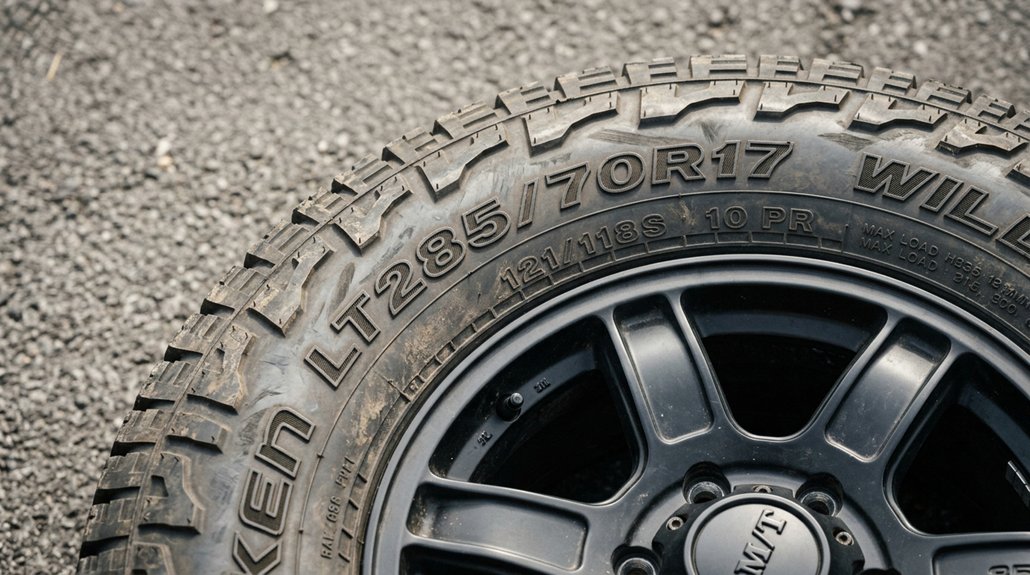
When you’re shopping for tires, you’ll quickly notice that “33s” isn’t stamped on any sidewall. It’s industry shorthand that spans multiple metric sizes, each with trade-offs in width, sidewall height, and wheel compatibility. I’ve watched too many buyers grab a 285/70R17 thinking it’ll measure true 33 inches, only to find it runs closer to 32.7″ mounted and loaded. The real equivalents—315/70R17, 305/60R18, 275/65R20, or 33×12.50R20 LT—vary by 0.3 to 1.2 inches in actual diameter depending on manufacturer construction, ply rating, and wheel width.
But here’s what most guides won’t tell you: your suspension travel, steering lock clearance, and gear ratio tolerance will disqualify some of these options before rubber ever meets pavement.
What “33s” Actually Means (and Why They’re Never Exactly 33″)
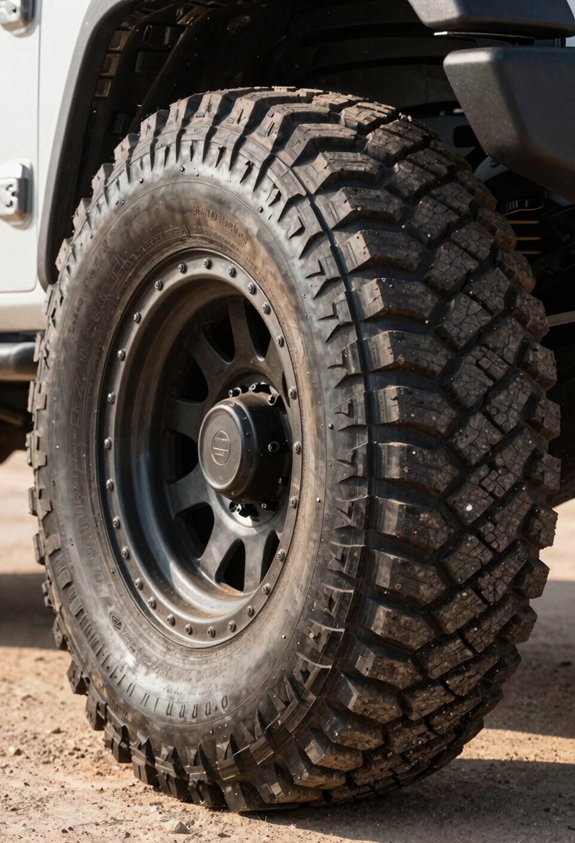
The disconnect between label and measurement matters because two tires both sold as “33s” can perform differently: one might measure 32.76 inches at recommended pressure, another 33.02 inches, and that quarter-inch difference becomes critical when you are calibrating for suspension travel, fender clearance, or matching diameters in a 4WD system.
I need you to understand that “33s” is marketing shorthand, not engineering precision. The nominal label ignores real construction variables; sidewall height, aspect ratio, and wheel diameter all shift actual diameter. A 33×12.50R20 carries differently than 33×10.50R15, and metric equivalents like 315/70R17 add further variance.
For builds where tolerance matters, I always compare actual diameter alongside width and wheel size rather than trusting the generic name.
Metric Tire Sizes That Match 33-Inch Tires
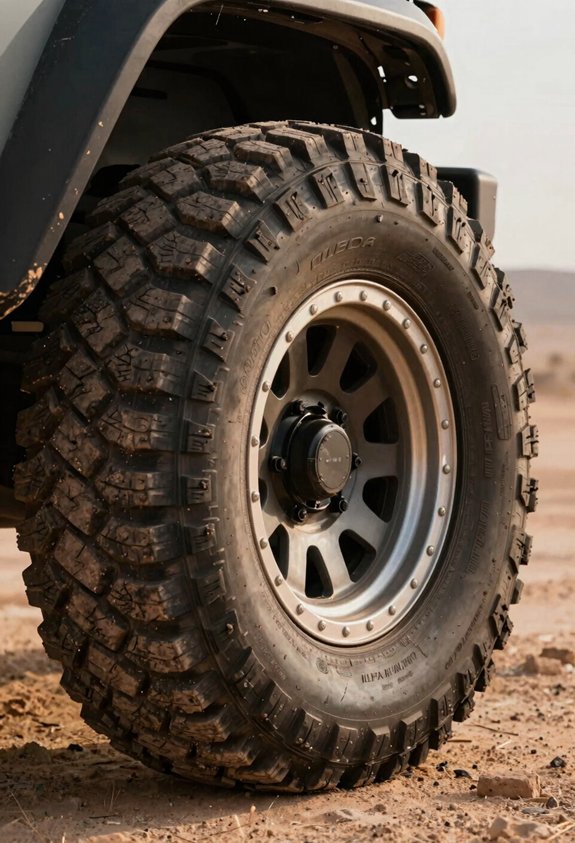
I’ll start by identifying the most common metric equivalents you’ll encounter when shopping for tires that match a 33-inch diameter, since these designations, typically ranging from 305/55R20 to 315/60R20, vary substantially depending on your wheel size and intended application.
You should note that wheel diameter directly impacts which metric sizes will yield that ~33.0-inch overall height, meaning a 20-inch wheel accepts entirely different aspect ratios than a 17- or 18-inch wheel to achieve the same result.
When cross-referencing, I always apply the standard conversion formula, multiplying section width by aspect ratio, doubling it, dividing by 25.5, then adding wheel diameter, to verify that labeled sizes actually approximate 33 inches. This matters because nominal sizing, especially with flotation equivalents like 33×12.50R20, frequently deviates from true measurements.
Common Metric Equivalents
- 315/70R17, the gold standard, delivering approximately 33.0 inches on 17-inch wheels
- 305/60R18, a versatile choice, measuring 32.8–33.0 inches depending on manufacturer
- 285/70R17 or 295/70R17, budget-friendly alternatives that hover right around 33 inches
- 305/55R20 or 315/50R22, your go-to options when running larger 20–22 inch wheels
Always verify actual mounted diameter before committing, as construction differences can shift final measurements substantially.
Wheel Size Variations
Wheel diameter isn’t just a mounting detail, it fundamentally reshapes which metric sizes will deliver that 33-inch target.
17-Inch Wheels
You’ll find 315/70R17 dominates here, yielding roughly 32.8–33.3 inches in overall diameter, a reliable match for traditional inch tire sizes.
16-Inch Wheels
I recommend 315/75R16, which stretches slightly taller, or 285/65R16 if you need narrower alternatives that still approach 33 inches.
18-Inch Wheels
Watch for 275/65R18; manufacturer tolerances vary considerably, so verify actual measurements before committing.
20-Inch Wheels
This is where conversion gets tricky. Your 33×12.50-20 equivalent shifts between 305/55R20 and 305/60R20, depending on width and aspect ratio priorities.
Critical Warning: Always cross-reference precise measurements, because small deviations in aspect ratio (70 versus 75, for instance) alter final diameter substantially, potentially affecting speedometer accuracy and clearance.
Will 33s Fit Your Truck? Clearance and Lift Requirements
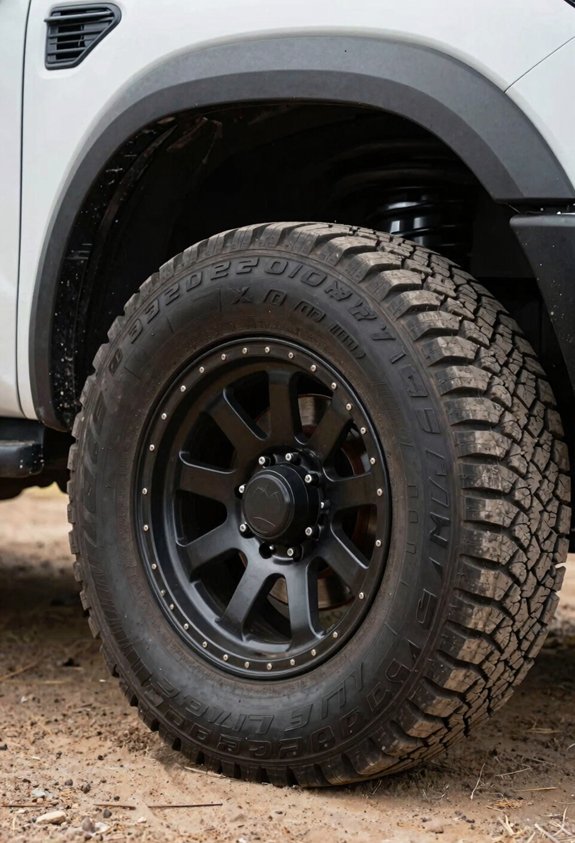
Whether you’re eyeing a set of 33×12.50R20 tires for your truck or comparing metric alternatives like 305/55R20, I’m going to walk you through exactly what clearance challenges you’ll face and when a lift becomes mandatory versus merely advisable.
That 12.5-inch tire width creates the biggest headache, plus a 6.5-inch sidewall that’ll rub fenders, control arms, and suspension components at full lock or compression. Real-world diameters vary from 32.76 to 33.02 inches between brands, so don’t trust the sticker alone.
Here’s what I’ve learned fitting hundreds of these:
- Check your wheel offset, too aggressive and you’ll grind metal
- Verify rim width compatibility (8.5–11 inches) before mounting
- Test full steering lock and suspension travel at maximum compression
- Budget for a suspension lift if your truck sits stock, many require 2–4 inches to clear safely without destroying sheet metal
Your truck, your rules, but measure twice, or you’ll pay for it twice.
Do You Need New Gears for 33-Inch Tires?
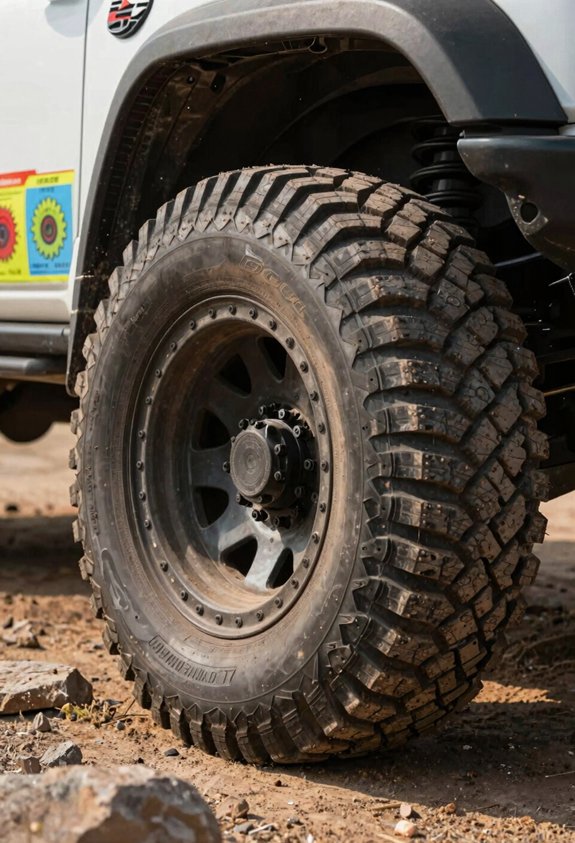
How greatly your truck’s performance changes after mounting 33-inch tires depends almost entirely on what gears you’re already running and how you actually use the vehicle.
When Re-Gearing Becomes Necessary
Moving from stock to 33s typically reduces final-drive RPM, dropping engine speed a few percent at highway speeds based on your gear ratio. If you’re running 3.55 or higher, you might not need changes for light 33×12.50R20 setups, though you’ll notice sluggish acceleration or strained towing if the ratio’s too tall.
Larger tires reduce final-drive RPM and engine speed, but 3.55+ gears often handle light 33-inch setups without re-gearing—though acceleration and towing will suffer if your ratio runs too tall.
Signs You Need New Gears
- High highway RPM requiring constant downshifting
- Reduced towing capacity and throttle response
- Speedometer errors exceeding acceptable limits
Alternatives Before Full Re-Gearing
Consider 305/55R20 metric equivalents with slightly smaller diameters, or install speedometer calibrators to maintain accurate readings without axle work.
How Tall and Wide 33-Inch Tires Actually Measure
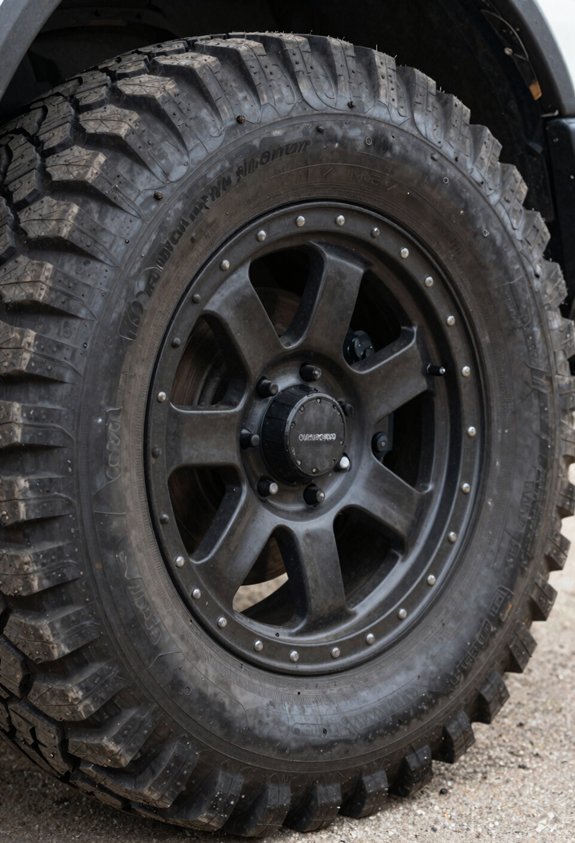
When you’re shopping for 33-inch tires, you’ll notice the printed size rarely matches the tape-measure reality, a discrepancy that can catch off-guard installers who’ve skipped the verification step.
- True diameter: Most 33-inch tires measure 32.5–33.5 inches, depending on construction and inflation pressure.
- Section width: A 33×12.50R20 spans 12.5 inches across the tread, requiring rim widths of 8.5–11 inches for proper seating.
- Sidewall height: Approximately 6.5 inches of sidewall cushions your ride, calculated from the aspect ratio differential between metric and flotation sizing.
- Revolutions per mile: Expect roughly 611 rpm, which directly impacts your speedometer accuracy and necessitates recalibration if you’ve upsized from stock.
Understanding these measurements helps you select compatible 33-inch tires for your specific application, avoiding clearance issues and drivetrain strain.
33×12.50R20 vs. 305/55R20: Which Is Better for Your 20s?
I’ll compare fitment specifications and performance characteristics to help you decide which tire suits your 20-inch wheels. The 33×12.50R20 demands wider rims (8.5–11 inches) and delivers a true 33-inch diameter with 12.5-inch width.
The 305/55R20 fits narrower wheels (8–10 inches) but measures roughly 2.4 inches shorter in diameter and half an inch narrower, affecting ground clearance and speedometer accuracy. Your choice depends on whether you prioritize maximum height and width for off-road clearance or easier fitment with slightly less aggressive proportions.
Fitment Specifications Compared
Why exactly do these two sizes, 33×12.50R20 and 305/55R20, create such persistent confusion among truck owners upgrading to 20-inch wheels? Both tire sizes share nearly identical overall diameters, approximately 33.0 inches, yet they diverge critically in width and fitment requirements.
When I examine the specifications, I notice four essential distinctions:
- Section width: 33×12.50R20 measures 12.5 inches, while 305/55R20 sits near 12.0 inches; a half-inch variance affecting clearance.
- Wheel width requirements: Both demand 8.5–11 inch rims, though brand tolerances shift ideal mounting.
- Sidewall height: At roughly 6.5 inches, the 33×12.50R20 offers marginally more cushion.
- Metric versus flotation sizing: Understanding these tire sizes’ nomenclature prevents ordering errors.
I’m careful matching offset and backspace; that extra width demands recalibration.
Performance Characteristics Analyzed
Overall Diameter and RPM
- 33×12.50R20: 33.0 inches, ~611 RPM/mile
- 305/55R20: 33.2 inches, ~607–611 RPM/mile
That 0.2-inch overall diameter advantage goes to the 305/55R20, marginally lowering engine RPM at highway speeds.
Critical Trade-offs
| Factor | 33×12.50R20 | 305/55R20 |
|---|---|---|
| Width | 12.5″ | ~12.0″ |
| Steering effort | Higher | Moderate |
| Turning radius | Wider | Tighter |
The wider 33×12.50R20 increases final-drive load and widens your contact patch, demanding more steering input while amplifying tramlining. Both trigger ~3–4% speedometer under-reading, though the 305/55R20’s modest width reduces mechanical stress on steering components.
For balanced highway manners with minimal drivetrain impact, the 305/55R20 preserves precision without sacrificing the 33-inch presence you want.
Picking the Right 33 for 17, 18, or 20-Inch Wheels
“Picking the Right 33 for 17, 18, or 20-Inch Wheels”: “How exactly do you translate a 33″ tire diameter across different wheel heights without compromising fitment or sacrificing performance? I’ve found that matching sizes to your wheel diameter demands careful attention to section width and overall clearance, since a true 33” diameter remains constant while rim height changes.
A 33″ tire diameter stays constant as rim height changes, demanding careful attention to section width and overall clearance for proper fitment.
Key Considerations for Each Wheel Size:
- 17-inch wheels: 33×10.50-17 or 305/70R17 work best for narrower preferences and tighter clearances
- 18-inch wheels: 33×12.50-18 or 315/70R18 require adequate fender and suspension space
- 20-inch wheels: 33×12.50-20 or 335/65R20 demand more clearance and may affect readings
- Width awareness: Wider tires increase rubbing risk on smaller fender gaps, regardless of diameter
You’re choosing among peers who’ve faced these same fitment puzzles.
How Much Speedometers Read Wrong With 33s
Once you’ve settled on the right 33-inch tire for your wheel setup, you’ll need to account for how that larger diameter affects your speedometer’s accuracy, since I’ve seen plenty of drivers roll out with new rubber only to realize their gauges are lying to them. A typical 33×12.50R20 measures roughly 33.0 inches, approximately 0.5 inches larger than stock, which creates measurable speedometer error; usually around 3.5% underreading, meaning your indicated 60 mph actually equals about 62.1 mph. RPMs drop slightly at highway speeds because each revolution covers more distance.
| Tire Size | Nominal Diameter | Typical Speedometer Error |
|---|---|---|
| Stock 32.5″ | 32.5″ | Baseline |
| 33×12.50R20 | 33.0″ | ~3.5% underread |
| 33″ (tall variant) | 33.2″ | ~4.2% underread |
| 33″ (short variant) | 32.8″ | ~2.8% underread |
Actual diameter varies by brand and tread pattern, so I recommend verifying against mile markers or using correction devices.
MPG Loss: Real Fuel Economy Numbers for 33-Inch Tires
I’ve identified four culprits draining your tank:
Four culprits draining your tank: heavier sidewalls, added weight, wide treads, and altered gear ratios.
- Increased rolling resistance from heavier, taller sidewalls
- Added weight that strains acceleration and cruising
- Wider treads (12.5-inch especially) creating aerodynamic drag
- Altered final-drive ratios raising engine RPM at speed
Your actual impact hinges on wheel diameter, vehicle weight, and whether you’ve regeared. I recommend modeling gear-ratio and RPM changes for your specific axle and transmission, then validating with controlled fuel economy tests across familiar routes. Otherwise, you’re guessing at real costs.
Off-Road Grip: What 33s Gain Over Stock 31s
While those fuel economy penalties sting on pavement, I’m more interested in what you’re actually getting for that trade-off once the asphalt disappears. Off-road, those 33s change your rig’s capability in ways stock 31s simply can’t match.
Traction Advantages
The wider footprint, think 12.5 inches on a 33×12.50R20, spreads your weight across more terrain, biting where narrower tires slip. Combined with increased sidewall height, you’ve got more rubber to conform around rocks and roots, maintaining contact where rigid shorter sidewalls would lift and spin.
Articulation Benefits
That taller sidewall acts as secondary suspension, absorbing impacts and allowing lower air pressures without rim damage. You’re gaining grip through deflection, not just tread pattern.
Trade-offs to Consider
Wider tires can tramline on rutted trails, and added rotational mass demands more from your brakes. The gains are real, but they come with mechanical consequences you’ll need to manage.
How to Check If Your 33s Are Actually 33 Inches
Because tire manufacturers operate with minimal regulatory oversight on dimensional claims, you’ll quickly discover that a “33-inch” tire rarely measures exactly 33.0 inches in the real world, which creates real problems for your speedometer calibration, gear ratio calculations, and clearances.
A “33-inch” tire rarely measures exactly 33.0 inches in the real world, which creates real problems for your speedometer calibration, gear ratio calculations, and clearances.
Here’s how to verify your actual diameter:
- Inflate your tires to rated pressure, then measure from ground contact to axle center; this gives you the loaded radius. Double it for true diameter.
- Park on level concrete, making sure you have even weight distribution across all contact patches.
- Compare your measurement against the 33.0″ specification, noting that most 33×12.50R20 tires measure 32.8″–33.0″ with ±0.5″ variance by brand.
- Account for tread pattern and construction differences, which typically shift diameter ±0.1″–0.2″ between manufacturers.
Your observations matter—document actual diameter, width, and revolutions per mile (approximately 611 for this size) to maintain accurate speedometer readings and proper gear ratios.
Top-Rated 33-Inch Tires by Terrain Type
I’ve tested enough 33-inch tires in actual conditions to know that your terrain dictates everything, so I’m breaking down the standouts across three distinct categories. Best All-Terrain Options balance the sidewall flex and tread compound you’ll need for wet highways and gravel alike, while Top Mud-Terrain Picks sacrifice some road noise for the aggressive void ratios and self-cleaning grooves that prevent packing in deep ruts.
Don’t overlook Premium Highway 33s either; these deliver the load ratings and heat resistance that towing and daily commuting demand, even if they never see a trail.
Best All-Terrain Options
Where exactly do you need your 33-inch tires to perform? I guide you through terrain-matched selections that balance capability with daily drivability.
Top All-Terrain 33-Inch Tires by Use Case
- Balanced On/Off-Road: BFGoodrich All-Terrain T/A KO2, Toyo Open Country A/T III, and Goodyear Wrangler Duratrac deliver proven dual-purpose performance
- Muddy/Rugged Trails: Falken Wildpeak A/T3W in 33×12.50R20 sizing provides aggressive tread blocks and durable construction
- Paved/Highway Priority: Michelin LTX A/T2 offers refined handling and extended tread life, though availability varies by wheel diameter
- Rock-Crawling Focus: Nitto Recon Grappler and Terra Grappler G2 feature reinforced sidewalls and enhanced puncture resistance
When selecting, prioritize 33×12.50R20 or metric equivalents (315/70R17, 285/70R17) maintaining approximately 12/32″ tread depth with reinforced casing for mixed-terrain durability.
Top Mud-Terrain Picks
How aggressively do you plan to tackle deep mud, loose silt, and jagged rock formations? When you’re ready to join the serious off-road community, I recommend starting with 33×12.50R20 mud-terrain tires, which deliver the aggressive tread patterns, tall sidewalls, and deep voids essential for clearing debris and maintaining traction in extreme conditions.
My top picks prioritize reinforced sidewalls and puncture-resistant compounds because terrain-focused durability matters more than highway comfort. Popular 33×12.50R20 models from BFGoodrich, Goodyear, and Nitto offer rugged off-road performance, though I caution that these configurations sacrifice fuel efficiency and ride smoothness.
You’ll find strong availability across dedicated off-road lines, with multiple 33×12.50R20 options featuring compound formulations designed specifically for rocky, muddy environments where standard all-terrains fail.
Premium Highway 33s
When daily driving demands refinement without compromising capability, you’ll find premium highway 33s, typically ranging from 9.5 to 12.5 inches in section width, deliver the controlled handling and reduced road noise that aggressive mud-terrain designs simply cannot match.
Why We Choose Premium Highway 33s
I’ve learned that size selection directly impacts your daily driving experience. Highway-oriented 33s (275/65R20, 33×10.50R20) prioritize low rolling resistance and reduced tread voids for maximum fuel efficiency and longevity.
Top-Rated Highway 33s by Size:
- 33×9.50-15 — Narrow profile fits 15-inch wheels, ideal for lighter trucks prioritizing mileage
- 33×10.50-15 — Balanced width delivering stable handling without harshness
- 33×10.50R20 — Modern 20-inch compatibility with enhanced load ratings
- 33×12.50-20 — Maximum section width for heavier applications requiring sidewall strength
Verify your wheel’s width and offset before purchasing; improper size matching causes uneven wear and compromised safety.