
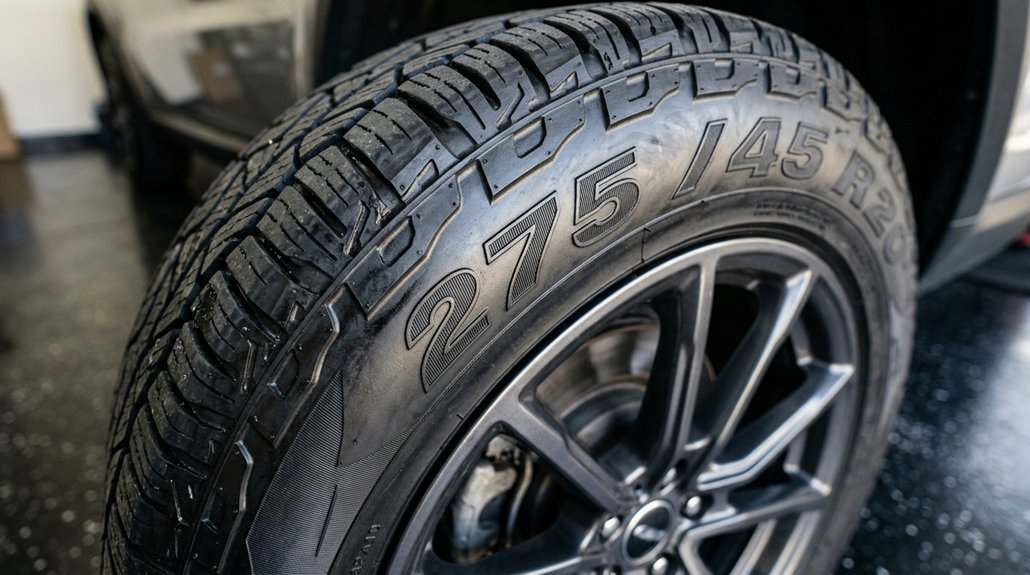
A 275 tire is a rabbit hole disguised as a simple number. I’m here to map its depths for you, because this three-digit code unblocks fitment puzzles that can make or break your build.
You’ll need to know what you’re measuring, and what you’re risking, before you commit.
What “275” Actually Means on a Tire Sidewall
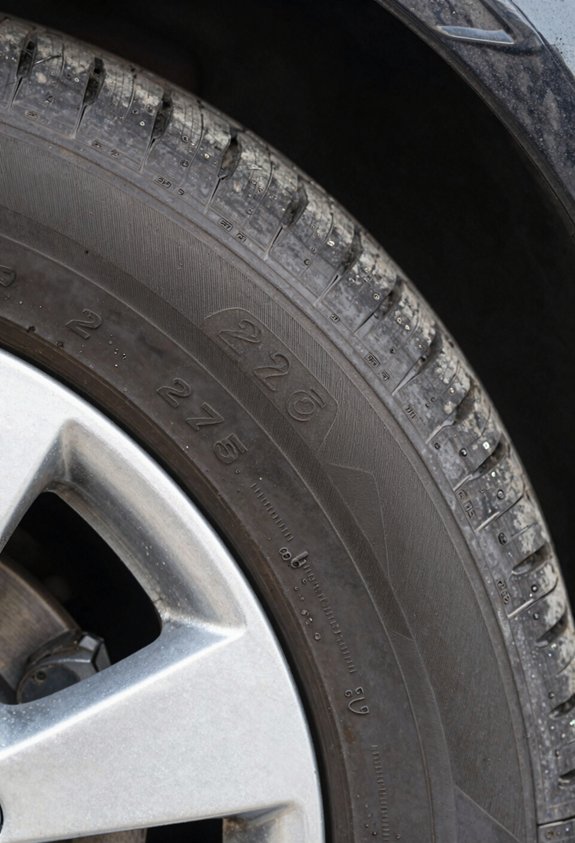
When you’re staring at the sidewall of your tire, that “275” stamped boldly between slashes isn’t just a random model number; it’s the critical starting point for understanding what you’re actually driving on. I want you to grasp that this 275 represents the tread width in millimeters, specifically 275 mm of rubber meeting the road.
In tire sizing, this measurement anchors the entire tire designation, working alongside the aspect ratio (the percentage that determines sidewall height) to define your tire’s profile. Don’t confuse width with overall diameter, 275 strictly measures across the tread, not the total height.
Understanding this distinction matters because misinterpreting tire sizing leads to fitment errors, compromised handling, and potential safety hazards you’ll want to avoid.
How a Full 275 Tire Size Breaks Down (275/65R20 Example)
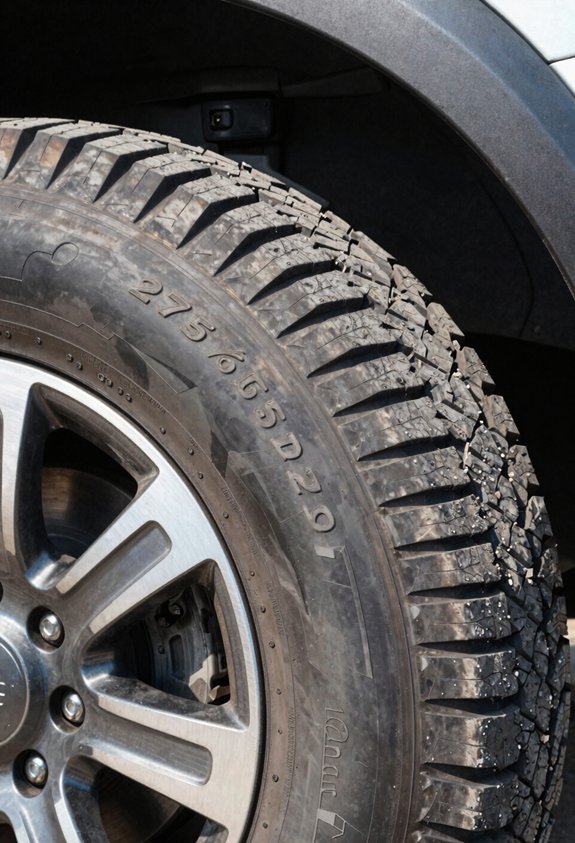
Your overall diameter reaches 34.1 inches, producing 592 revolutions per mile. This matters because swapping sizes without recalibration throws off your speedometer accuracy.
Compared to a 275/60R20, this taller sidewall raises ride height and ground clearance, but your speedometer reads slow if unadjusted.
How Big Is a 275 Tire in Inches and Millimeters?
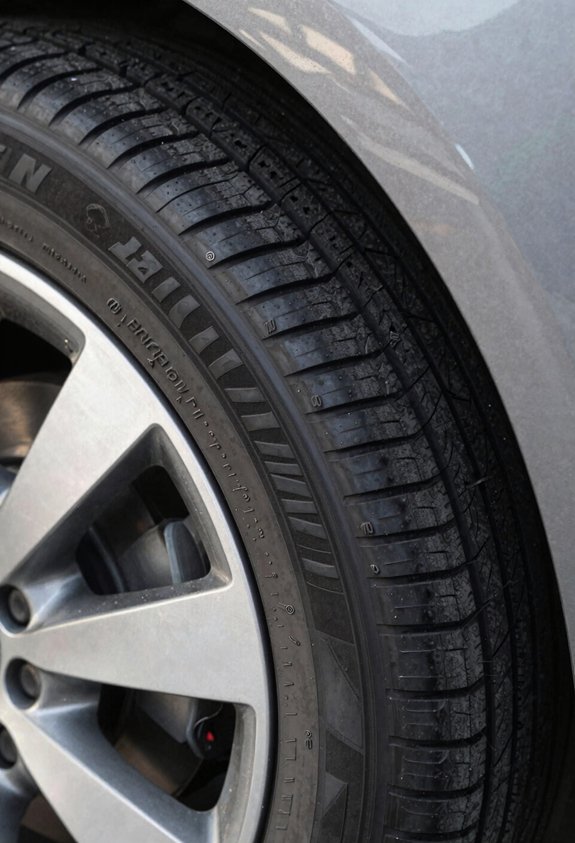
That contact patch, where rubber meets asphalt, spreads about 10.8 inches wide, balancing fuel economy against grip. I want you fitting in with fellow enthusiasts who speak both languages, so remember: 275 millimeters equals 10.8 inches, and your choice between 275 and 285 (11.2 inches) means trading 0.39 inches of width for efficiency or traction.
Why 275 Tires Use Two Different Measuring Systems
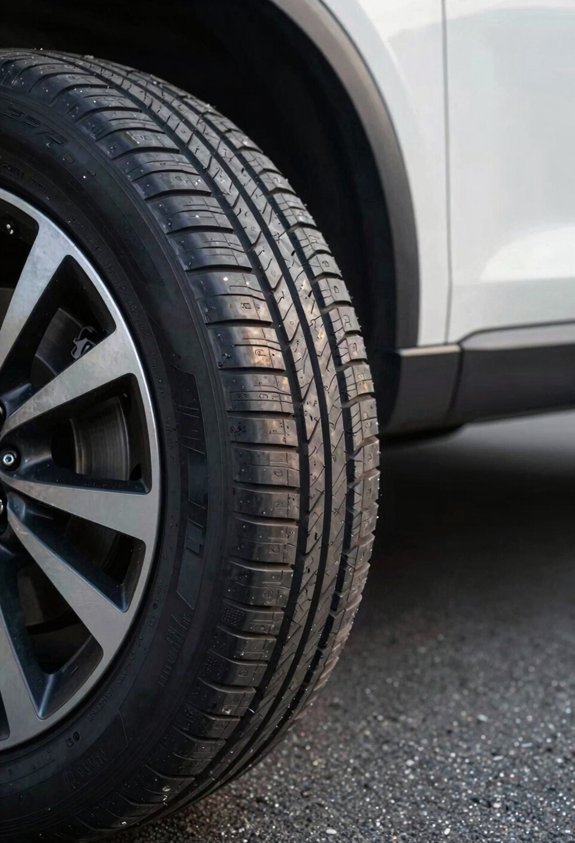
I’ll explain why your 275 tire carries two conflicting measurement systems, starting with its Metric Width Origins, which designate the tread at 275 millimeters, a standardized European convention that makes global manufacturing consistent. This metric width then feeds directly into the Aspect Ratio System, where that 275 mm figure becomes the base for calculating sidewall height, expressed as a percentage, such as 65 in a 275/65R17, creating a mathematical bridge between millimeter-based width and the resulting tire profile.
Finally, you’ll encounter the Inch Diameter Standard, where that same 275/65R17 abruptly switches to imperial units for the wheel diameter (17 inches), a legacy of American automotive dominance that persists because retooling entire industries for pure metric sizing would introduce dangerous fitment inconsistencies across millions of existing vehicles.
Metric Width Origins
When I examine a 275/65R17, I see 275 representing tire width in millimeters, specifically 275 mm, while the 17 reveals wheel diameter inches. This split isn’t arbitrary; it reflects how tire sizing evolved where metric conquered width measurements, yet inches stubbornly remained for wheel fitment.
I recognize this width difference matters practically: a 275 versus 285 tire spans 10 mm, affecting clearance calculations. You’ll convert that 275 mm width to inches (10.8″) for suspension clearances, checking that your chosen tire actually fits without rubbing. Understanding metric width origins empowers precise, confident selections.
Aspect Ratio System
Understanding these relationships empowers you to interpret any size confidently.
Inch Diameter Standard
| Specification | Metric Value | Inch Equivalent |
|---|---|---|
| Tire width | 275 mm | ~10.8 in |
| Sidewall height (65% aspect) | 178.75 mm | 7.0 in |
| Overall diameter | 866 mm | 34.1 in |
I caution you: never assume 275 versus 285 tells the full height story, since aspect ratio dramatically shifts overall diameter.
275 Tire Sizes for Every Common Wheel Diameter
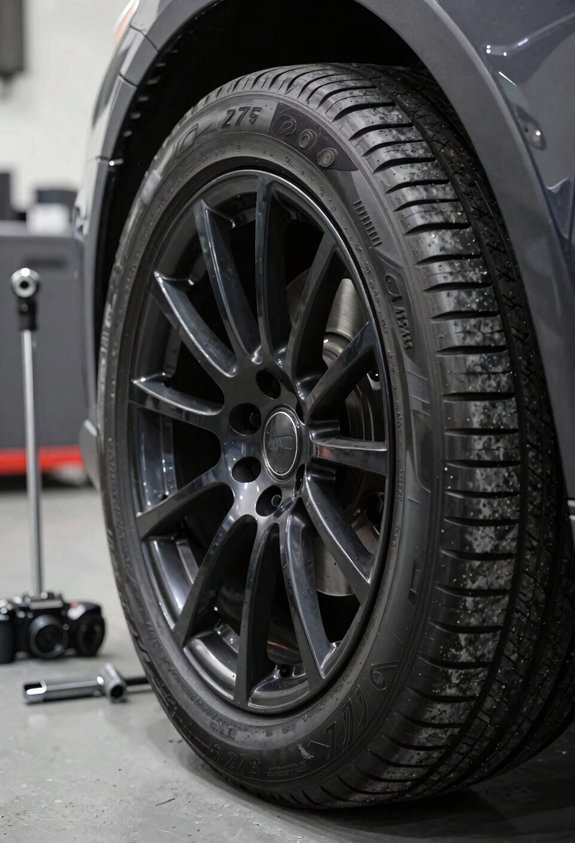
I’ll walk you through the 275 Tire Size Chart and 275 Tire Dimensions Guide, breaking down how this section cross-references every common wheel diameter so you can match specifications to your vehicle’s requirements. You’ll see exact measurements for popular fitments like the 275/65R20, which spans 34.1 inches in diameter with a 7-inch sidewall.
You’ll also find critical comparisons showing how aspect ratio changes affect overall height and speedometer accuracy. Pay close attention to wheel width compatibility, 8–10 inches for most applications, since mounting a 275 on an incompatible rim compromises both safety and performance.
275 Tire Size Chart
Breaking down a 275 tire’s dimensions requires precise cross-referencing across wheel diameters, aspect ratios, and section widths, so I’ll walk you through the critical specifications you’ll need to match your setup correctly.
275 Tire Size Fundamentals
A 275 tire size indicates 275 millimeters of tread width, with sidewall height determined by the aspect ratio percentage. For example, 275/65R17 delivers a 65% aspect ratio, radial construction, and 17-inch wheel diameter.
Key Specifications by Configuration
| Size | Wheel Diameter | Sidewall Height | Overall Diameter |
|---|---|---|---|
| 275/65R17 | 17 in | 7.0 in | 31.1 in |
| 275/65R20 | 20 in | 7.0 in | 34.1 in |
Critical Fitment Data
- Tread width: 10.8 inches (275mm conversion)
- Compatible wheel widths: 8–10 inches (7.5–9.5 optimal)
- Width difference versus 285: 10mm (0.39 in)
Consult this tire size chart carefully; incorrect pairing risks handling instability, premature wear, or clearance interference.
275 Tire Dimensions Guide
Now that you’ve seen how 275 tires scale across basic configurations, I’m expanding this breakdown to cover every common wheel diameter you’ll encounter, from 15-inch applications up through 22-inch and larger fitments.
Understanding 275 Tire Dimensions
A 275 designation indicates 275 millimeters of tread width, but overall diameter varies dramatically by aspect ratio and wheel size. For example, a 275/65R20 measures 34.1 inches in diameter, with 7.0-inch sidewall height, 10.8-inch tread width, circumference of 107.1 inches, and 592 revolutions per mile.
Compare this to 275/60R20, same wheel size, shorter aspect ratio, and you’ll lose approximately 1.1 inches in height. When evaluating 275 versus 285 alternatives, remember that 10 millimeters of additional tread width (as in 285/70R17 versus 275/65R17) can alter diameter by 1.63 inches depending on aspect ratio combinations.
275 vs. 285 vs. 265 Tires: Which Width Fits You?
When you’re deciding between 275, 285, and 265 tire widths, I want you to understand that these numbers represent millimeters of tread width, 275 mm, 285 mm, and 265 mm respectively, and that apparently small 10-millimeter increments (roughly 0.39 inches) create substantial differences in fitment, performance, and daily drivability.
| Feature | 275 Width | 285 Width |
|---|---|---|
| Wheel Fitment | 8–10 inch wheels | 9–10 inch wheels |
| Sidewall Height | 7.0 inches (275/65R20) | Taller overall |
| Daily Driving | Better fuel economy, quieter | Enhanced traction, stability |
| Installation | Stock suspension friendly | May require lift/spacer |
I recommend 275 for balanced daily use, while 285 suits aggressive traction needs with proper wheel fitment clearance.
Is a 275 Tire a True 33 or 35?
How exactly does a 275 tire measure up against the common 33-inch and 35-inch benchmarks you’ve likely encountered in off-road discussions? When I examine the 275/65R20, its diameter measures approximately 34.1 inches, which positions it awkwardly between standard categories; it is neither a true 33 nor a true 35.
For those seeking authentic true 33 fitment, I’d point you toward 275/60R20 or 33×12.5R20 options instead, as the 275/65R20 stands roughly 1.0–1.1 inches taller than those alternatives. This discrepancy directly impacts your ground clearance, granting about 1.1 inches additional height over typical 33-inch selections, while simultaneously threatening speedometer accuracy through increased rolling circumference.
Compared to true 35 tires (approximately 35.1 inches), the 275/65R20 remains about one inch shorter; close, yet distinct enough to matter when selecting tire sizes for specific trail requirements or gear ratios.
Which Trucks and SUVs Fit 275 Tires Without Modifications?
Which trucks and SUVs can accommodate 275 tires without requiring suspension modifications or body trimming? I’ve found that most modern half-ton pickups, including the Ford F-150, Chevrolet Silverado 1500, and Ram 1500, offer excellent tire size compatibility with 275/65R20 dimensions on stock suspension. Full-size SUVs like the Chevrolet Tahoe, Ford Expedition, and GMC Yukon similarly accept this fitment without drama.
Critical Fitment Considerations
Before mounting, I always recommend thorough clearance checks, particularly at full steering lock and maximum suspension compression. The 275/65R20 measures 34.1 inches in diameter and 10.8 inches wide, substantially larger than factory 33-inch options, so wheel fitment demands attention to offset and backspacing specifications. Narrower than 285 alternatives, the 275 tire typically avoids rubbing issues that plague wider setups, granting you that clean, capable stance your truck community respects.
Why 275 Tires Change Your Speedometer and MPG
Swapping to a 275/65R20 tire fundamentally alters your vehicle’s electronic calculations and mechanical efficiency in ways you’ll notice immediately behind the wheel.
Speedometer Error and Diameter Increase
The diameter increase creates significant speedometer error; your gauge reads approximately 6.2% slower than actual speed. At an indicated 60 mph, you’re truly traveling 64 mph, risking unintentional speeding tickets and odometer discrepancies that affect resale value and maintenance intervals.
Rolling Resistance and Fuel Economy
Rolling resistance increases substantially with heavier, taller tires. Each 275/65R20 weighs 55–65 pounds, contributing to drivetrain losses that reduce fuel economy by 1–2 mpg. The transmission stays in lower gears longer during acceleration, further consuming fuel.
Tire Width Impact
The tire width impact extends beyond the 275 specification. Comparing 275/65R20 versus 285/60R20 reveals how width and sidewall height interact, altering ground coverage per revolution and compounding calibration errors.