
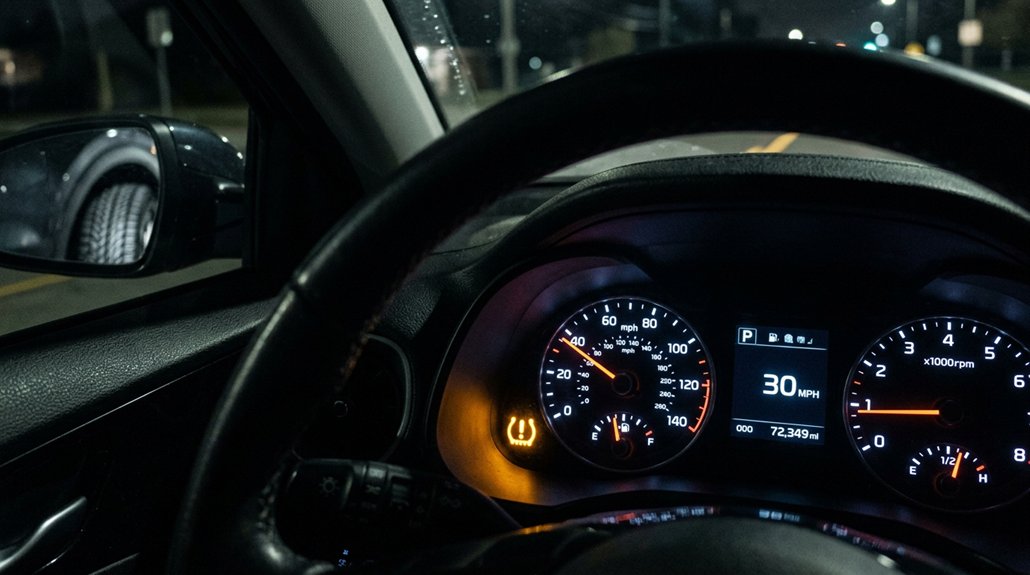
I’ve dealt with TPMS faults on enough vehicles to know they’re more than dashboard annoyances. They’re warnings that your tire monitoring system has lost communication with one or more wheel-mounted sensors, typically due to depleted batteries (5–10 year lifespan), physical damage from potholes or corrosion, or receiver malfunctions.
When that light appears, you’ll often see incorrect pressure readings, a flashing indicator for 60–90 seconds, or a direct fault message. I’ll walk you through exactly how to diagnose whether you need a simple reset or professional sensor replacement.
What Does a Tire Pressure Sensor Fault Mean?
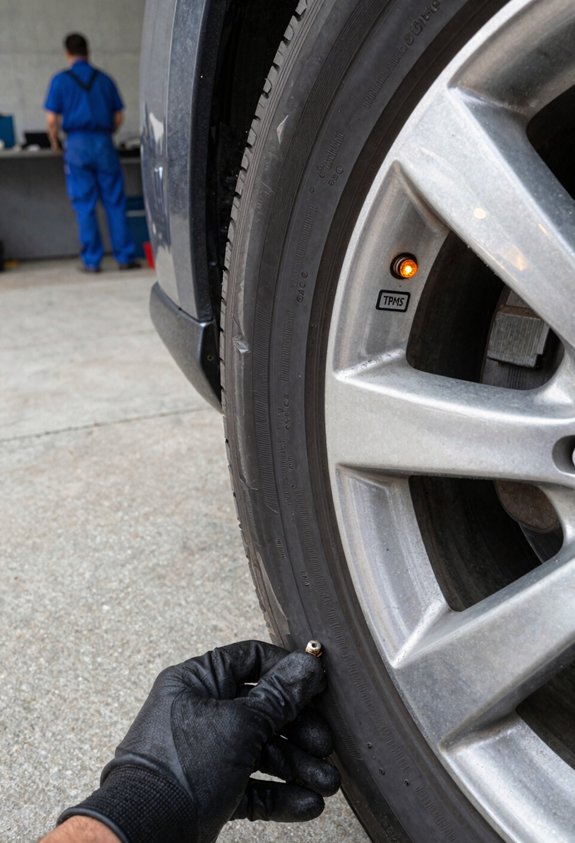
A TPMS fault means your car’s computer has lost reliable communication with one or more wheel sensors, so it can’t verify actual tire conditions. You might notice the warning light, inaccurate pressure readings, or explicit fault messages on your Driver Information Center, even when inflation appears normal.
Internal sensor batteries typically last 5 to 10 years before dying; battery failure usually demands complete sensor replacement. I recommend using a relearn/diagnostic tool to identify whether you’re facing a dead battery, signal interference, or a transient glitch requiring only system reset rather than component replacement.
Why Is My TPMS Light On? Common Causes Explained
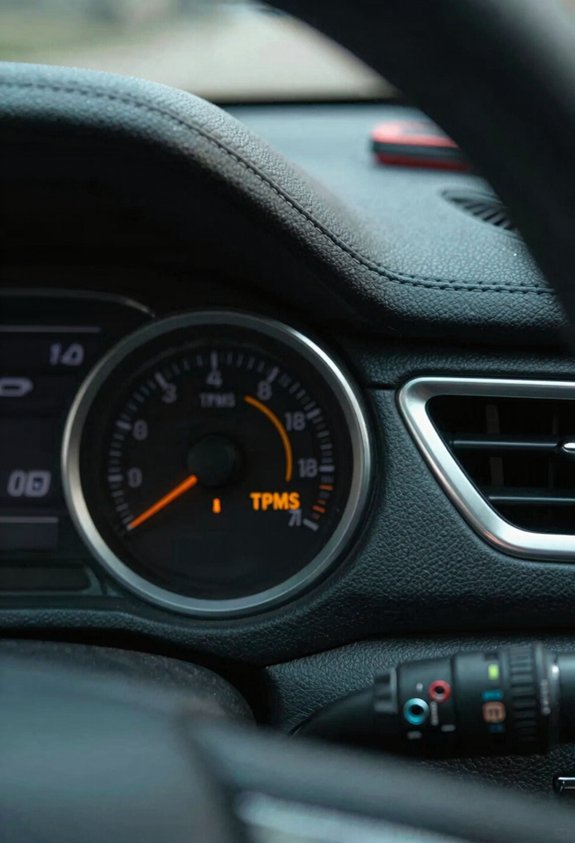
Why does your TPMS light illuminate when everything seems fine, and should you worry? I’ll walk you through what’s actually happening with your tire pressure monitoring system.
Low Pressure Triggers
Your TPMS light typically signals low tire pressure, which compromises safety, fuel economy, and handling. I always emphasize that even minor underinflation demands prompt attention.
Temperature-Related Fluctuations
Ambient temperature shifts cause pressure changes (roughly 1 PSI per 10°F), potentially triggering alerts without visibly flat tires.
Sensor Malfunctions
A TPMS sensor fault, whether from a dead battery or internal failure, causes persistent or flickering warnings. Don’t dismiss these. I’ve seen drivers assume false alarms when diagnostics reveal genuine failures.
My Recommended Response
- Verify pressures manually with a gauge; TPMS doesn’t replace this step
- Unexplained light behavior warrants professional diagnostics
- Technicians may perform TPMS relearn procedures
- Persistent faults require sensor replacement
We’re all learning this together; your vigilance keeps our roads safer.
Why You Shouldn’t Ignore a TPMS Fault Warning
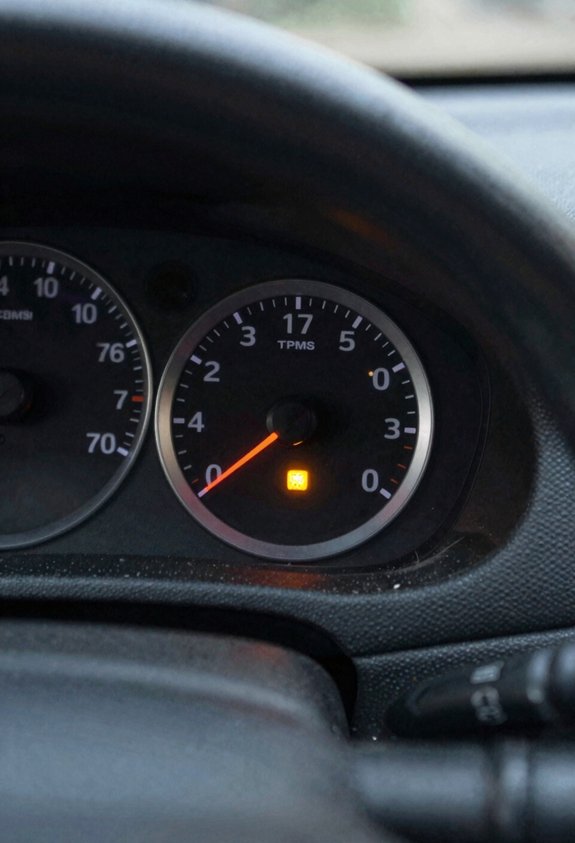
When your dashboard illuminates that persistent warning symbol, how certain are you that your tires are actually safe, and what risks are you accepting by driving onward without verification? I’ve learned that ignoring a TPMS fault isn’t just about dismissing an annoying light; it’s about losing critical protection our driving community depends on.
A faulty sensor, dead battery, or communication breakdown can mask true tire conditions, leaving us vulnerable to blowouts, extended stopping distances, and compromised handling we might not detect until it’s too late.
Critical risks of ignoring this warning:
- Dangerous underinflation goes undetected, increasing crash risk
- Sensor failures create false confidence when tires appear fine
- Delayed maintenance transforms minor issues into costly repairs
- Unreliable data from aging sensors endangers everyone sharing our roads
Prompt professional diagnosis preserves our safety and collective peace of mind.
Reset Your TPMS in Under 5 Minutes (First Thing to Try)
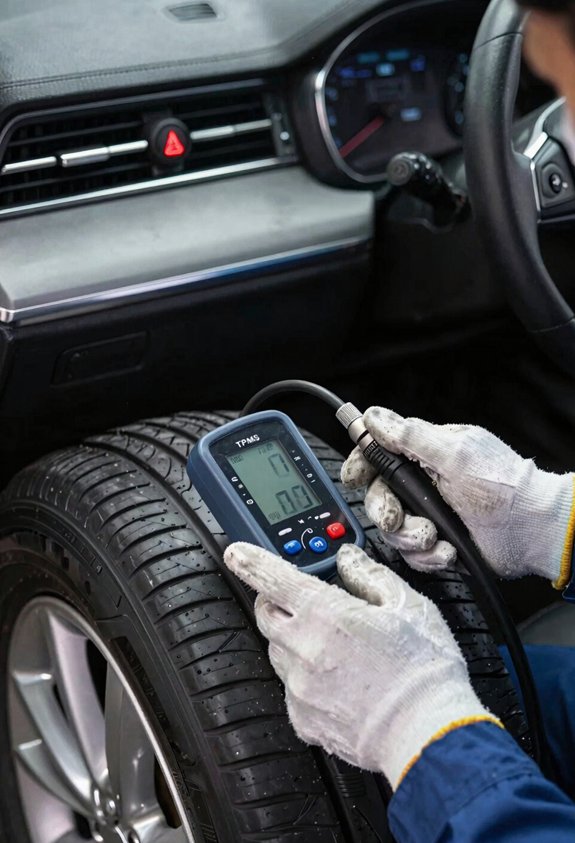
Before assuming your tire pressure monitoring system demands costly professional intervention, I’ll walk you through a rapid reset procedure that resolves many temporary electronic glitches, interference, voltage spikes, or brief communication lapses between sensors and your vehicle’s control module, without specialized tools or a service appointment.
Resolve temporary TPMS glitches with a rapid reset—no tools or service appointment needed.
Locate Your TPMS Reset Button
Consult your owner’s manual to find the TPMS reset button, typically positioned beneath the steering column or inside the glove compartment. With the ignition on, press and hold this button until the dashboard light blinks three times or extinguishes entirely, signaling completion of the TPMS reset sequence.
Drive to Recalibrate
For indirect TPMS systems, drive 10–20 minutes at steady, moderate speeds; this allows sensors to reestablish baseline readings and clears transient tire pressure sensor fault codes.
When Standard Reset Fails
Persistent illumination suggests deeper sensor or wiring faults, or requirements beyond basic reset: some vehicles demand a TPMS relearn tool to ping individual sensors, completing manufacturer-specific initialization protocols that handheld devices execute in under two minutes per wheel.
Check Your Actual Tire Pressure With a Manual Gauge
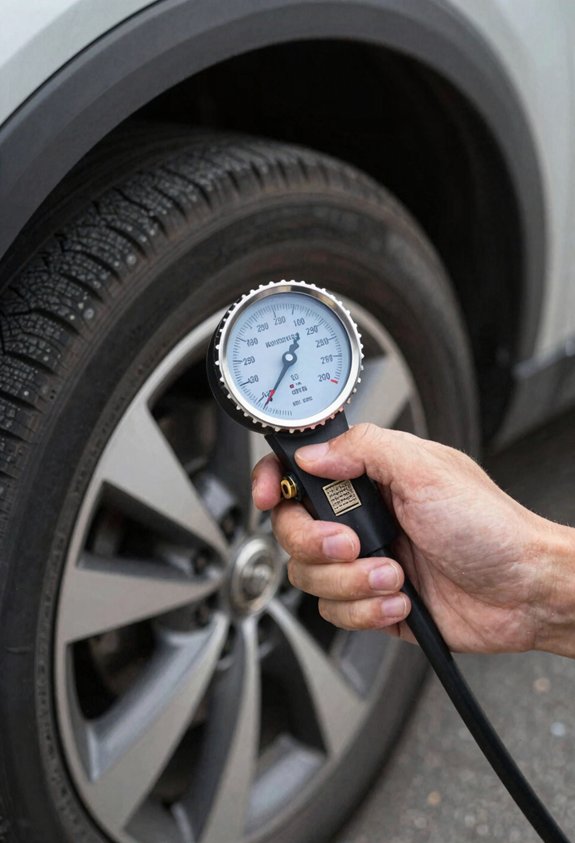
If your TPMS reset didn’t clear the warning, I’m moving straight to verifying what your sensors are actually reporting, because electronic resets mean nothing when your tires hold incorrect pressure. I’ve learned we can’t trust dashboard lights alone.
Here’s what I do with my tire pressure gauge:
- Check the door jamb sticker for manufacturer PSI, since every vehicle demands precise calibration standards.
- Test all five tires (spare included), because one underinflated tire triggers false TPMS faults.
- Inflate low readings to spec, then recheck for accuracy.
- Drive to recalibrate the system, verifying again with my gauge after 10-15 minutes.
This method eliminates guesswork. When your TPMS encounters pressure discrepancies, manual verification separates sensor failure from actual inflation problems requiring immediate attention.
How to Inspect Valve Stems for Damage or Corrosion
I’ll start by examining the valve stem’s condition through a two-part assessment: visual damage inspection, where I look for cracks, bending, or corrosion at the stem-to-rim interface, and corrosion checking steps, which require close scrutiny of brass valve cores and aluminum rims for moisture-induced degradation that compromises sensor electrical contact. Watch for bent valve caps, puncture damage from mounting tools or road debris, and any wobbling that indicates loose seating; these defects frequently trigger erroneous TPMS fault codes by allowing air leakage or interrupting signal transmission.
This inspection demands attention to both obvious structural failures and subtle electrochemical deterioration, since either can masquerade as sensor malfunction while actually originating at this vulnerable pressure boundary.
Visual Damage Inspection
When I inspect for problems, I focus on these critical checkpoints:
- Cracks or splits in the rubber stem that permit air leaks and corrupt TPMS sensor data transmission
- Bent or misaligned stems, typically angled 15-30 degrees off perpendicular, which strain internal sensor connections
- Corrosion at valve stem base, especially the galvanic reaction zone where brass valve cores contact aluminum rims, disrupting both sealing and electrical continuity
- Debris accumulation around caps and stem shoulders, causing false pressure alerts through compromised sealing surfaces
I also scan adjacent bead areas for punctures that mimic sensor faults through slow pressure loss.
Corrosion Checking Steps
Where does corrosion typically establish itself first? I’ll show you exactly where to look during corrosion checking.
Critical Inspection Points
I examine valve stems for white or blue-green deposits, rust, or pitting; these signal valve stem corrosion from moisture exposure. Brass valve cores inside aluminum stems create galvanic reactions when salt and water meet, accelerating damage I can’t ignore.
What I Watch For
I scan for cracked, bent, or compromised stems permitting moisture ingress. Any breach risks TPMS sensor failure from poor electrical contact between the sensor and wheel. I check threads, base connections, and core interfaces thoroughly; corrosion disrupts signal transmission silently until your warning light activates.
Required Action
When I find damage, I replace the valve stem immediately. I inspect the TPMS sensor for hidden corrosion, replacing it if needed. This restores reliable communication, protecting you from dangerous underinflation we all work to prevent together.
Why a Dead Battery Causes Most TPMS Faults
How exactly does a small battery inside your tire generate such persistent dashboard warnings? I’ve seen this confuse countless drivers, and I’ll break it down so you understand what’s happening in your vehicle.
Your TPMS battery powers a tiny transmitter that sends pressure data to your car’s computer. When battery depletion occurs after 5-10 years, that signal weakens or dies entirely, triggering a fault warning even when your tires are properly inflated. This sensor failure creates false alarms that disrupt your driving experience and wear away confidence in your vehicle’s systems.
A dying TPMS battery weakens the signal to your car’s computer, triggering false warnings regardless of actual tire pressure.
Why Battery Failure Dominates TPMS Issues:
- Voltage drop causes intermittent signals before complete failure
- Extreme temperatures accelerate drain, especially in aging sensors
- Replacement requires sensor dismounting, making prevention critical
- Whole sensor replacement is often necessary since batteries aren’t serviceable
I recommend monitoring your TPMS age proactively.
How Road Debris and Tire Changes Damage TPMS Sensors
Why do perfectly functional TPMS sensors suddenly fail after routine maintenance or a routine drive? I’ve seen this countless times, and it usually comes down to physical trauma you never saw coming.
Road Debris: The Hidden Attacker
Road debris strikes wheel components with surprising force, causing TPMS sensor damage to the body, valve stem, or internal wiring. Even small impacts create micro-cracks in sensor contact points, leading to corrosion and intermittent readings that confuse your dashboard.
Tire Change Impact: When Service Becomes Sabotage
Mounting equipment can crush valve stems during tire changes, breaking seals and triggering false alerts. Sharp impacts also disturb internal battery connections, accelerating voltage drop and premature failure.
The Fix: TPMS Relearn
After any tire service or curb hit, I always recommend a TPMS relearn and diagnostic check. This confirms communication between sensors and your vehicle’s computer, catching damage before it strands you.
Can Cold Weather Cause False Tire Pressure Sensor Faults?
I’ll break down how temperature impacts sensors and winter battery performance issues so you understand why your TPMS might misbehave when the mercury drops. Cold weather reduces air pressure inside your tires, roughly 1 PSI for every 10°F decrease, and can simultaneously degrade the lithium-ion batteries inside TPMS sensors, which typically operate between -40°F and 257°F but lose efficiency near the lower extreme, causing weak signals or delayed transmissions your receiver interprets as faults.
Before you replace anything, check whether the warning clears after 20 minutes of driving; if pressure equalizes and voltage recovers, you’re likely witnessing a false fault rather than component failure.
Temperature Impact on Sensors
Temperature fluctuations, particularly those driven by seasonal cold, can indeed trigger false tire pressure sensor faults, and understanding this interaction will help you diagnose alerts without unnecessary panic.
I’ve seen how TPMS temperature impact creates confusion when systems misread normal physics as failures. Let me break down what’s really happening:
- Cold weather reduces tire pressure approximately 1 PSI per 10°F drop, which your system may flag as a sensor fault
- Sensor fault warnings multiply when temperature swings between frozen roads and heated rubber create rapid pressure spikes
- Voltage drop hits older TPMS batteries hardest; aging cells below 3 volts struggle below 20°F, producing erratic signals
- Quick pressure equalization checks before dawn driving separate real punctures from thermal deception
You’re not alone in this frustration. Winter TPMS quirks plague us all until we recognize temperature’s starring role.
Winter Battery Performance Issues
I’ve observed that distinguishing genuine sensor failure from cold-induced TPMS anomalies requires systematic battery voltage assessment and historical performance pattern evaluation, especially during seasonal transitions.
When to Replace Just the Battery vs. the Whole Sensor
- Check if your sensor has a replaceable cell: newer designs allow this, while sealed units demand full sensor replacement.
- Inspect for corrosion or physical damage, which always requires replacing the entire sensor.
- Monitor for persistent erratic readings after any battery change.
- Remember that sensor relearn proves necessary after either repair type.
When readings stay unreliable despite a fresh battery, the sensor electronics have failed, and you’ll need that sensor relearn procedure regardless of which path you chose.
Using a TPMS Relearn Tool to Restore Sensor Communication
Once you’ve replaced a sensor or its battery, the vehicle’s TPMS control module won’t automatically recognize the new hardware, which is where a dedicated relearn tool becomes indispensable. A TPMS relearn establishes fresh sensor communication by pinging each wheel in a specific sequence, mapping unique sensor IDs to their correct positions in your vehicle’s computer.
Before starting, make sure you have stable battery voltage and properly inflated tires. Weak power or low pressure corrupts calibration data and perpetuates the tire pressure sensor fault. The tool transmits radio signals to wake dormant sensors, then records their responses for the TPMS control module to archive.
Successful completion typically triggers a dashboard confirmation message or light sequence. Should the process stall, the tool identifies which specific sensor or receiver failed, directing your repair efforts precisely.
What If the TPMS Light Returns Immediately After Reset?
If your TPMS light returns immediately after you’ve completed the reset procedure, I’m pointing you toward two primary culprits: underlying sensor malfunction signs, which typically involve battery depletion (sensors generally last 5-10 years, or roughly 100,000 miles), physical damage from impacts, or corrosion disrupting the radio frequency signals, and reset procedure errors, where incorrect activation sequences, skipped relearn steps, or mismatched tool protocols leave the vehicle’s receiver unable to maintain stable communication with the transmitters.
I’ll walk you through how to distinguish between these scenarios, because misdiagnosing the root cause wastes time and leaves you vulnerable to driving with undetected low pressure, a condition that escalates blowout risk by 300% at highway speeds.
You need systematic checks, not guesswork, to stop this frustrating loop of persistent warnings.
Sensor Malfunction Signs
A TPMS light that illuminates within seconds or minutes of completing a reset procedure signals a fundamental malfunction rather than a simple pressure discrepancy, and I want you to understand this distinction because it fundamentally changes your diagnostic approach.
When this happens, you’re likely dealing with underlying hardware failures that require methodical identification:
- TPMS battery failure: internal batteries typically degrade after 5-10 years, preventing signal transmission during TPMS re-learn sequences
- Physical sensor malfunction: road debris impacts, valve stem corrosion, or fractured sensor housings compromise integrity
- Wheel speed sensor errors: miscalibrated or defective units disrupt system synchronization, causing immediate fault recurrence
- Receiver/module communication breakdown: damaged wiring or failed antenna connections prevent reset retention
Persistent symptoms demand professional intervention using specialized TPMS re-learn equipment to isolate whether the fault originates at individual sensors or within central processing components.
Reset Procedure Errors
- Miscalibrated relearn: I must redo the relearn with the proper sequence, or employ a TPMS relearn tool to ping each sensor individually
- Pressure issues: incorrect tire pressures or slow leaks re-activate the system upon rechecking
- Incomplete drive cycle: some vehicles use indirect TPMS recalibration requiring specific driving patterns; skipping this step causes instant return
When the light persists, professional diagnostics become essential to distinguish sensor, receiver, or control-unit failures.
When to Fix TPMS Yourself or See a Mechanic
Although TPMS faults can often look alarming on your dashboard, I can handle several common scenarios myself while recognizing when professional intervention becomes necessary.
Here’s how I decide:
- DIY when it’s a temporary glitch: I’ll try a TPMS reset first, since regular checks and resets can clear false warnings.
- Handle basic tire pressure sensor maintenance myself: I’ll verify actual tire pressure with a gauge because faults occur even when tires look properly inflated.
- See a mechanic for relearn tool procedures: I can’t perform proper sensor registration without specialized equipment, which shops use to reprogram new sensors to my vehicle’s computer.
- Schedule professional sensor replacement: When internal batteries (lasting 5–10 years) die, or corrosion and wiring damage disrupt readings, I need expert diagnosis and replacement, as persistent TPMS fault indicators demand technical intervention beyond home capability.
How Often to Check TPMS Sensors to Prevent Future Faults
Because TPMS faults often develop gradually rather than appearing without warning, I’ve found that establishing a disciplined inspection routine prevents most sensor failures before they trigger dashboard alerts.
How Often to Check TPMS Sensors to Prevent Future Faults
I recommend TPMS maintenance every 3 to 6 months, which lets us catch slow leaks or aging batteries early. Internal sensor batteries last 5 to 10 years, so plan sensor replacement after that window to avoid sudden failures.
In extreme temperatures, I check more frequently, since heat and cold distort readings. During each manual tire pressure check, I inspect valve stems for corrosion and damage from road debris or harsh service.
If something seems off, I verify pressure manually, then run preventive diagnostics with a TPMS tool to relearn sensors and confirm their health.
TPMS Light Still On? Final Steps Before Professional Help
If you’re still seeing that stubborn TPMS warning after your reset attempt, you’ll need to confirm whether the system actually registered your recalibration. Sometimes the process requires specific driving sequences, ignition cycles, or button holds that vary by manufacturer, so double-check your owner’s manual for exact reset confirmations.
Next, inspect each valve stem and wheel assembly for visible damage, corrosion, or impact trauma that could compromise sensor integrity. Even minor curb strikes or corrosion around the sensor grommet can trigger intermittent faults.
These two verification steps, confirming proper reset completion and ruling out physical damage, give you definitive data before deciding whether the issue demands professional diagnostic equipment.
Reset Confirmations
- Verify pressures first: Grab a quality gauge, check every tire against the door jamb sticker, and eliminate underinflation as the culprit.
- Attempt a manual relearn: Many vehicles require you to enter a specific mode; horn chirps or light flashes provide confirmation that sensors were recognized.
- Deploy a relearn tool: If the light persists, actively ping each sensor to isolate which one fails to respond, pinpointing the sensor fault.
- Evaluate sensor age: Weak batteries (typically 5–7 years) cause intermittent signals, so inconsistent readings after relearn attempts mean replacement looms.
If these measures fail, receiver faults or corroded valve stems likely hide beyond basic diagnostics.
Damage Checks
_reset attempts sometimes leave that stubborn warning illuminated, which signals we’ve reached the stage where systematic damage assessment becomes necessary before escalating to dealer-level diagnostics.
Pressure Verification
I start by re-checking all pressures with a quality gauge; precision matters here, since we’ve already put in effort together.
Physical Inspection
I examine valve stems closely for corrosion, cracks, or hidden damage that blocks proper sensor function, and I scan for visible TPMS sensor damage from road debris or botched tire changes disrupting vehicle communication.
Battery Assessment
I factor in sensor battery degradation; these internal units typically fail after 5–10 years, and age alone explains many stubborn faults.
Diagnostic Isolation
If problems persist, I grab my relearn tool, ping each sensor individually, and determine whether we’re replacing hardware or tracing receiver issues; this final step keeps us informed before that service appointment.