
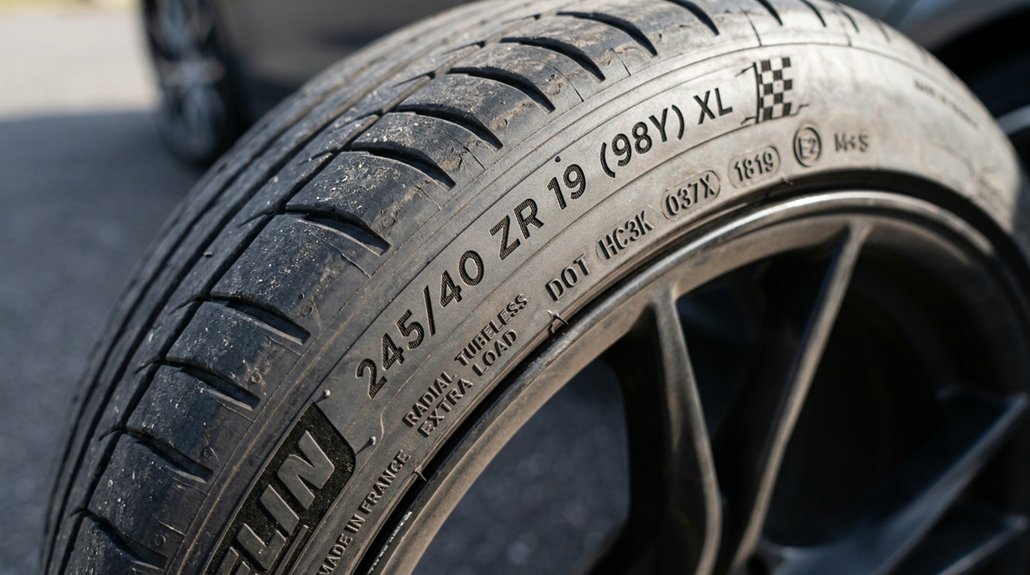
Your tire’s sidewall contains a coded language that dictates fitment, safety limits, and performance capabilities. Ignore it, and you’re risking blowouts, uneven wear, or complete failure. I’ve decoded thousands of these markings. I’ll walk you through every digit, letter, and symbol you need to understand before your next purchase.
Where to Find Your Tire Size on the Sidewall
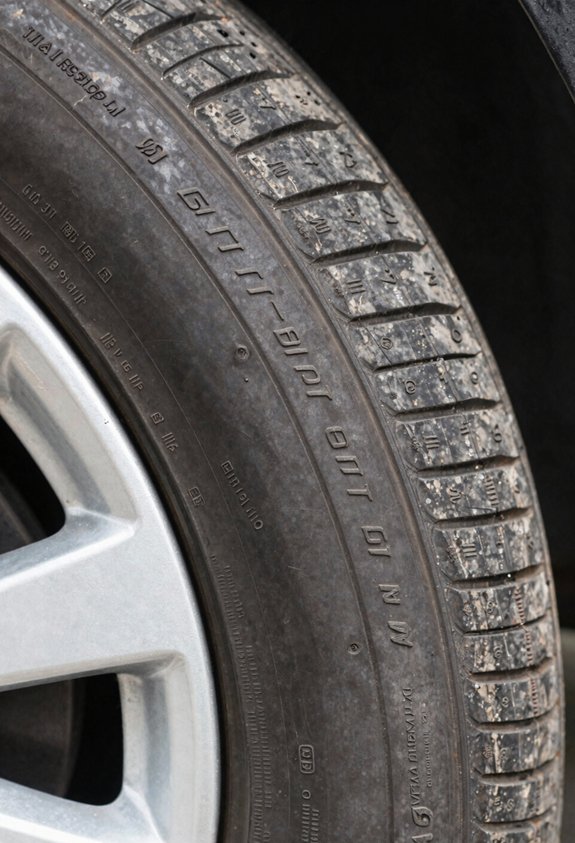
Locating your tire size requires examining the sidewall, the outer vertical surface between where the tire meets the road and where it seals against the wheel rim, where a standardized alphanumeric code, typically the most prominent marking molded into the rubber, delivers critical dimensional specifications.
I’ve found that once you spot this sequence, you’ll decode width, aspect ratio, and wheel diameter in one string. Take P205/65R15: the 205 represents width in millimeters, the 65 indicates aspect ratio (sidewall height as percentage of width), and 15 denotes wheel diameter in inches.
This sidewall engraving isn’t decorative—it’s your foundation for proper replacement. Mismatch any dimension, particularly wheel diameter, and you’ll compromise fitment, handling, and safety. We’re all seeking confidence on the road, and reading your tire size correctly is where that assurance begins.
P, LT, or No Letter: What Your Tire Type Means
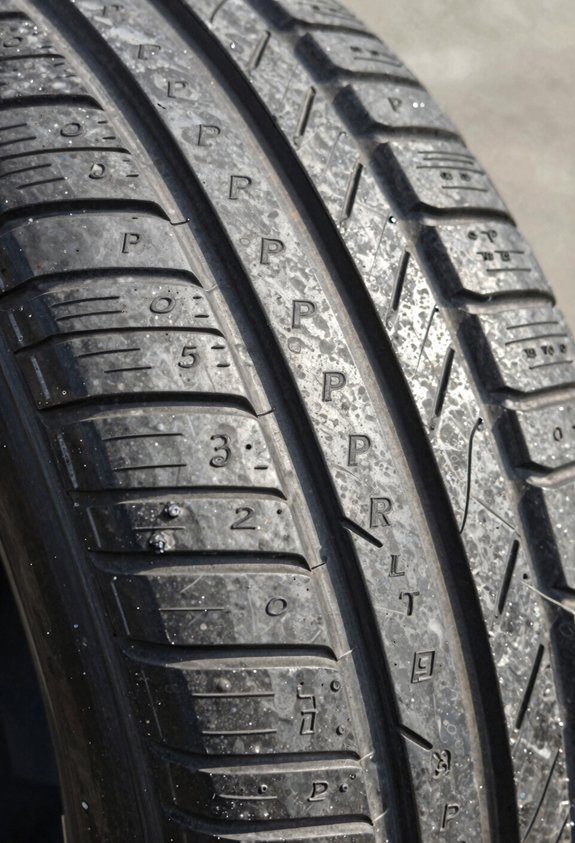
When you look at the start of your tire’s sidewall code, you’ll notice it either begins with P, LT, or no letter at all. Each prefix indicates a fundamentally different tire category with distinct load capacities, construction standards, and intended vehicle applications.
The P designation signals a passenger tire engineered to U.S. P-Metric standards for standard cars, minivans, and light SUVs. The LT prefix marks a light truck tire built for heavier loads, towing demands, and three-quarter or 1-ton vehicles that operate under substantially greater stress.
If you find no leading letter, you’re looking at a Euro-Metric tire, which follows European sizing conventions. These require careful cross-referencing against load index tables. Though functionally similar to P-Metric in many applications, metric-specified tires demand precise matching to your vehicle’s requirements to avoid dangerous under-rating scenarios.
Passenger Tire Designation
How do you know whether your tire can safely handle your vehicle’s demands? I examine the sidewall codes, starting with that essential first character.
The P prefix, as in P205/65R15, signals a passenger-vehicle tire engineered to U.S. standards, where “P” explicitly denotes passenger service. Following this letter, the three-digit section width (205 millimeters) appears, then aspect ratio, construction type, and wheel diameter. I always cross-reference these figures with the load index and speed rating trailing the size sequence, since these values determine weight capacity and maximum safe velocity.
When I spot no letter preceding the first number, I’m looking at Euro-Metric sizing; still measured in millimeters for section width, yet following European rather than American load formulas. This distinction matters for proper replacement selection.
Light Truck Classification
Why does that single prefix character carry such weight in tire selection?
When I see LT stamped before the numbers on a sidewall, I’m looking at a tire engineered for the demands that would destroy lesser constructions. These Light Truck tires handle the pressures of heavy loads, sustained highway towing, and the punishment of three-quarter ton or 1-ton platforms where passenger designs catastrophically fail.
The LT designation elevates both load index and inflation targets, typically 80+ psi versus 35-44 psi for P-Metric alternatives. This isn’t mere preference; it’s structural necessity. When I’m outfitting a heavy-duty rig, I watch for that prefix because standard passenger tires on three-quarter ton trucks create dangerous underinflation scenarios.
P-Metric tires suit lighter duties. Euro-Metric sizes (no prefix) occupy middle ground. I match construction to vocation, never reversing that hierarchy.
Metric Size Indicators
Where exactly does that first character lead you? It reveals your tire’s entire identity system.
| Prefix | Meaning | Common Use |
|---|---|---|
| P | P-Metric sizing | Passenger cars, crossovers |
| LT | Light truck | Heavy loads, towing |
| (none) | Euro-Metric codes | European imports, EVs |
I’ve learned to read these codes carefully because they dictate everything that follows. That metric width, the three-digit number, typically 155-305, measures your tire’s cross-section in millimeters, while the aspect ratio, that two-digit percentage following the slash, describes sidewall height relative to width.
After the construction type, you’ll spot wheel diameter in inches; yes, millimeters flip to inches mid-code, which confuses plenty of owners.
Euro-Metric codes eliminate the prefix entirely, signaling European specifications that may carry different load ratings than their P-Metric equivalents. Watch for EV markings, too; electric vehicles increasingly demand specialized compounds.
Euro-Metric Explained: When There’s No Leading Letter
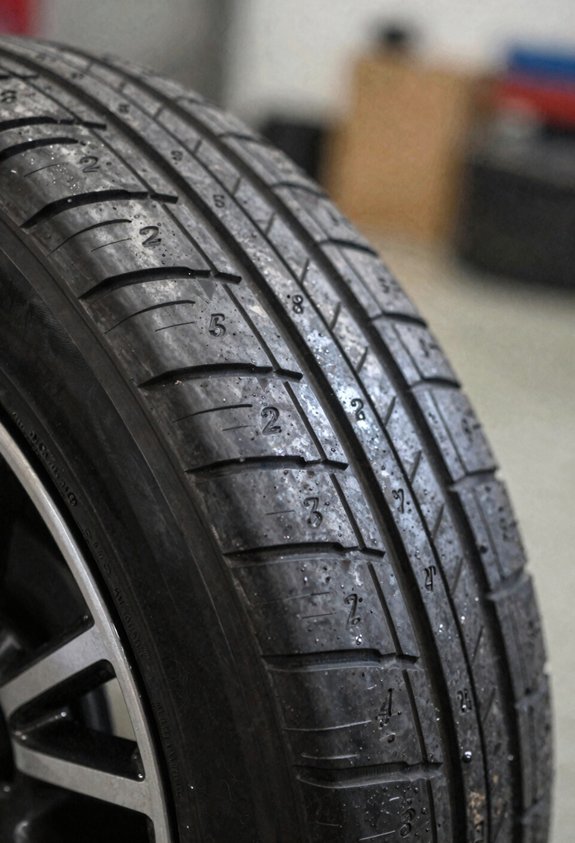
When you spot a tire size that begins directly with a three-digit number, such as 205/65R15, you’re looking at Euro-Metric sizing, which omits the P or LT prefix entirely and instead presents width in millimeters, aspect ratio, and diameter in one continuous string.
I’ll break down how this Euro-Metric size indicator signals a passenger-constructed tire built to European standards, how its load capacity differences (often requiring close attention to the load index, since Euro-Metric tires aren’t automatically interchangeable with P-Metric equivalents) can trip up unsuspecting buyers, and the critical P-Metric comparison points you must weigh, particularly regarding inflation pressures and load ratings, before assuming cross-compatibility.
Ignore these distinctions, and you risk mounting a tire that handles differently under stress than your vehicle’s suspension was engineered to manage.
Euro-Metric Size Indicators
How exactly do you decode a tire size that appears to lack any obvious starting point? When I examine Euro-metric size indicators on sidewall codes, the absence of a leading letter, no P, no LT, immediately signals European construction standards rather than US-based P-Metric specifications.
The section width still appears first as a three-digit number, typically ranging 155-355 millimeters, followed by the aspect ratio, construction type, and wheel diameter. This format (e.g., 205/65R15) looks familiar, yet the missing prefix conceals critical distinctions. The load capacity designation system differs fundamentally from American codes, employing separate indexing that I’ll clarify shortly. Otherwise, standard sidewall markings, speed ratings, DOT codes, UTQG grades, apply identically across metric formats.
Load Capacity Differences
Your Euro-metric tire’s stated load capacity and inflation pressure represent the tire’s engineered limits, not your vehicle’s requirements. That maximum load figure assumes proper inflation pressure, typically molded onto the sidewall. Your owner’s manual specifies cold pressure targets for safe operation. Never confuse these independent values; they serve different purposes entirely.
P-Metric Comparison Points
Where exactly does one draw the line between Euro-Metric and P-Metric sizing?
Understanding the Critical Distinction
When I examine sidewall codes, I immediately look for that leading letter. P-metric tires display a “P” before the width measurement, signaling passenger vehicle standards developed for North American markets. Euro-Metric sizing omits this prefix entirely. If there’s no letter preceding the three-digit width, you’re handling European specifications.
Both systems employ identical numerical structures: width (millimeters), aspect ratio (percentage), construction type, and wheel diameter (inches). For example, P205/65R15 (P-metric) versus 205/65R15 (Euro-Metric) appear strikingly similar, yet their load capacities and inflation pressures differ significantly.
I caution against assuming interchangeability. Consult your vehicle’s placard, as mixing these standards compromises safety and performance.
Tire Width: Why 225 Mm Isn’t Exactly 225 Millimeters
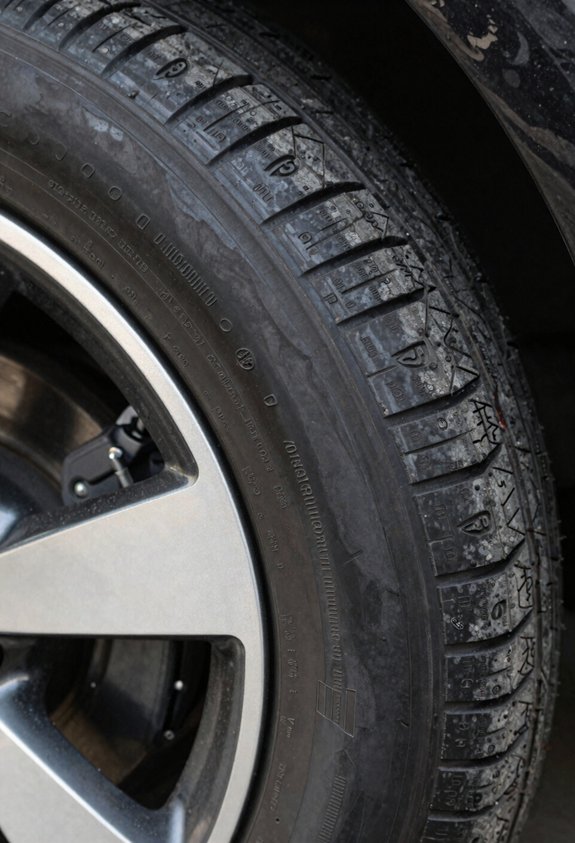
Why does a tire stamped with 225 mm so rarely tape-measure to that precise figure once it’s mounted on your wheel? When I read those sidewall codes, I recognize that tire width represents a nominal value, not an exact measurement.
The 225 mm marking denotes section width, sidewall to sidewall, but manufacturing tolerance allows ±1–2 mm variation. I’ve learned that tread width differs from this sectional measurement, since tread width addresses only the ground-contact surface. Your rim width, inflation pressure, and specific tire design all influence the final dimension.
European metric tires follow this same convention without leading letters. Understanding this distinction matters because fitment calculations depend on these nominal figures, even when physical reality varies slightly.
Aspect Ratio: How to Calculate Sidewall Height
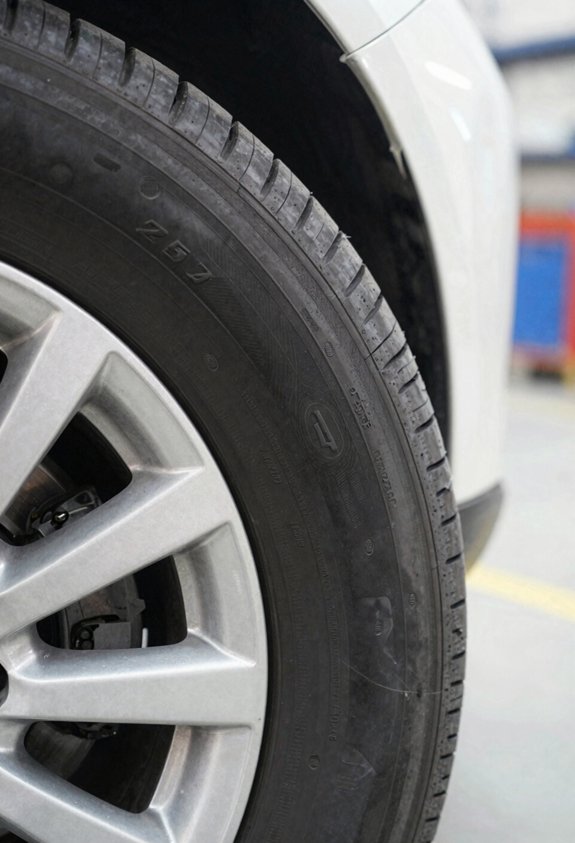
I’ll walk you through the three critical elements you need to grasp. Defining Aspect Ratio, which appears as the two-digit figure following the slash in your tire size (such as the 65 in P205/65R15). Calculating Sidewall Height, converting that percentage of section width into measurable dimensions that determine your tire’s physical stature. And Impact on Performance, where taller sidewalls cushion impacts but reduce responsiveness while lower profiles sharpen handling at the cost of ride comfort and increased vulnerability to road damage.
Defining Aspect Ratio
Every tire’s sidewall conceals a critical dimension that governs ride quality, handling response, and fitment compatibility: the aspect ratio, a two-digit figure positioned immediately after the slash in any standard tire size designation. This percentage expresses how the sidewall height relates to tire width, fundamentally shaping your vehicle’s character.
| Aspect Ratio | Sidewall Characteristic | Typical Application |
|---|---|---|
| 70-75 | Tall, cushioned sidewall | SUVs, light trucks |
| 55-65 | Balanced profile | Passenger sedans |
| 35-45 | Short, stiff sidewall | Performance vehicles |
Higher aspect ratios yield taller sidewalls that absorb road imperfections but increase body roll, while lower ratios, found on sportier tire dimensions, deliver razor-sharp steering response at the cost of ride harshness. Understanding this relationship helps you interpret tire size markings intelligently, making certain your tire dimensions match your driving priorities without compromising safety or compatibility.
Calculating Sidewall Height
How precisely does that percentage translate into actual rubber? Let me walk you through the math, because understanding your tire’s profile starts with this calculation.
Converting Millimeters to Inches
First, I take the tire width from the tire size, say, 205 mm, and multiply by 0.03937, giving me 8.07 inches.
Calculating Sidewall Height
Next, I convert the aspect ratio (65 in P205/65R15) to a decimal: 0.65. Multiplying 8.07 inches × 0.65 yields approximately 5.25 inches of sidewall height.
Why This Matters
This figure determines your tire’s overall profile, influencing how much cushion sits between your rim and the road. Get this wrong, and you’re looking at clearance issues or compromised ride quality, so double-check your numbers before buying.
Impact on Performance
What separates a cushioned highway cruiser from a corner-carving performance tire? It comes down to the aspect ratio, that critical second number in your tire size code.
The aspect ratio determines sidewall height as a percentage of tread width, and this single variable reshapes everything you feel behind the wheel. A higher ratio, think 65 or 70, means more sidewall height, additional flex, and superior ride comfort as the tire absorbs pavement imperfections. Drop to 35 or 40, however, and you’ve entered performance territory: shorter sidewalls reduce flex, sharpen steering response, and elevate handling performance, though you’ll sacrifice cushioning and increase rim damage risk.
To calculate sidewall height yourself, convert millimeters to inches (width × 0.03937), then multiply by the aspect ratio as a decimal. That 205/65R15? You’re looking at roughly 5.2 inches of sidewall, enough compliance for daily commuting, but perhaps too much wallow for spirited back roads where precise control matters most.
R vs. Bias Construction: Does the Letter Matter?
- R (Radial): Cords run perpendicular to travel direction; this is what you’ll find on virtually every modern passenger vehicle
- B (Bias-ply) or D (Diagonal): Cords angle diagonally across the tire; older construction, still used in some specialty applications
Radial construction delivers superior traction, tread wear, and fuel efficiency, so it’s today’s standard. However, compatibility becomes crucial when you’re replacing older tires. Mixing constructions on the same axle creates dangerous handling imbalances. Always match your vehicle’s original specifications, particularly when dealing with classic cars or trailers that may have shipped with bias-ply originals.
Wheel Diameter: Reading the Only Number in Inches
The wheel diameter, which represents the bead seat measurement where the tire seals against the rim, stands out as the sole value in the entire sidewall code expressed in inches rather than millimeters. This distinction becomes immediately apparent when you examine a size such as P205/65R15 and recognize that 15 denotes the rim’s bead seat diameter in inches while every other preceding number relies on metric units.
This consistent use of imperial measurement for rim diameter, regardless of whether you’re examining standard passenger tires, European metric formats, or high-flotation designs, creates a critical compatibility checkpoint that I’ll urge you to verify meticulously. Mismatching this value, even by a single inch, renders the tire completely unusable with your intended wheel.
When you’re cross-referencing replacement options or considering aftermarket rims, confirm that this inches-not-millimeters value aligns precisely with your vehicle’s specifications. The bead seat must mate flush with the rim flange to maintain structural integrity, proper inflation retention, and safe operational performance under load.
Bead Seat Measurement
Following the tire’s size code and aspect ratio, you’ll encounter a two-digit number that represents the bead seat diameter, more commonly known as wheel diameter, which stands alone as the sole imperial measurement in an otherwise metric-dominant tire code. This number, found in your tire’s sidewall codes, specifies the exact rim size your tire requires.
In P205/65R15, that final “15” denotes a 15-inch bead seat diameter. This measurement must precisely match your wheel’s actual diameter for proper seating and safe mounting. A mismatch means the tire won’t seal, creating serious safety risks.
The wheel diameter functions independently from load index and speed rating, serving only as the rim diameter specification within the complete tire size code.
Inches Not Millimeters
Wheel diameter stands alone as the only imperial holdout in your tire’s otherwise metric-encoded sidewall, a quirk I’ve always found worth emphasizing since it trips up plenty of do-it-yourselfers who assume the entire size string converts uniformly.
The final number in your tire size code represents wheel diameter in inches, indicating the bead seat diameter the tire fits upon (for example, 15 in P205/65R15). This inches-only measurement determines rim compatibility and overall fitment, operating separately from width or aspect ratio measured in millimeters.
Even in non-metric Euro-metric sizes lacking a leading letter, the trailing number remains wheel diameter expressed in inches. Sidewall numbers for wheel diameter work alongside load index and speed rating to assess complete performance characteristics.
Always verify this inch measurement matches your vehicle’s reference rim size, typically found on the door placard or within your owner’s manual, to prevent dangerous fitment errors.
Load Index: What That Two-Digit Number Really Holds
Why does that seemingly modest two-digit figure stamped after your tire size command such critical attention? It’s your load index, and ignoring it risks everything.
That number, part of essential sidewall codes, translates directly to your tire’s maximum load capacity. Higher means stronger: 95 handles roughly 1,521 pounds. But here’s what many miss: this tire capacity only holds true at specified inflation pressure. Run underinflated, and you’ve effectively downgraded your own safety equipment.
Your vehicle’s actual carrying limit? That’s a separate calculation entirely, found on your door placard, not the tire alone.
| Load Index | Approximate Maximum Load (lbs) | Typical Application |
|---|---|---|
| 75 | 853 | Compact sedans |
| 85 | 1,135 | Mid-size cars |
| 95 | 1,521 | Crossovers, light trucks |
| 105 | 2,039 | Full-size SUVs |
| 115 | 2,679 | Heavy-duty trucks |
Check yours. We’re all road-sharing together.
Speed Rating: Maximum Safe Speed or Overrated Spec?
- H-rated tires handle approximately 130 mph, while V, W, and Y ratings reach 149, 168, and 186 mph respectively
- Your vehicle’s vehicle operating limits are set by the *lowest* speed rating among all four tires, not the highest
- Tire load and speed ratings are interdependent; exceeding either compromises safety
Controlled laboratory testing determines these ratings, assuming proper inflation and load conditions. No speed rating overrides legal limits or your manufacturer’s guidelines in the owner’s manual
DOT Date Codes: How to Check Your Tire’s Age
Where exactly does your tire’s age hide in plain sight? I’ll show you where to look, because understanding DOT date codes keeps you safe on the road.
Your tire’s sidewall code contains everything you need. Find the DOT serial number, then focus on its last four digits, that’s your production week year breakdown. The first two numbers indicate the week (01 through 52), and the final two reveal the year. For example, 5212 means week 52 of 2012.
Before 2000, manufacturers sometimes used three-digit codes or triangle symbols, so vintage tires require extra attention.
I check my DOT date codes regularly because tire age directly impacts tire safety. Most experts recommend replacement after six to ten years, regardless of tread wear. Don’t gamble with aging rubber; know your numbers, protect your vehicle, and join the informed drivers who prioritize safety through awareness.
Max Sidewall PSI vs. Recommended Pressure: Don’t Mix Them Up
How often have I glanced at my tire’s sidewall, spotted that prominent PSI number, and assumed it was simply what I should inflate to? That number marks the max sidewall pressure, not your recommended operating pressure, and confusing them risks your safety.
Max sidewall pressure indicates the tire’s absolute ceiling, not your target. Cold inflation specs from your door placard override sidewall numbers. Recommended operating pressure optimizes handling, efficiency, and tread life.
Sidewall codes pair max pressure with tire load capacity, but your vehicle’s needs differ. Never inflate to the tire’s maximum unless specifically directed by your manufacturer.
Follow your vehicle’s guidance, not the tire’s absolute limit.
Weather and EV Symbols: M+S, 3PMSF, and the EV Label
Beyond pressure ratings, your tire’s sidewall carries equally important markings that determine whether it’s suited to your climate and vehicle type. Let me break down the symbols you need to recognize.
| Symbol | Meaning & Purpose |
|---|---|
| M+S | Mud and Snow rating for all-weather tires handling light snow, muddy conditions |
| 3PMSF | Three-Peak Mountain Snowflake, indicating winter-tested performance meeting IS DOT standards |
| EV label | Electric vehicle designation, signaling low rolling resistance for maximum range |
| EV/EL | Extra-load marking for heavier EV weights, higher torque compatibility |
I want you to understand that 3PMSF denotes winter-tested tires, which means they are suitable for severe winter conditions. You should recognize this symbol doesn’t guarantee absolute performance in every scenario; it simply certifies compliance with IS DOT standards for winter traction.
When you’re driving an electric vehicle, you’ll specifically want that EV label, because standard tires wear faster under EV torque and load demands.
High Flotation Sizes: Decoding the Off-Road Number Format
When you’re sizing tires for lifted trucks or off-road rigs, you’ll inevitably encounter a numbering system that looks nothing like the P-metric codes on passenger cars. It’s called flotation sizing, and I’m going to show you exactly why it matters for your build.
Flotation sizing: the imperial measurement system that makes visualizing off-road tire fitment intuitive, starting with total diameter in inches rather than millimeter conversions.
This high flotation tire size format prioritizes imperial measurements, total diameter first, then width in inches, which makes visualizing fitment on your off-road build far more intuitive than converting millimeters. The construction type (R or D) and wheel diameter follow, with some LT variants adding a load range suffix.
Here’s what each position represents:
- First two digits: Overall tire diameter in inches
- Next three or four digits: Section width in inches, with decimal
- Middle letter: R for radial or D for diagonal bias construction
- Final one or two digits: Wheel diameter in inches
- Trailing letter: Load range (C, D, or E) on LT applications
UTQG Grades: What Treadwear, Traction, and Temperature Mean
Three standardized metrics—treadwear, traction, and temperature—form the backbone of the Uniform Tire Quality Grading system, which you’ll find molded into every passenger tire sidewall sold in the United States. The UTQG ratings help you compare tires, though only within the same brand.
Treadwear (numeric grades: 300, 500, etc.) measures wear resistance against a control tire rated at 100; higher numbers suggest longer potential tread life.
Traction (AA, A, B, C) indicates wet-braking capability, with AA representing superior performance.
Temperature (A, B, C) assesses heat resistance and dissipation under load, where A withstands the highest speeds.
Remember: never cross-compare these ratings between manufacturers, as testing methods vary. I recommend using UTQG data alongside your driving conditions, climate, and vehicle requirements to select appropriately graded tires.