
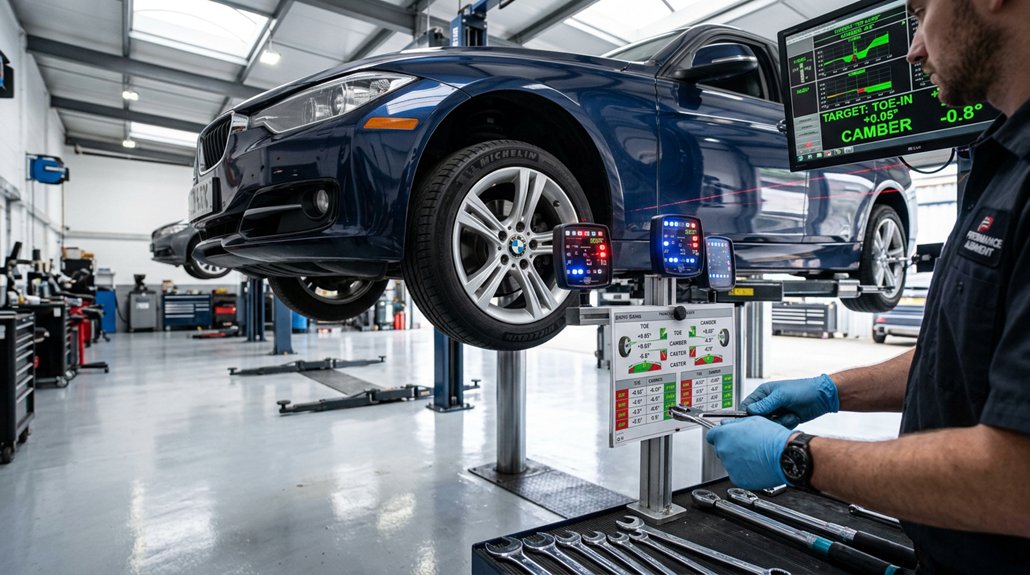
I want you to imagine your car’s wheels as precision instruments, because that’s exactly what they are. When I align your tires, I’m adjusting three critical angles: camber, caster, and toe, so each wheel meets the road at the manufacturer’s exact specifications (typically within 0.1 degrees).
Without this calibration, you’re fighting your steering wheel, burning extra fuel, and wearing through $400+ tires in half their rated lifespan.
The real question isn’t whether you need alignment, but how you’ll recognize misalignment before it costs you.
Five Warning Signs Your Car Needs Alignment
When exactly does a driver know their vehicle’s alignment has drifted from factory specifications? I’ve learned to watch for five critical indicators that signal deteriorating steering alignment before catastrophic failure occurs.
Your Vehicle Pulls to One Side
When you’re fighting constant pressure on the steering wheel to maintain a straight trajectory, typically requiring 2-3 pounds of corrective force, that’s your chassis begging for realignment.
When your steering wheel fights you with constant pressure, your chassis is begging for realignment.
Uneven Tire Wear Patterns
I inspect my tread depth religiously. Inner-edge feathering, outer-edge scalloping, or diagonal wear stripes indicate camber or toe misalignment destroying rubber prematurely.
Crooked Steering Wheel
Your steering wheel should sit dead-center at 12 o’clock during straight-line cruising. Any persistent tilt reveals angular displacement between wheels and chassis.
Vibration at Speed
High-frequency tremors through the column suggest alignment-induced contact patch instability.
Bumpy, Unsettled Ride
Diminished road compliance often traces to caster angle deviation compromising suspension geometry.
What Exactly Is a Wheel Alignment?
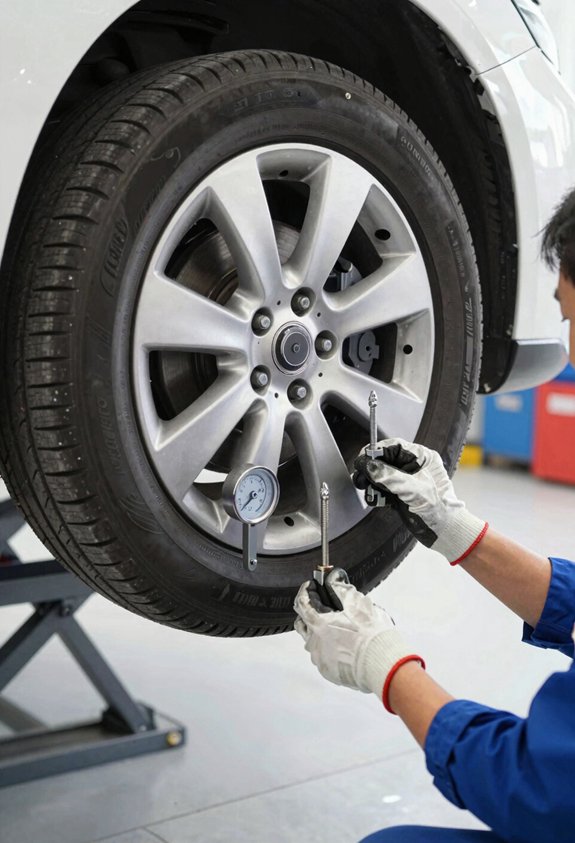
When I perform an alignment, I modify three specific measurements:
- Camber, the vertical tilt of your tires, which prevents uneven wear on inner or outer edges
- Toe, the inward or outward direction your tires point when viewed from above, affecting straight-line stability
- Caster, the steering axis tilt visible from the side, which influences handling and steering return
What Alignment Actually Does
I don’t replace your tires; I optimize how they meet the road. Proper alignment prevents irregular wear, reduces pulling, and provides stable steering. Without it, you’ll face premature tire replacement and compromised safety.
Alignment vs. Rotation: What’s the Difference?

How precisely does alignment differ from rotation, two services I often see confused despite addressing entirely separate mechanical concerns? Let me break this down thoroughly.
Alignment adjusts your suspension angles, specifically camber (vertical tilt), toe (inward/outward pointing), and caster (steering axis angle), to manufacturer specifications, guaranteeing proper road contact and straight tracking. Rotation simply relocates tires to different wheel positions to equalize wear patterns; it changes nothing about your suspension geometry.
Here’s what you need to understand: rotation cannot correct uneven wear caused by misaligned camber or toe angles, nor can it fix a pulling steering wheel. While rotation promotes even tread life through position changes, alignment preserves that life by correcting fundamental geometry. Many shops wisely combine both, verifying caster and other angles with 3D aligners before rotating tires during thorough maintenance.
Why Misalignment Wastes Gas and Ruins Steering
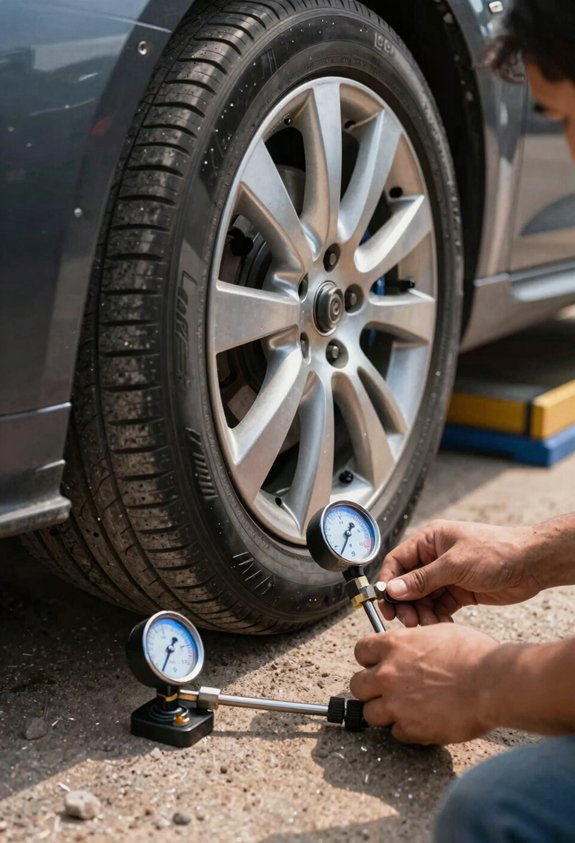
Misalignment forces your engine to burn extra fuel by increasing rolling resistance and aerodynamic drag, while simultaneously degrading your vehicle’s directional stability through uneven tire contact patches and accelerated component wear.
When your wheels pull against each other or your steering geometry drifts from factory specifications, you’re not just losing 2-4 miles per gallon. You’re overworking your power steering pump, tie rods, and suspension bushings with every corrective input you make.
I’ll break down exactly how these two failure modes compound each other, starting with the mechanical efficiency losses that hit your wallet at the pump.
Fuel Efficiency Loss
Why exactly does your car burn through more fuel than it should, even when the engine seems fine? I see this frustration constantly, and the culprit is often neglected tire alignment. When your wheels stray from manufacturer specifications, rolling resistance increases dramatically, forcing your engine to consume extra fuel just to maintain cruising speed.
This mechanical inefficiency creates a cascade of problems that hit your wallet at every fill-up.
- Increased rolling resistance demands greater engine output, directly degrading fuel efficiency
- Uneven tire contact with pavement disrupts aerodynamic flow, boosting consumption
- Excessive tire scrub from misaligned angles generates drag that proper alignment eliminates
- Steering resistance during corrections wastes kinetic energy through unnecessary friction
- Accelerated tire wear compounds efficiency losses as tread patterns degrade unevenly
Regular alignments preserve your vehicle’s intended geometry, maintaining optimal fuel economy across your ownership experience while protecting against premature component deterioration.
Steering System Strain
Beyond the fuel you’re pouring down the drain, misalignment wages a quieter war against your steering system itself. When your wheels lose proper alignment, I feel the steering grow stiff, demanding constant muscle just to track straight on the highway. The tires wear unevenly, their compromised grip forcing me to fight the wheel at speed.
That persistent pulling or drifting? It’s my car begging for correction, but I’m the one compensating; micro-adjusting, tensing shoulders, wearing out components I can’t see. Every mile of misalignment accelerates wear on ball joints, tie rods, and the rack itself. I’ve learned that skipping alignment checks doesn’t save money; it transfers costs to my steering precision and, eventually, my repair bill.
Three Angles That Control Your Tires: Camber, Caster, Toe
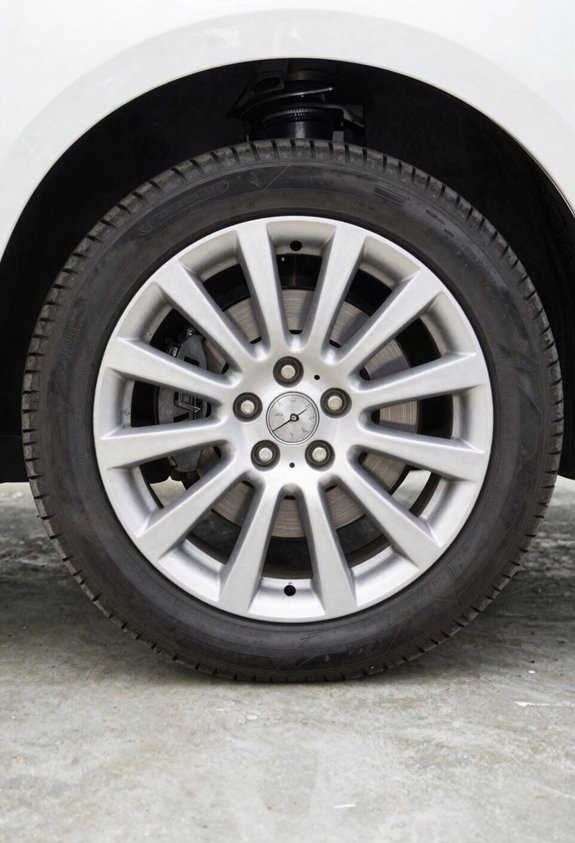
I’ll break down the three critical angles, camber, caster, and toe, that technicians measure and adjust during every alignment. Understanding how each one affects your tire contact patch and vehicle behavior helps you recognize alignment problems before they destroy expensive rubber or compromise your safety.
When camber tilts your tires inward or outward, caster angles your steering axis toward or away from you, and toe points your tires slightly together or apart, any deviation from factory specifications creates uneven wear patterns, pulling sensations, or vague steering that worsens with speed. I’ll walk you through each angle’s specific function, the symptoms its misalignment produces, and why your technician’s adjustments must account for how these three measurements interact rather than treating them as isolated fixes.
Camber Angle Explained
How exactly does a few degrees of tilt affect your tires’ lifespan and your vehicle’s handling?
I want you to understand camber because it directly shapes what happens where rubber meets road. Camber, the inward or outward tilt of your tires when viewed from the front of the vehicle, measured in precise degrees, fundamentally determines contact patch geometry and load distribution across the tread surface.
When your alignment exhibits positive camber, the tire tilts outward at its top, while negative camber tips it inward; both configurations alter how much tire actually grips the pavement during straight-line travel and cornering maneuvers. Excessive camber produces characteristic inner or outer edge wear patterns, depending on directionality, which accelerates replacement intervals and compromises handling precision.
Unchecked camber deviation, often betraying worn suspension bushings or bent components, degrades steering feedback and straight-line stability, transforming routine highway driving into a correction-intensive, fatiguing experience. Proper camber optimization, however, maximizes tire contact during lateral accelerations and promotes balanced tread wear, provided technicians adhere strictly to manufacturer specifications during alignment procedures.
Camber represents one of three primary alignment angles, alongside toe and caster, that skilled technicians calibrate to restore factory-engineered handling characteristics.
Consider how camber influences your driving experience:
- Tread contact optimization: Proper negative camber increases tire footprint during cornering, when body roll compresses the suspension and naturally alters wheel orientation.
- Predictable wear patterns: Correct settings distribute contact forces evenly, preventing the shoulder-heavy deterioration that necessitates premature replacement.
- Suspension health indicators: Uneven camber readings frequently signal deteriorating ball joints, control arm bushings, or strut assemblies requiring immediate attention.
- Steering precision preservation: Manufacturer-specified camber maintains directional stability and reduces driver correction demands during highway cruising.
- Alignment integration: Camber adjustment works synergistically with toe and caster settings to achieve complete wheel geometry restoration.
Caster Angle Overview
Positive caster tilts toward you, enhancing stability and steering feel, while negative caster tilts away, compromising straight-line control. This geometry works alongside camber to maintain road contact through corners and suspension travel. Incorrect caster causes pull or vagueness even when other angles meet manufacturer specifications.
Certified alignment machines measure and adjust this critical parameter, so your steering responds predictably. Precise alignment keeps you confidently connected to every mile.
Toe Angle Basics
- Toe angle directly governs steering response and directional stability during straight-line travel
- Proper alignment minimizes rolling resistance and prevents premature tire degradation
- Feathered tread wear, characterized by sharp, angled edges across tread blocks, signals excessive toe deviation
- Wear patterns develop rapidly because even minor misalignment scrubs rubber with every rotation
Technicians reference OEM specs, adjusting toe after camber and caster using precision alignment equipment.
I know incorrect toe makes my vehicle drift unpredictably, demanding constant correction. Subtle changes compound over thousands of miles, so I don’t ignore routine inspections. Matching manufacturer specifications preserves handling integrity and protects my investment.
How Bad Alignment Destroys Your Tires
Why should you care about alignment? I’ll show you exactly how misalignment quietly dismantles your tires from the inside out.
The Mechanics of Destruction
When camber and toe drift from factory specifications, often by just fractions of a degree, your tires make improper road contact. I’ve seen inner-edge wear from excessive negative camber, and feathering across tread blocks from toe misadjustment. These aren’t cosmetic issues; they’re accelerated degradation.
Recognizing Damage Patterns
Watch for these destructive tread wear patterns:
- Heel-toe wear: tread blocks worn unevenly front-to-rear
- Camber wear: pronounced inner or outer shoulder deterioration
- Feathering: raised edges indicating toe angles outside ±0.1°
The Cost of Neglect
Progressive misalignment compounds tire wear geometrically. Your vehicle pulls, your wheel sits off-center, and contact patch efficiency drops.
This erosion of tire longevity demands premature replacement, raising lifetime ownership costs substantially.
When to Check Alignment: Mileage, Events, and Red Flags
- Pulling to one side during straight-line driving indicates camber or toe misalignment requiring immediate correction
- A steering wheel crooked when traveling straight signals improper caster angles or thrust alignment issues
- Uneven tire wear patterns—feathering, cupping, or one-shoulder degradation—reveal chronic misalignment destroying rubber prematurely
Post-suspension repairs or tire replacements necessitate tire alignment verification to restore factory geometry. High-speed steering vibrations often precede visible damage, demanding proactive inspection before component failure accelerates.
I treat these warnings seriously; delayed response compounds repair costs and compromises vehicle stability.
What Happens Inside the Alignment Bay
How precisely does a technician transform wandering wheels into a properly tracking vehicle?
I start with a visual inspection, checking suspension components for wear before rolling your car onto the alignment machine. This computerized system measures three critical steering angles: camber (inward or outward tire tilt), toe (whether tires point inward or outward), and caster (the steering axis angle affecting stability).
Depending on your vehicle’s suspension design, I’ll adjust front wheels, rear wheels, or all four, making sure tires sit and roll at manufacturer-specified angles, not by altering tread or size. The process typically takes about an hour. After verification through a brief test drive, you’ll receive a post-service printout comparing pre- and post-alignment measurements, confirming your vehicle now tracks straight with stable, predictable handling.
Alignment Costs: What You’ll Actually Pay
You’ll typically pay between $50 and $168 for a wheel alignment. Four-wheel alignments run higher than front-only services, and luxury or 4WD vehicles demand specialized equipment that pushes costs upward. Local labor rates, which fluctuate by region and shop, combined with your vehicle’s specific requirements, ultimately determine where you’ll fall within that range. Most shops complete the work in about an hour, and many provide pre- and post-service printouts so you can verify exactly what adjustments were made.
Price Range Overview
Where exactly does your money go when you pay for a wheel alignment? I’ve broken down the tire alignment cost structure so you’ll know what to expect before walking into any shop.
Typical Price Range Breakdown
- Front-end alignment: $50–$75 for two-wheel adjustment
- Four-wheel alignment: $100–$168 for full service
- Luxury or 4WD vehicles: Often 20–40% higher due to complexity
- Labor rates: Vary significantly by region and facility type
- Time investment: Approximately one hour for standard procedures
You’ll notice four-wheel alignment commands premium pricing because technicians must adjust camber, caster, and toe at all four corners, whereas front-end alignment addresses only the steerable wheels. When I research local options, I always verify whether quotes include initial inspection, as some shops itemize this separately.
Cost Influencing Factors
Several variables push your final bill higher or lower than those baseline figures I’ve just outlined, and understanding these distinctions prevents sticker shock when you’re standing at the service counter.
Key Factors Affecting Your Alignment Price
- Vehicle Type: Luxury cars and 4WD/AWD systems demand specialized equipment and extended diagnostic procedures, frequently adding 30–50% to standard wheel alignment costs.
- Labor Rates: Your geographic location directly impacts pricing. Metropolitan shops typically charge $90–150 hourly versus $60–85 in rural markets.
- Time to Complete: While most alignments require roughly one hour, complex suspension issues or preliminary damage assessments extend this window, increasing labor charges proportionally.
- Service Bundling: Many facilities offer alignment packaged with oil changes or tire rotations, potentially lowering your per-service expenditure through improved shop efficiency.
These factors collectively determine where your specific quote falls within that $50–168 spectrum.
Driving Habits That Kill Your Alignment
- Impacts with potholes, curbs, and rough roads jar precise angles out of specification, creating immediate misalignment and uneven tire wear
- Excessive trunk weight alters suspension geometry, shifting camber and toe angles toward progressive misalignment
- Improper tire inflation, whether under- or over-inflated, generates uneven stress loads that accelerate alignment degradation
- Aggressive cornering and hard braking tilt suspension components gradually, fostering progressive geometry shifts
- Neglected wheel balance and rotation masks emerging issues, permitting undetected misalignment to worsen unchecked
Recognizing these behaviors helps you protect your investment.
How Many Miles Will an Alignment Last?
How long you can expect an alignment to hold depends on several interconnected factors, though manufacturer guidelines provide a useful baseline. Most manufacturers recommend checks every 6,000 miles, often aligning with oil-change intervals at 5,000–7,500 miles. However, tire alignment longevity varies substantially based on road conditions and driving habits.
| Factor | Impact on Alignment Duration |
|---|---|
| Smooth highways | Extends mileage between alignments |
| Potholes, curbs, rough terrain | Shortens interval, risks immediate misalignment |
| Aggressive cornering, hard braking | Accelerates angle drift |
| Proper tire pressure, regular rotation | Preserves alignment, prevents uneven tire wear |
Watch for warning signs: vehicle pulling, crooked steering wheel, or uneven tire wear indicate degraded alignment requiring immediate attention regardless of mileage.
Two-Wheel or Four-Wheel: Which Do You Need?
- Two-wheel alignment addresses front wheels only, sufficient for select older vehicles with solid rear axles
- Four-wheel alignment synchronizes all four wheels, essential for modern independent suspensions and optimal straight-line stability
- Rear steering systems or visible rear tire wear demand complete four-wheel service
- Four-wheel procedures consume additional time and carry higher costs than front-end alternatives
- Complete four-wheel alignment guarantees every tire meets manufacturer specifications for toe, camber, and caster
I recommend verifying your vehicle’s suspension design before scheduling service, as incorrect selection compromises alignment effectiveness and accelerates uneven tires wear.
Where to Get Your Alignment Done Right
When you’re weighing where to schedule this service, you’ll quickly discover that not every facility delivers the same caliber of precision, which matters immensely given that even minuscule angular deviations, measured in tenths of a degree, can compromise handling, accelerate tire degradation, and create subtle but persistent safety hazards during emergency maneuvers.
Selecting a Qualified Facility
I recommend seeking shops with modern alignment machine technology capable of measuring front wheels and rear wheels simultaneously; four-wheel wheel alignment provides cohesive operation between axles, unlike two-wheel approaches that neglect rear geometry. Four-wheel alignments ($75–$168) correct thrust angle and straight-line stability; two-wheel service ($50–$75) addresses front wheels only.
Verification and Documentation
Demand a post-service printout documenting camber, toe, and caster angles before and after adjustment. Most alignments require approximately one hour; same-day scheduling is common at reputable facilities.