
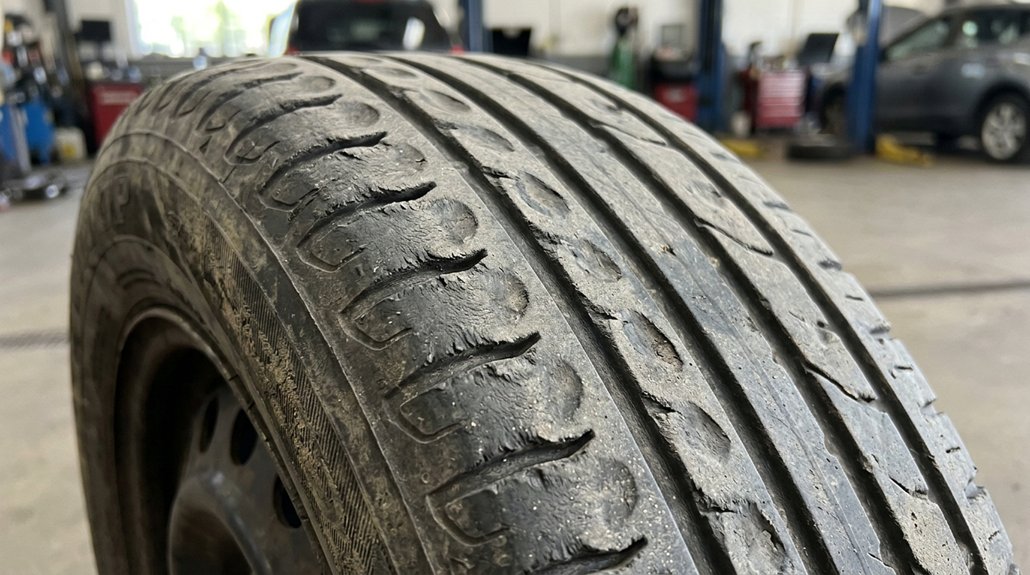
Most drivers mistake tire cupping for simple wear, but it’s actually a mechanical warning sign that your suspension has lost its ability to control wheel movement. When shocks, struts, or ball joints degrade, they allow tires to bounce and skip across pavement instead of maintaining steady contact.
I’m going to break down exactly which components fail, how they create those distinctive scalloped patterns, and why ignoring them costs you far more than a new set of tires.
Is This Cupping? Visual and Audio Warning Signs to Confirm
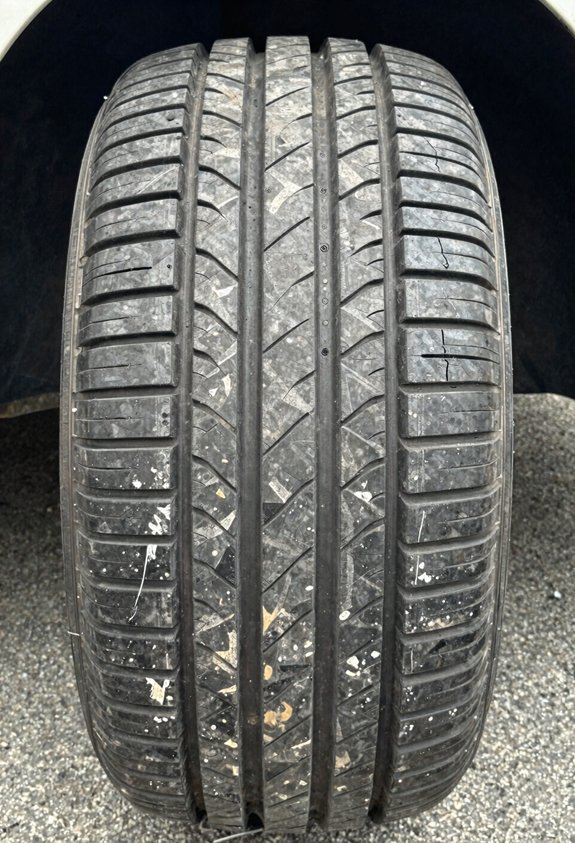
How exactly can you tell whether your tires have developed cupping rather than some other form of uneven wear? I look for visual cupping, which appears as irregular scalloped patches along the tire edge, typically forming every few inches and giving a “high-low” tread pattern. This cupping wear differs from other irregular tread wear because it creates rhythmic dips you can both see and feel.
I listen for unusual tire noise, a rhythmic hum or growl that increases with speed, often accompanied by vibrations in my steering wheel or seat. These audible signals warn me before damage becomes severe.
I watch for handling issues, too. When my vehicle pulls to one side or needs constant correction, I suspect suspension alignment problems. Cupping rarely occurs in isolation; it signals underlying mechanical faults requiring immediate attention to prevent further deterioration.
Worn Shocks and Struts: How Bouncing Creates Cupped Patterns
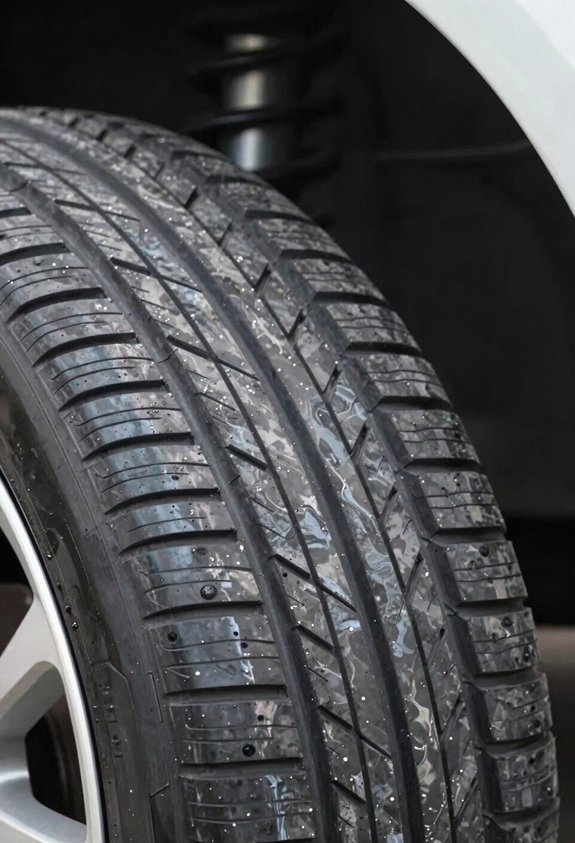
- Leaking fluid signals complete shock failure, eliminating damping capacity entirely
- Internal valve wear reduces damping performance without visible external symptoms
- Each uncontrolled rebound amplifies irregular wear through inconsistent force distribution
- Tire cupping accelerates exponentially until I address the underlying damping deficiency
Replacement Timing Considerations
I must replace worn shocks before installing new tires, since existing cupping patterns indicate systemic suspension problems requiring immediate correction.
Bad Ball Joints: The Second Culprit Behind Tire Cupping
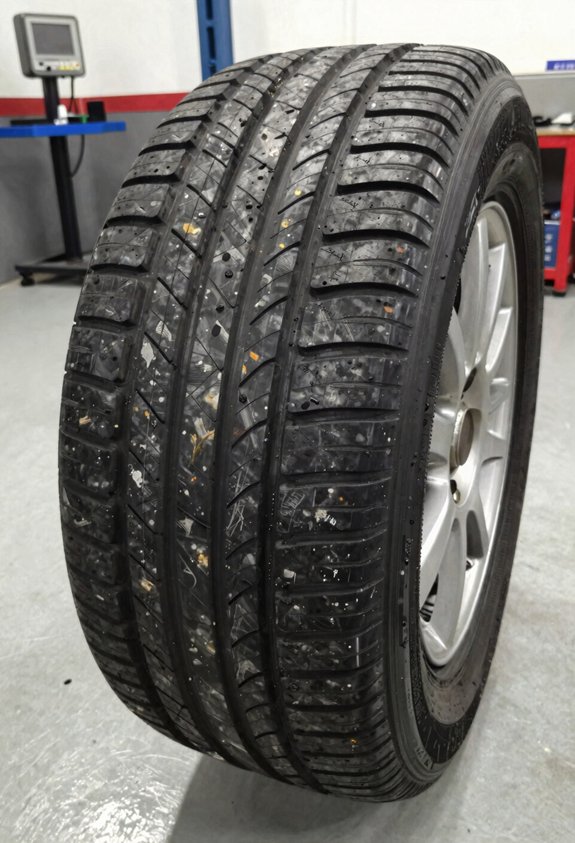
Where does the second major source of tire cupping originate when your suspension components begin to fail? Let me walk you through bad ball joints, often overlooked yet equally destructive.
How Ball Joints Create Cupping
When your upper or lower ball joints wear, they allow excessive wheel movement, which prevents consistent tire contact with the road. This looseness produces cupping patterns identical to those from bad shocks, making diagnosis tricky without hands-on inspection.
Diagnosing Faulty Ball Joints
I recommend probing ball joints with a pry bar; detectable movement, or a gap that closes when pressing the tire upward, confirms wear. Cupping from this source occurs because loosened joints cannot hold suspension components rigidly, creating irregular loading and accelerated tread wear.
Critical Prevention
Replace faulty ball joints before installing new tires; rotation won’t restore them, and irregular wear will return immediately.
Misalignment vs. Cupping: Why the Difference Matters for Diagnosis
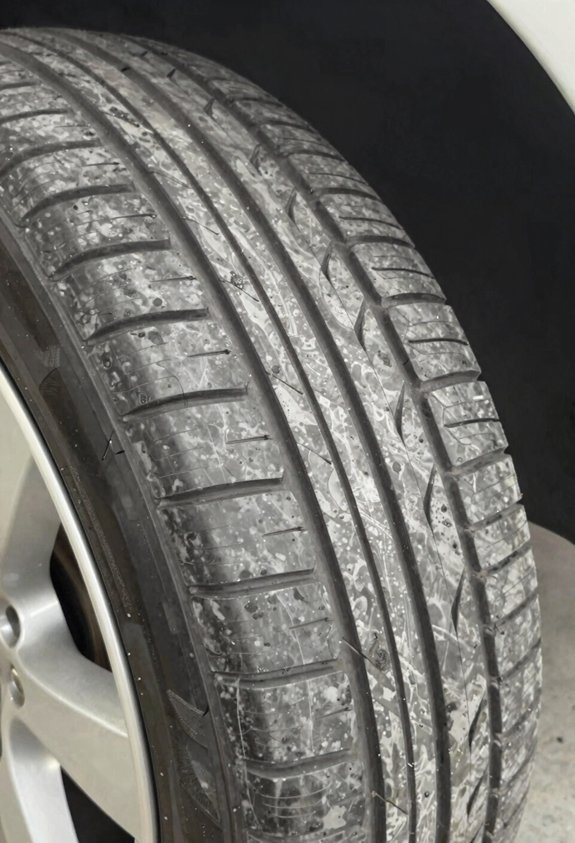
While worn ball joints certainly deserve your attention, I’d be doing you a disservice if I stopped there. Suspension failures tell only part of the cupping story, and in my experience, misalignment ranks among the most frequently misdiagnosed contributors to this destructive wear pattern. Misalignment shifts your suspension angles, forcing tires to shoulder uneven loads and roll improperly; this initiates cupping through repeated high and low contact zones that hammer the tread with every rotation.
While worn ball joints certainly deserve your attention, I’d be doing you a disservice if I stopped there. Misalignment ranks among the most frequently misdiagnosed contributors to this destructive wear pattern.
Recognizing misalignment-driven cupping demands sharp observation of these distinguishing markers:
- Irregular wear appearing alongside pulling sensations or off-center steering
- Cupping concentrated on one axle, typically the front, rather than distributed randomly
- Accelerated shoulder wear combined with diagonal tread scalloping
- Symptoms persisting even after suspension component replacement
Remember that correcting misalignment halts further cupping progression, yet cannot resurrect already-compromised tread. A methodical diagnostic approach separates alignment-related cupping from wear caused by balance deficiencies, pressure irregularities, or degraded suspension hardware. Confusion here wastes money and invites continued tire destruction.
When Unbalanced Tires and Skipped Rotations Make Cupping Worse
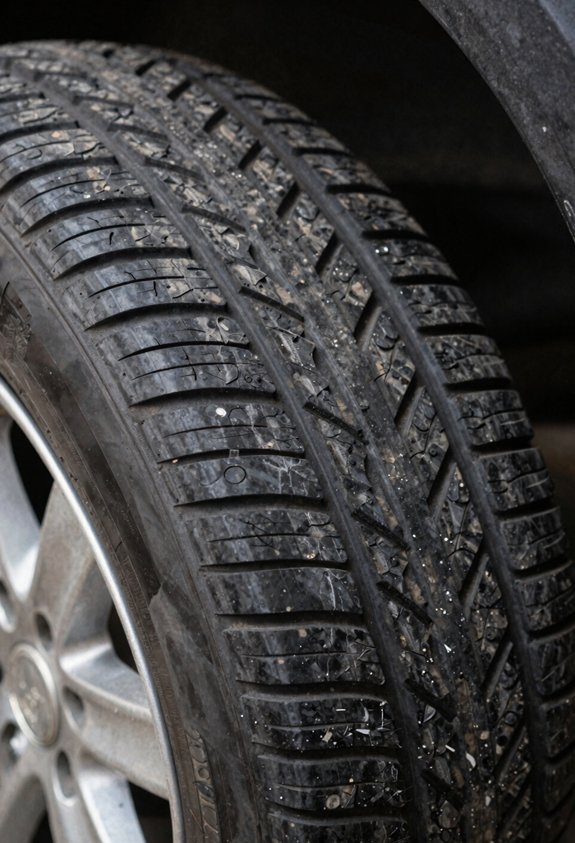
I’ll walk you through how rotational force effects, uneven wear progression, and maintenance timing impact work together to worsen cupping. When your tires aren’t balanced, the wheel assembly generates irregular centrifugal forces that concentrate stress on high and low tread spots. This hammers those areas with every revolution.
If you skip rotations, say, pushing past that 5,000-mile interval, you’re allowing those uneven patterns to diverge across your tire positions. Front-drive wear compounds differently than rear. By the time you address it, the cupping has often progressed to where you’ll feel vibration through the steering wheel and hear that characteristic rhythmic noise on smooth pavement.
I’m telling you this because catching it early matters: balance after any tire service, rotate on schedule, and you’ll distribute loads evenly enough to keep cupping from becoming a safety issue, rather than just an annoyance.
Rotational Force Effects
Why does a tire’s rotational behavior matter so much in preventing cupping? I’ll explain how unbalanced tires and neglected rotation create destructive forces.
When your wheels carry imbalance, they generate uneven centrifugal force with every revolution, producing irregular contact between tread and pavement. This oscillation doesn’t merely ride rough; it physically hammers specific tread sections, initiating depression while adjacent areas bulge slightly.
Here’s what compounds this damage:
- Unbalanced tires amplify vibration, converting minor surface variations into pronounced scalloping
- Irregular rotation intervals allow localized wear to become self-reinforcing cyclical damage
- Skipped maintenance deepens existing wear pattern irregularities through repetitive stress concentration
- Out-of-balance assemblies accelerate deterioration by 30-40% versus properly maintained equivalents
I recommend balancing during every rotation, typically every 5,000-8,000 miles. This distributes forces uniformly, interrupting the feedback loop that transforms minor imperfections into severe cupping.
Uneven Wear Progression
Although cupping begins as minor surface irregularity, I’ve watched it transform into severe structural damage when unbalanced tires and skipped rotations compound each other’s effects, creating a self-accelerating cycle that’s remarkably difficult to interrupt once established.
Unbalanced tires generate uneven rotational forces that exaggerate cupping, making worn patches increasingly pronounced with each mile. This imbalance increases vertical tire movement, amplifying edge cupping dramatically. When you skip rotation, one tread area bears concentrated stress while others remain relatively untouched, promoting irregular cupping patterns that deepen rapidly.
The combination proves particularly destructive: high and low spots reinforce themselves revolution after revolution, accelerating uneven wear beyond what either cause achieves alone. I’ve seen cases where neglected balance and delayed rotation advanced cupping by 40-50% faster than isolated factors.
Checking tire pressure helps, but addressing balance and keeping to rotation schedules, typically every 5,000-8,000 miles, gives you the strongest protection against progressive cupping damage.
Maintenance Timing Impact
Timing transforms maintenance from preventive measure into decisive intervention against cupping progression, where delaying action converts manageable wear into accelerated structural degradation. I’ve learned that unbalanced tires create repeating rotational forces that amplify cupping once irregular wear begins, making the pattern unmistakably pronounced. When you skip tire rotation, uneven wear compounds, deepening cupping and spreading it across the tread surface.
Your maintenance timing directly determines whether cupping remains superficial or advances to structural failure. Consider how these factors interact:
- Unbalanced tires generate harmonic vibrations that exacerbate existing cupping patterns
- Irregular wear accumulates unchecked without scheduled redistribution
- Tire rotation every 5,000 miles redistributes load patterns effectively
- Combined neglect accelerates degradation faster than isolated issues
Proper maintenance timing demands proactive scheduling, not reactive response, to preserve tread integrity and your connection to confident, predictable handling.
Can You Fix Cupped Tires or Must You Replace?
Before installing replacements, you’ll need to fix underlying suspension failures: replace leaking shocks, worn struts, or degraded ball joints that permitted the bouncing motion.
Once repaired, you can mount new tires with confidence, knowing you’ve eliminated the mechanical defects that created the problem.
Your Prevention Checklist: Rotation, Pressure, and Annual Alignment
Since you’ve addressed any suspension damage that caused your cupping, I’ll walk you through the three pillars of prevention that’ll keep your next set of tires wearing evenly from mile one.
Rotate your tires every 5,000 miles to distribute forces evenly across all positions, which minimizes irregular wear patterns before they develop. Maintain manufacturer-specified pressure monthly, checking when tires are cold, since underinflation expands the contact patch unevenly and accelerates cupping.
Schedule annual alignment inspections to correct camber, caster, and toe angles. This keeps your suspension geometry from forcing repetitive, uneven road contact. Combine all three practices consistently, because isolated efforts fail; rotation without proper pressure, or alignment without rotation, still leaves you vulnerable to irregular wear.
Together, rotation, pressure management, and alignment form your complete defense against cupping’s return.
Testing Shocks and Ball Joints Before Your Next Tire Purchase
How else can you be certain your new tires won’t suffer the same fate as your last set? I always inspect my shocks/struts and ball joints before buying rubber, because hidden suspension failures guarantee cupping returns.
Testing Shocks/Struts
I check for oil leaks, uneven damping, and excessive bounce. Any of these indicate failure that causes tire wear. Even without visible leaks, worn units allow tire bounce that forms the cupping pattern.
Testing Ball Joints
I use a pry-bar method: with the tire elevated, I observe gaps between the knuckle and lower control arm. Movement indicates bad ball joints contributing to irregular tire wear. I test upper joints identically; any play demands replacement.
Replacing compromised shocks/struts and ball joints before mounting new tires prevents cupping progression, protecting your investment.