
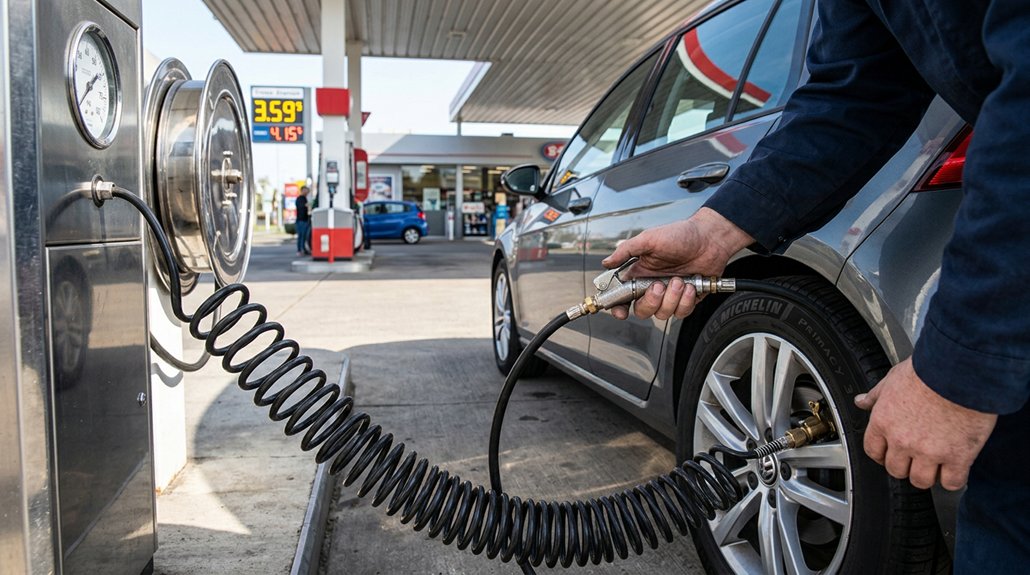
I’ve inflated hundreds of tires at gas stations, and the process demands more precision than most drivers realize. Start by locating your vehicle’s recommended PSI, typically 30-35 for sedans, 35-45 for trucks, printed on the driver’s door jamb placard (not the tire sidewall, which shows maximum pressure).
You’ll need cold tires, meaning the car’s sat idle for three-plus hours or you’ve driven under a mile, because friction from driving raises pressure 3-5 PSI artificially. Remove the valve cap, clear debris from the stem, and press the pump nozzle squarely until the lock lever catches; hear that brief hiss? That’s your first warning: you’re losing air.
Inflate in ten-second bursts, checking frequently with a secondary gauge since station displays are notoriously inaccurate, off by 5-10 PSI isn’t uncommon. Hit your target, disconnect, and recheck; ambient temperature drops of 10°F slash roughly 1 PSI naturally, so seasonal adjustments matter.
But here’s what most guides won’t tell you about those “free” pumps…
How Low Tire Pressure Wrecks Fuel Economy and Safety
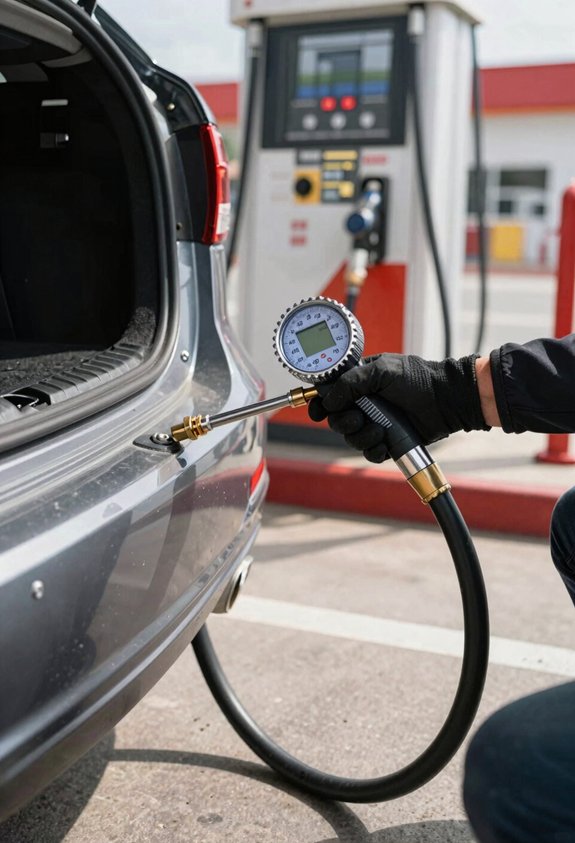
Why does something as simple as tire pressure command your attention? Because underinflation quietly steals from your wallet and jeopardizes your safety, and I’ve learned that catching it early at the gas station pump saves you from costly consequences.
When your tires drop below proper PSI levels, they create rolling resistance that drags down fuel economy by 0.2–0.5% for every single PSI missing. Underinflation forces sidewalls to flex excessively, generating heat that accelerates tread wear and can trigger catastrophic blowouts on highways. Your handling and braking degrade, increasing stopping distances when you need control most.
I check my cold tire pressure, after three hours undriven, with a reliable PSI gauge, removing the tire valve cap, pressing firmly onto the valve stem, and noting readings before any drive. This ritual, repeated monthly, protects your safety, preserves fuel efficiency, and prevents the premature tire replacement that underinflation guarantees.
Find Your Recommended PSI Before You Leave
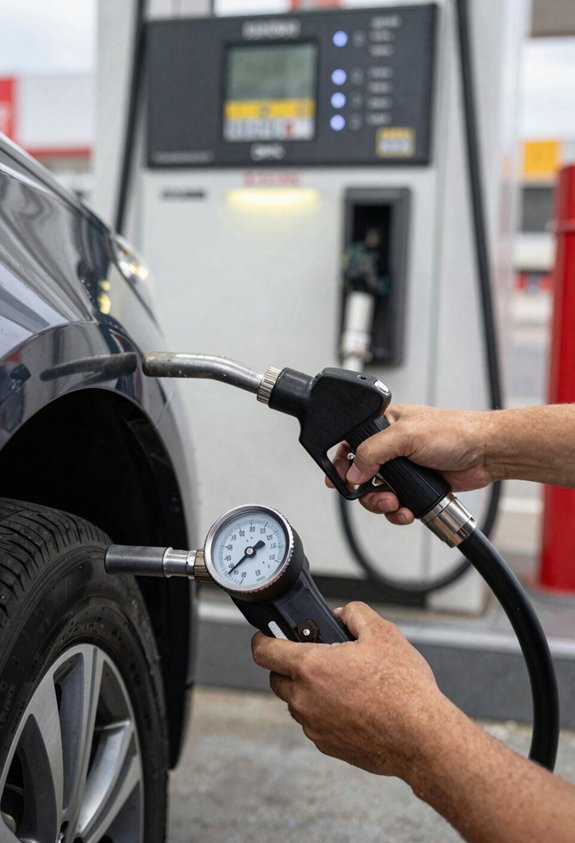
Most passenger vehicles need 30, 35 psi, though your specific model may differ. Do not use the tire’s sidewall maximum. That number indicates structural limits, not proper tire pressure for everyday driving. Some cars require different front and rear values, so verify whether yours specifies separate pressures.
When you inflate tires to the correct recommended PSI, you’ll guarantee optimum handling, fuel efficiency, and tread longevity with every mile you drive.
Check Tires Cold or Wait Three Hours
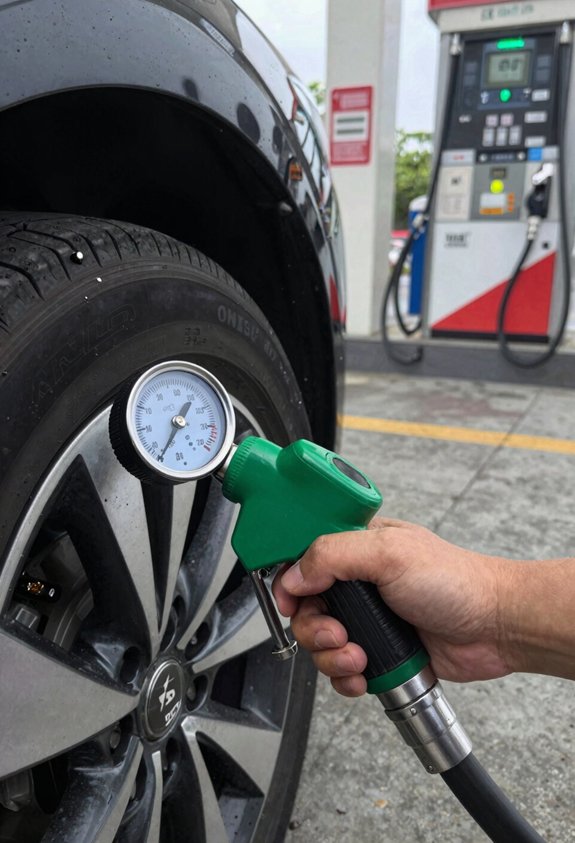
I always check my tires when they’re cold, because driving creates friction that raises both tire temperature and internal air pressure by approximately 4 PSI, which yields readings that don’t reflect the tire’s baseline state.
The NHTSA recommends waiting at least three hours after operation, or preferably checking before I’ve driven at all, since heat-affected measurements would lead me to underinflate when the tires cool and pressure drops. Getting this timing wrong means I’m working from inaccurate data, so I’ll either wait for full cooling or adjust my target PSI to account for warm-tire readings if I’m pressed for time.
Why Cold Tires Matter
Accurate tire pressure measurement depends on temperature conditions that most drivers overlook, since even a brief drive generates friction between the tire and road surface, causing the contained air to expand measurably and produce falsely elevated readings.
The Science of Cold Tire Check
I always check cold tires before driving to get trustworthy numbers on my gauge. Hot tires can read roughly 4 PSI higher than actual, tempting me to under-inflate when they cool.
When I remove the valve cap and connect the gas station pump, I need that recommended tire pressure as my baseline, typically found on the door jamb, not the tire sidewall. If I must check warm, I note the elevated reading and recheck later. Proper tire pressure protects my tires, my fuel economy, and everyone sharing the road with me.
NHTSA Timing Guidelines
- I remove the valve cap and set it aside
- I wait three hours after driving, since my tires can increase by about 4 PSI from heat
- I verify my reading with a reliable air gauge
If I cannot wait three hours, I wait until my tires cool before adjusting pressure. Cold readings give me accurate tire pressure data for safe handling decisions. I never rely on immediate post-drive readings, knowing they mislead my inflation choices.
Heat Affects Accuracy
Temperature fluctuations dramatically skew pressure readings, thereby making timing your check matter as much as the gauge you’re using.
Heat’s Impact on Accuracy
I’m telling you this because I’ve learned the hard way: heat increases tire pressure by roughly 4 PSI after driving, and that’ll throw off your entire inflation strategy. When tires are hot, your gauge lies to you, showing numbers that exceed your cold baseline, which leads to under-inflation later when they cool.
The Three-Hour Rule
For true accuracy, I always wait three hours before checking. Cold tires give you the only reliable reading, period. Remove that valve cap, press your gauge firmly, and note the actual PSI.
If you’ve driven recently, don’t inflate yet, waiting protects you from over-inflation when temperatures drop. Trust cold readings, adjust accordingly, and your air pump session becomes precise, not guesswork.
Gas Station Air Pump Costs and Runtime
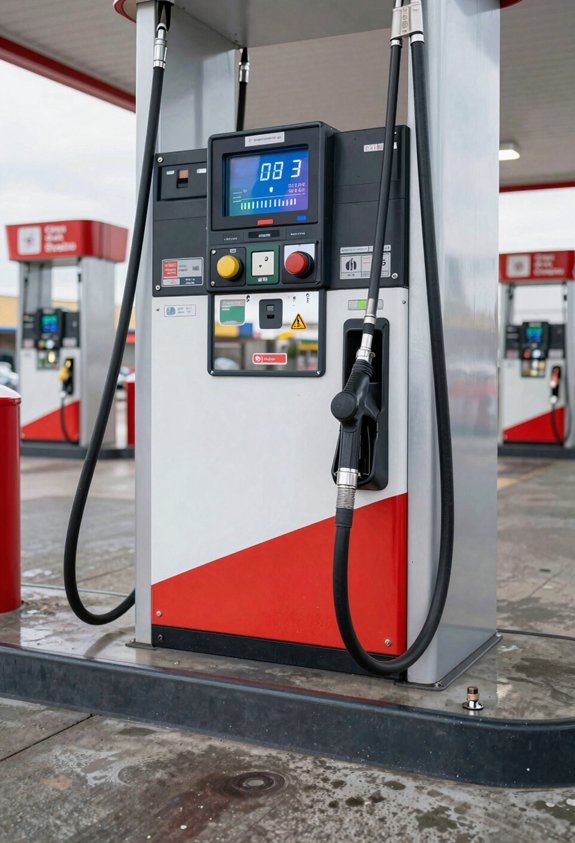
Before committing coins or card swipes at the service station, I weigh whether I’m paying for mere convenience or really necessary infrastructure, because gas station air pumps typically extract $1.00 to $2.50 per inflation cycle from your wallet. I’ve learned, through repeated stops across state lines, that this expense isn’t universal. Some locations, particularly in California and certain cooperative stations, waive the cost entirely with fuel purchase, which means I’ve developed the habit of checking policy details before rolling up.
Gas station air pumps can cost $1 to $2.50 per use, but some locations waive fees with fuel purchase—always check policy details first.
Understanding Runtime and Efficiency
The runtime you purchase, usually three to five minutes, demands efficiency. I remove every valve cap beforehand, position myself at the first tire, and keep my personal gauge ready, since built-in gauges often display inaccurate PSI readings that compromise my air pressure check.
Dirty hoses and worn connectors waste precious seconds, so I inspect equipment before paying.
Cost-Saving Strategies
To inflate tires properly within limited windows, I overfill slightly, then bleed air using my own gauge for precision. This approach prevents repeated cycles, protects my wallet, and guarantees accurate inflation despite machine limitations.
Prepare Your Valve Stem for Connection
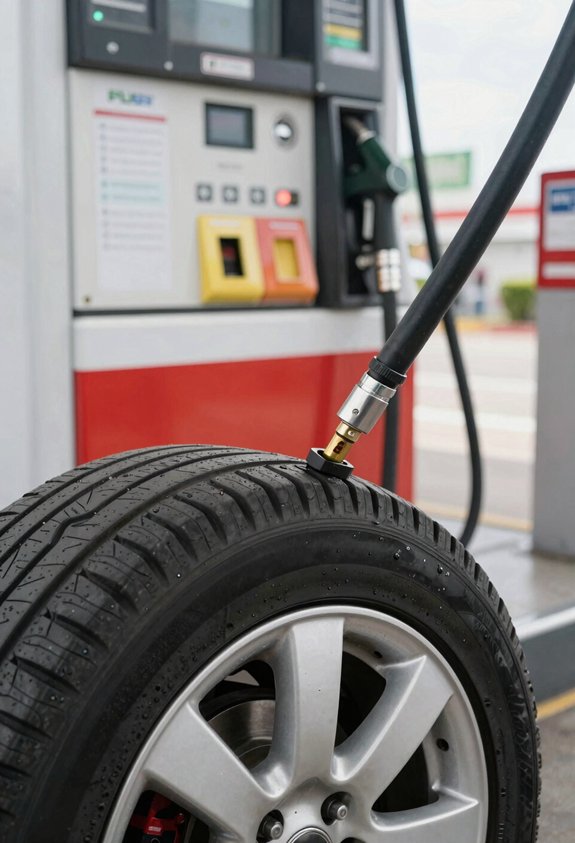
After I’ve secured my payment and runtime at the machine, I shift focus to the immediate tactile work of readying the valve stem, since even the most efficient inflation cycle becomes worthless if I can’t establish a clean, airtight connection at the point of entry.
I twist off the valve cap, set it in my pocket so it won’t vanish on oily concrete, and scan the stem for cracks or corrosion that would sabotage leak prevention. I wipe away debris with my thumb: grit, brake dust, whatever’s collected, because a clean seal demands bare metal contact. I’m checking that my tires are cold, too; heat from driving swells pressure readings.
With the air hose chuck positioned straight, I push it firmly onto the valve stem until it seats, locking the lever if one exists, completing this pump attachment phase before inflation begins.
- Remove the valve cap deliberately, storing it somewhere you’ll remember, since replacement costs accumulate and lost caps expose threads to corrosion
- Eliminate all debris manually, recognizing that microscopic particles between metal surfaces create escape paths for pressurized air
- Verify cold tires, understanding that elevated temperatures from recent driving inflate pressure readings 2-4 PSI above actual cold specifications
- Inspect for physical damage, including bent stems, cracked rubber bases, or slow leaks audible as faint hissing
- Position the air hose chuck perpendicular, maintaining straight alignment during initial contact to preserve valve core integrity and make certain of instantaneous leak prevention
Start the Pump and Connect Securely
I’ll activate the pump by inserting payment and starting the compressor, which typically runs for three to five minutes, so I need to work efficiently. Before attaching anything, I’ll remove the valve stem cap from each tire, keeping it safe for reattachment later. Then I’ll press the tire chuck firmly onto the valve stem to create a secure seal, locking the lever if one is present, and I’ll monitor the gauge carefully as air flows.
Activate Payment Method
- Locate your PSI target (door jamb or manual) so you’re not guessing in front of strangers
- Keep valve caps in your pocket, losing them signals inexperience
- Listen for the compressor hum, silence means failed payment
- Watch the gauge immediately, pressure builds fast, and overinflation risks blowouts
- Accept the brief hiss, it’s normal, but prolonged leaking demands reattachment
Secure Hose Connection
Before I can connect the hose, I locate the valve stem, a small protruding tube on the wheel hub, typically capped in black or green plastic, and twist off the cap, storing it somewhere I won’t lose it (my pocket, my cupholder, anywhere but the ground). I wipe the valve stem clean, then push the pump nozzle straight onto it, engaging the locking lever to create a secure seal. That brief hiss I hear means air is flowing. I check that the gasket sits flush to prevent air leaks.
I verify my target PSI on the gauge, check the hose for damage, and position myself so I won’t kink the line. Now I’m ready to inflate correctly.
| Step | Action | Outcome |
|---|---|---|
| 1 | Remove cap/gasket | Clean valve stem access |
| 2 | Wipe stem | Debris-free connection |
| 3 | Push pump nozzle on | Hose connection initiated |
| 4 | Engage locking lever | Secure seal confirmed |
| 5 | Check gauge/PSI | Inflate correctly, zero air leaks |
Inflate in Short Bursts and Check Pressure
Why risk a blowout or uneven wear when you can control the process with deliberate restraint? I inflate in bursts, giving the gauge time to settle between each pulse of the air pump, watching my tire pressure climb gradually toward that door jamb sticker target.
Deliberate restraint prevents blowouts: inflate in bursts, let the gauge settle, climb gradually toward your target.
You’re part of a community that values precision, so rely on your own gauge if the station’s readout wavers, accuracy matters when you’re measuring PSI. Stop the moment you hit the recommended mark; overinflation damages tread life and handling. I always recheck after disconnecting the hose, confirming I haven’t overshot. If I’ve pushed too far, I bleed air slowly, then verify again until the reading settles exactly where it belongs.
- Control prevents catastrophe: Burst inflation protects against sudden pressure spikes that compromise structural integrity
- Verification builds confidence: Cross-referencing gauges ensures you belong to the informed minority
- Precision preserves investment: Exact PSI maximizes tire longevity and fuel efficiency
- Adaptability demonstrates mastery: Knowing when to bleed air separates novices from practitioners
- Documentation anchors accuracy: That door jamb sticker is your authoritative reference point
Finish and Repeat for All Four Tires
Once I’ve finished inflating the first tire, I immediately screw the valve cap back on to block dirt and moisture from entering the stem. Then I move systematically to the remaining tires, driver’s side rear, passenger’s side rear, and finally passenger’s side front, repeating the short-burst inflation and pressure-checking routine for each one.
I don’t skip the spare if my vehicle carries one externally or in a readily accessible location, since an underinflated spare renders it useless during an actual roadside emergency. After completing all four tires, I pull out my own digital or dial gauge to recheck every pressure reading against the gas station pump’s display, as those public machines can drift out of calibration by 2-5 PSI through heavy use, and I won’t drive away until I’ve confirmed each tire sits within 1 PSI of my target pressure.
Replace Valve Caps
How exactly does one properly finish an inflation cycle after reaching target pressure? I remove the tire pump nozzle, then immediately thread the valve cap onto the valve stem, tightening it finger-tight to seal out moisture and debris that could corrupt the seal. At this gas station, I’ve learned that cap replacement isn’t optional, it’s essential protection.
I check pressure once more with my own gauge, confirming the reading matches my target before moving on. Don’t overlook your spare tire. I always include its valve stem in this routine.
- Seal integrity: A secure valve cap prevents grit from damaging the valve core
- Pressure retention: Missing caps allow slow air pressure loss over weeks
- Cost efficiency: Free cap replacement beats buying new sensors later
- Systematic completion: Each tire gets equal attention, building thorough habits
- Vehicle readiness: Four tires plus spare equals total preparedness for the road ahead
Check Remaining Tires
With the first tire sealed and its valve cap secured, I turn my attention to the remaining three tires, repeating the same inflation protocol at each corner of the vehicle to achieve uniform pressure distribution.
To check remaining tires effectively, I always rely on my personal tire pressure gauge rather than trusting gas station pumps alone, since their built-in meters frequently deviate by 2-5 PSI. Following consistent tire inflation steps, I remove each valve cap, attach the hose with firm pressure, and inflate in bursts, typically 3-5 second intervals, pausing to verify readings against my recommended PSI (usually 30-35 PSI for standard sedans, though your placard specifies exact values).
After all four tires reach target pressure, I replace every valve cap tightly, preventing debris infiltration and gradual air seepage. I then visually scan for bulges, cracks, or embedded objects, and, completing thoroughness, verify the spare tire’s pressure, making sure no corner leaves me vulnerable on the road.
Broken Gauges and Other Pump Failures
- I inspect the air hose for cracks and dirt before connecting
- I always remove my valve cap first to avoid losing it if the timer cuts short
- I bring a portable gauge because broken gauge readings ruin PSI accuracy
- I check pressure with my tire gauge after inflating, never trusting the pump alone
- I account for heavy usage damage that causes unreliable readings
When I see an out-of-order sign or hear air hissing from a worn connection, I move on. I won’t let time pressure rush me into over-inflation.
When Portable Inflators Make More Sense
Why should I rely solely on gas station pumps when portable inflators offer complete autonomy over my tire maintenance? A portable inflator lets me check pressure and adjust PSI anywhere, eliminating waits and broken equipment risks.
| Scenario | Portable Inflator Advantage | Recommended Action |
|---|---|---|
| Cold tires at home | Accurate baseline readings before driving | Remove valve cap, connect inflator, check pressure |
| Remote off-road areas (e.g., ETENWOLF Vortex S7) | No gas station dependency | Verify PSI with built-in gauge after operation |
| Hot tire correction | Avoid heat-inflated readings | Let tires cool, then recheck with personal unit |
| Multi-vehicle households | Consistent PSI maintenance across cars | Store inflator for weekly pressure audits |
I value precision and readiness, owning a portable inflator means I’m never stranded when station availability fails me.
Maintain Pressure Between Gas Station Visits
How often do you actually check your tires between those rushed stops at the gas station? I check mine monthly, and I’m part of a community that knows waiting too long risks safety and efficiency.
Here’s how I maintain tire pressure between visits:
- I verify my tire gauge reading against the gas station pump display, since worn station equipment can drift from true PSI
- I check pressure when tires are cold, after at least three hours of sitting, to eliminate heat expansion errors
- I always replace the valve cap securely after inflating, keeping debris from damaging the seal
- I recheck all four tires (plus spare) immediately after I inflate tires, bleeding air carefully to avoid overinflation
- I keep a portable inflator handy for quick top-offs, so I’m never stranded with low pressure
Your Tire Inflation Questions Answered
Monthly checks keep your tires in shape, but I’ve learned that knowing how to handle the pump itself saves time and prevents costly mistakes. When you pull up to a gas station air pump, remember these compressors typically run on timers, usually three to five minutes per payment.
Before You Start
- Check your recommended PSI on the door frame sticker or owner’s manual
- Test cold tires for accurate tire pressure readings
During Inflation
- Attach the nozzle firmly, inflate in bursts, and monitor the pressure gauge
- Fine-tune by bleeding small air amounts; never exceed recommended PSI
Afterward
– Replace your valve cap immediately to block debris
If the pump seems off, trust your handheld gauge or switch to a portable inflator—accuracy matters, and you’re protecting everyone on the road.