
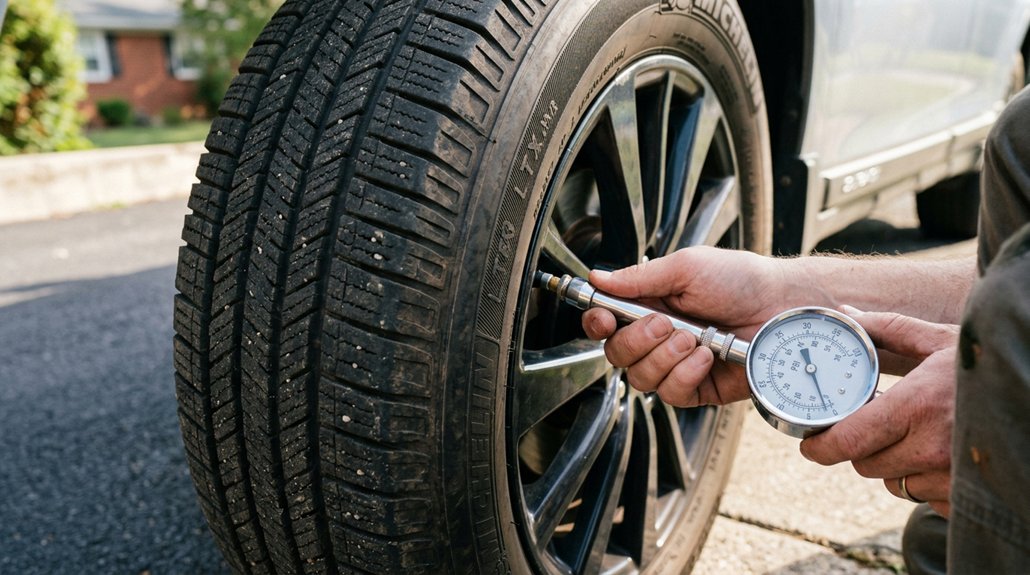
I’ll walk you through proper tire gauge operation, though you’ll need to stick with me to avoid the costly errors most drivers make.
Start with cold tires: anything above ambient temperature throws your numbers off by 2-3 PSI, which matters more than you’d think
Ensure Your Tires Are Cold First
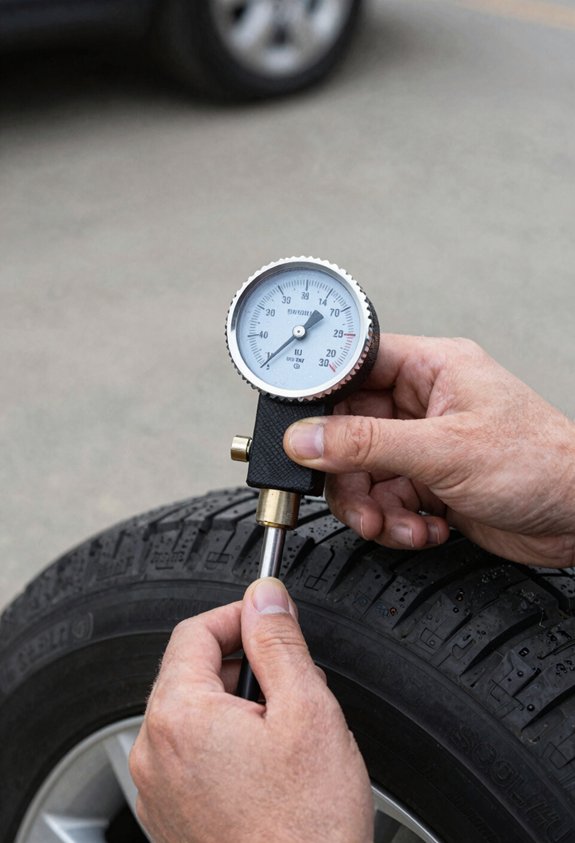
Before I even touch a tire gauge, I need to confirm my tires qualify as “cold,” a technical condition defined by specific criteria that directly affect pressure measurement accuracy. Cold tires mean they’ve rested for three hours minimum, or I’ve driven less than one mile at moderate speed; anything beyond this warms the rubber, expanding internal air and distorting my gauge reading.
I always check my door jamb sticker or owner’s manual first, since manufacturers base recommendations on cold PSI, not the elevated pressure hot tires produce. If I’ve been driving, I wait for proper cooling before approaching the tire valve; hot readings mislead me from proper inflation targets. Matching my tire pressure to that specified cold PSI guarantees accuracy, because starting with legitimately cold tires forms the foundation every subsequent measurement builds upon.
Find Your Recommended PSI and Grab Your Gauge
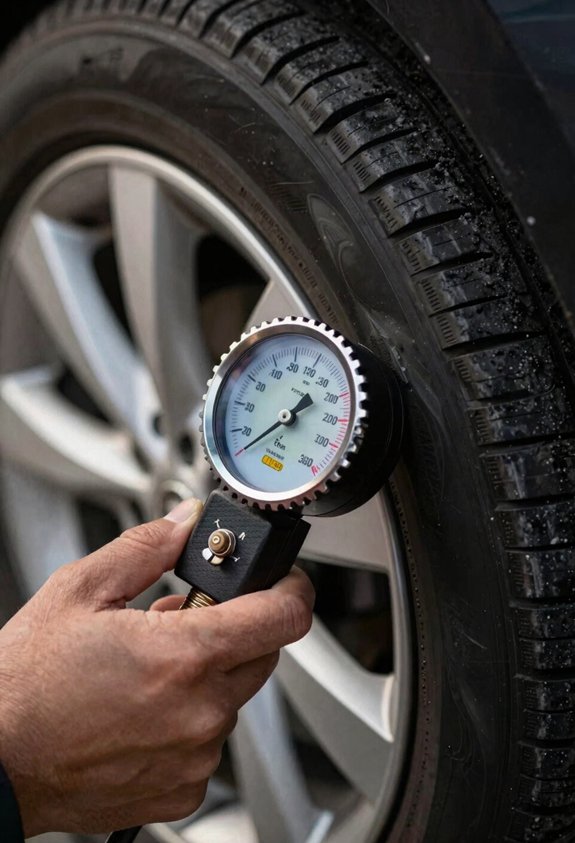
The manufacturer’s prescribed pressure specifications, which represent the optimal balance between load-bearing capacity, tread wear patterns, and fuel efficiency I’ve committed to maintaining, reside in two authoritative locations: the driver-side door jamb placard (affixed permanently to the door frame or adjoining pillar) and the vehicle’s owner manual, where I’ll verify whether front and rear axles carry identical recommendations or divergent values based on weight distribution engineering.
I record these recommended PSI figures before proceeding, noting any variance between front and rear tires. For proper inflation check accuracy, I confirm cold tire pressure standards, measured after three hours of vehicle inactivity, or driving less than one mile at moderate speed.
I’ll grab my tire gauge, selecting either digital gauge (offering precise LCD readouts) or analog gauge (utilizing calibrated Bourdon tube mechanics). I make certain air source accessibility for potential adjustments. I’ll twist off each valve cap counterclockwise, exposing the valve stem for immediate gauge attachment and reading.
Press the Tire Pressure Gauge Onto the Valve Stem
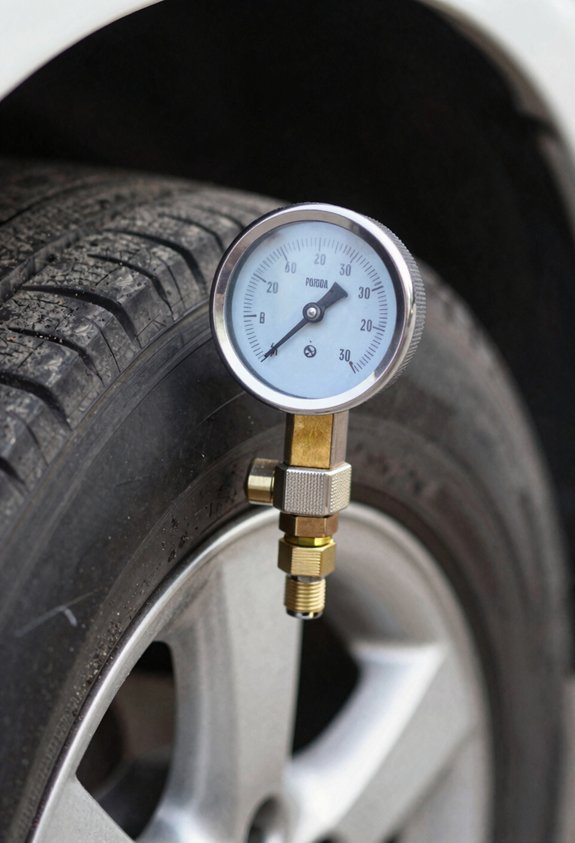
With the valve caps removed and my recorded PSI figures at hand, I’ll now establish proper gauge-to-valve contact, a procedure where technique directly determines measurement integrity.
Creating the Seal
First, I remove the dust cap from the valve stem, checking for debris that could compromise accuracy. I position my tire gauge perpendicular to the stem, then press firmly until I feel resistance; this creates an airtight connection essential for valid measurement. I maintain steady pressure; any gap permits air flow escape, corrupting my readings.
Gauge-Specific Technique
Whether I’m using a digital gauge or analog gauge, I hold position for two seconds minimum, allowing complete air flow into the mechanism. I avoid tilting, which breaks the seal. Proper technique here makes my subsequent readings reflect true tire pressure, not partial estimates compromised by leakage.
Read the PSI and Compare to Your Target
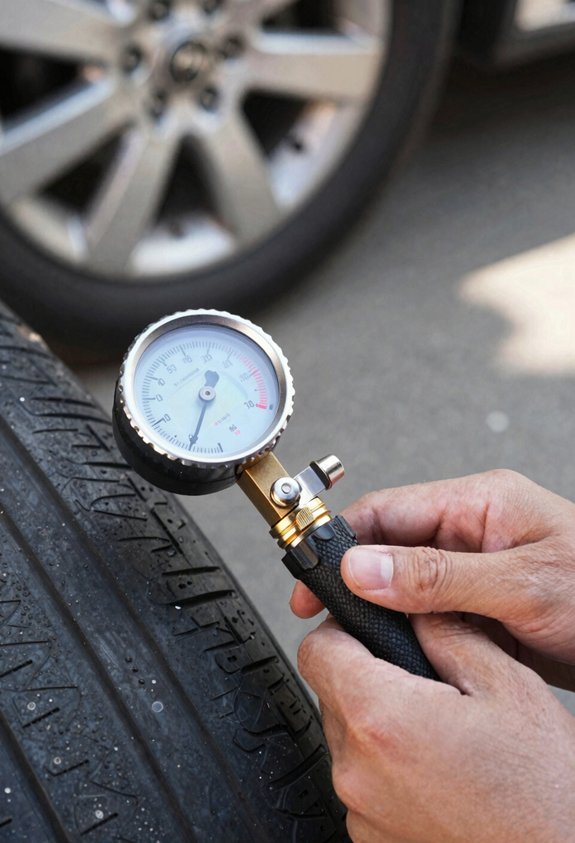
Pressure measurement accuracy hinges on proper gauge interpretation, so I’ll examine my reading with deliberate attention to detail. Once I’ve pressed my tire gauge onto the valve stem, I’ll check the PSI, either the numerical display on my digital gauge or the needle position on my analog gauge, making sure I’m reading cold tires for reliable air pressure assessment.
I’ll then locate my target PSI in the owner’s manual or on the driver-side door jamb sticker, comparing my measured value against this specification. If my reading diverges from the recommended figure, I’ll note the discrepancy for each tire, including my spare, recording these values systematically.
Precision matters here; heat-inflated readings mislead, so I’ll verify conditions before trusting any number my gauge presents.
Inflate or Bleed Air, Then Recheck for Accuracy
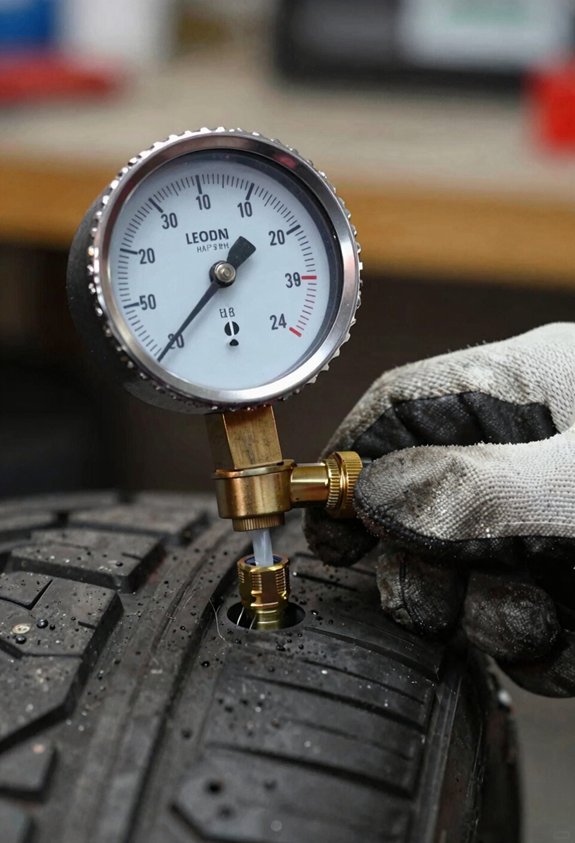
How do I correct a tire pressure discrepancy once I’ve identified one? If my cold tires read low on the pressure gauge, I attach an air compressor hose to the valve stem and inflate steadily, pausing to recheck with my gauge until I hit the recommended psi. Should I overshoot, I bleed air by pressing the valve core briefly, then recheck again.
I repeat this inflation-and-recheck cycle for each tire, sparing none, including my spare, until every tire pressure matches specifications. For accuracy in my final reading, I make sure the tires have cooled thoroughly, ideally after three hours parked or less than one mile of moderate driving, since warmth artificially elevates readings and compromises true psi verification.