
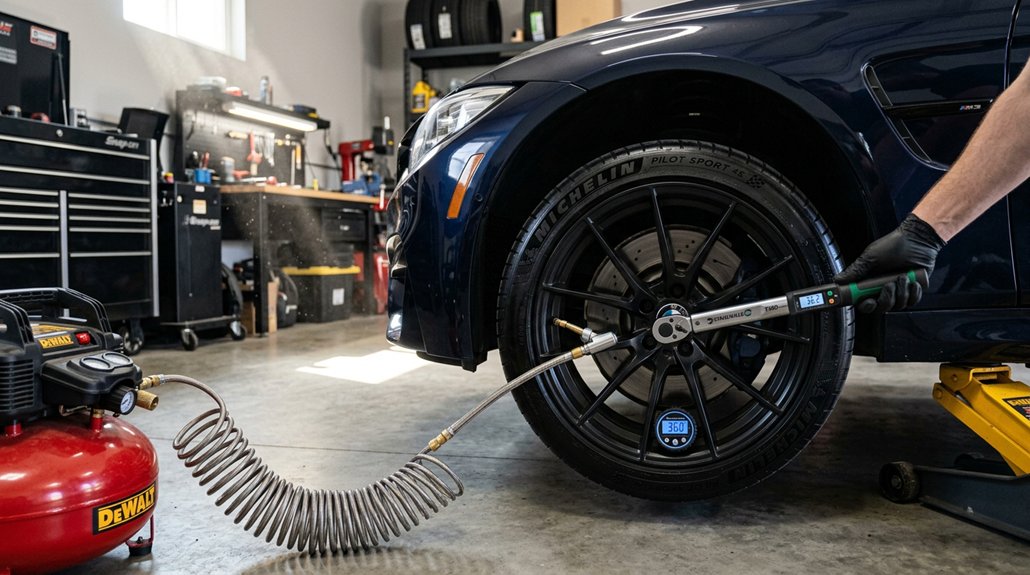
Most drivers assume a plugged tire is only a roadside curiosity, yet a properly installed plug can seal punctures up to ¼-inch in diameter faster than changing a spare, provided you recognize which wounds demand professional intervention. You will need to master the distinction between safe, repairable damage and structural failures that compromise sidewall integrity.
I will lead you through each phase, from initial assessment to post-repair validation, highlighting the precise techniques that separate a temporary fix from a catastrophic highway failure.
Check if Your Damage Is Actually Fixable First
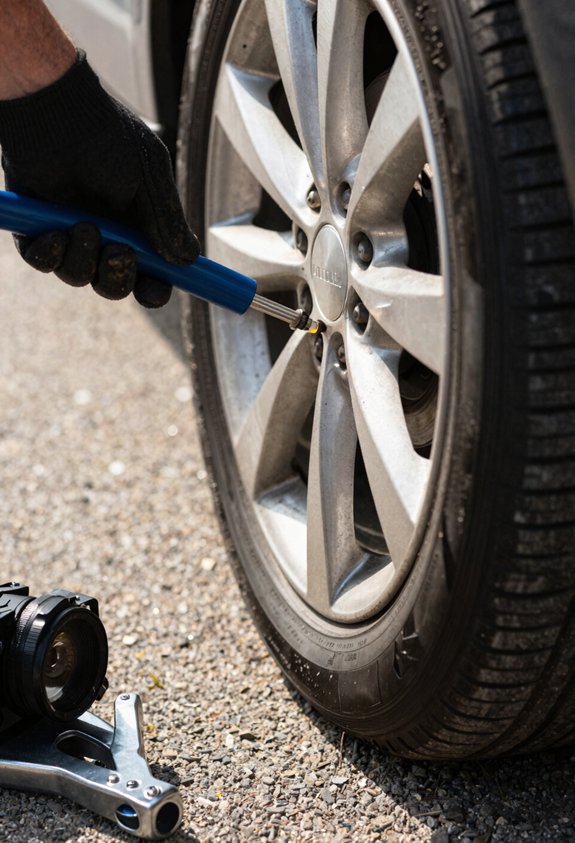
I don’t remove objects until I’m safely positioned. Why risk instant deflation on a busy road?
And here’s what seasoned mechanics know: plug-patch combinations outperform standalone plugs, meeting USTMA guidelines for lasting reliability. When I see uncertain damage, I seek professional inspection. Your safety, and mine, isn’t negotiable.
Grab These 3 Items From Your Trunk Kit
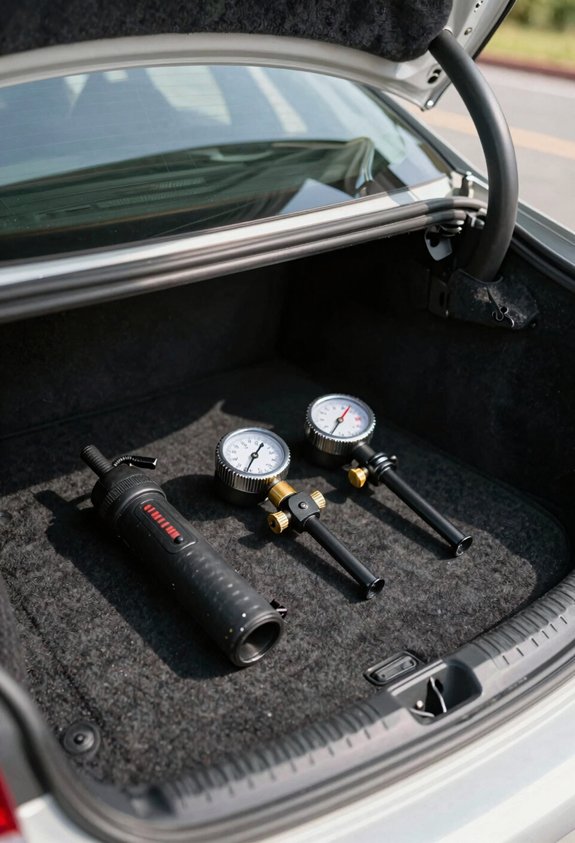
Before I start the repair, I’ll gather my tire plug kit (which contains repair cords, a T-handle insert tool, and a spiral probe for reaming the puncture), needle-nose pliers to extract whatever object caused the damage and clear debris from the hole, and, crucially, air compressor access (either a portable unit or knowledge of where I’ll inflate the tire afterward) since a plug won’t hold without proper pressure, typically 30-35 PSI for most passenger vehicles.
Tire Plug Kit
A tire plug kit functions as your primary defense against roadside punctures, and mine currently occupies a designated corner of my trunk alongside the jack and lug wrench. This compact tire plug kit empowers you to execute a puncture repair without removing the wheel from your vehicle, transforming a disabling flat into a manageable roadside fix.
Your kit should contain these essentials:
- Repair cords (worms), sticky, fibrous plugs that seal the breach from the outside
- T-handle insert tool, drives the plug into the puncture channel
- Puncture tool (reamer), cleans and prepares the hole for adhesion
When inserting, leave 1/2 to 3/4 inch protruding; this guarantees a secure seal. Remember, this temporary repair demands professional attention afterward. Embracing this skill connects you to the self-reliant community of prepared drivers everywhere.
Pliers And Probe
Why fumble through a glovebox when the right tools sit within arm’s reach? I keep three essentials ready for tire repair: needle-nose pliers, a T-handle spiral probe, and a T-handle insert tool, each serving distinct functions when puncture strikes.
Pliers grip and extract nails, screws, or debris embedded in the tread. I clamp firmly, pull straight out, and inspect the puncture cavity for damage.
The Spiral Probe reams the hole, enlarging it to accept plug or patch material. I twist slowly, cleaning burrs and preparing uniform surfaces for adhesion.
The Insert Tool drives the plug home.
These three items, packaged together in grab-and-go trunk kits, enable roadside puncture management. After removal and reaming, I combine probe and pliers with a plug or patch, completing temporary repair before reinflation.
Air Compressor Accessory
Once I’ve sealed the puncture, I’m not leaving the roadside with a flat, which is why I prioritize air compressor access as the capstone of any trunk kit. A portable air compressor, typically 12V or 110V, restores PSI to manufacturer specifications after plugging, and I won’t run one without verifying output using a dedicated tire pressure gauge rather than trusting built-in displays alone.
My trunk kit contains three interconnected essentials:
- A tire inflator (the compressor itself, often drawing from my vehicle’s outlet)
- A standalone tire pressure gauge for cross-referencing readings midway through inflation
- An extension hose, which eliminates awkward valve stem angles
I preset my target PSI, inflate in small increments, and recheck after five minutes of rest. Then I verify again following a brief drive, because temperature fluctuations and bead seating can alter readings substantially.
Pull Over Safely and Stop the Roll
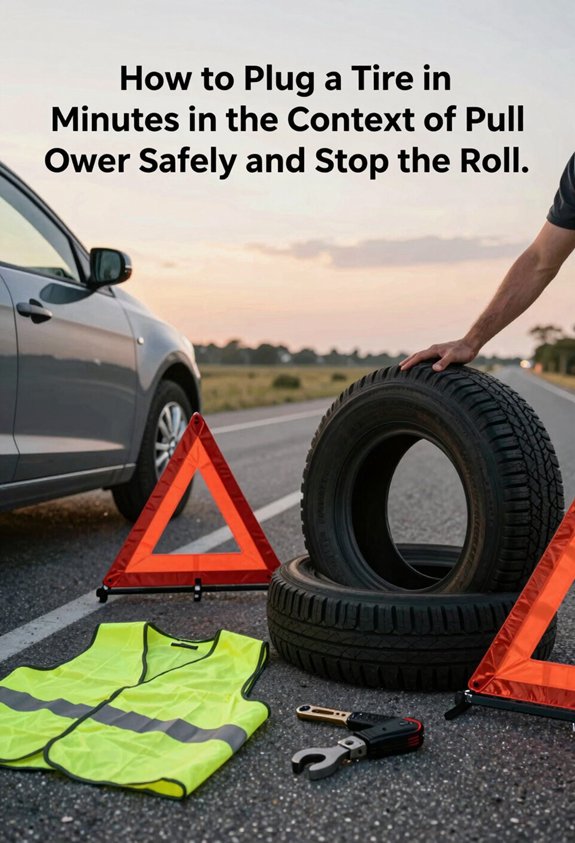
I immediately scan for traffic, signal, and guide my vehicle to a straight, stable shoulder away from moving lanes, making sure I don’t brake suddenly or swerve erratically, which could compromise control or trigger a blowout.
Once stationary, I engage the parking brake fully, activate hazard lights, and visually confirm the vehicle won’t roll or shift during inspection, making positional security my priority over haste. I leave the puncturing object embedded until I’ve assessed the damage from this secured position, resisting any impulse to extract it prematurely or inspect while the vehicle remains in motion.
Immediate Safety Response
Where exactly should you position your vehicle when a tire fails at highway speeds? I pull over to a safe location away from traffic, engage the parking brake, and turn on hazard lights before inspecting the tire stack to prevent further damage. Your immediate safety response determines whether this becomes a manageable roadside repair or a dangerous situation.
Secure the scene: I slow, controlled vehicle movement only to a safe distance if I need to reposition or assess all tires, ensuring I don’t roll the vehicle further into traffic.
Assess without intervention: If I locate a puncture object, I do not remove it yet; I secure the area and assess the immediate danger to avoid rapid deflation or injury.
Confirm damage: I use a visual check and listen for escaping air sounds to confirm a puncture before proceeding with any repair steps, then quickly assess whether a plug-patch or patch-plug approach suits my needs, prioritizing professional repairs for long-term reliability.
Vehicle Positioning Priority
I scan for shoulders, parking lots, or wide medians, any space separating me from active traffic lanes, because my tire repair position directly impacts survival, not just convenience. I’ll signal early, decelerate gradually without abrupt steering, and coast to the furthest possible refuge, ideally 100+ feet beyond curves or hill crests where approaching drivers gain visibility.
Securing the Rolling Chassis
Once stationary, I immediately engage the parking brake, chocking wheels if I’m on any grade. This stops the roll before I exit. I’ll move the vehicle only as needed; minimal, slow adjustments align the punctured tire for access. I check that the wound sits within the tread area, where plugs actually function.
I leave the embedded object intact until I’ve controlled every variable.
Brake and Hazard Activation
Signal the distress immediately by punching the hazard light button; those amber flashers aren’t optional courtesy, they’re survival beacons that broadcast my disabled status to approaching traffic from distances exceeding 500 feet in daylight, farther at night.
I ease off the accelerator, scan shoulders for level, debris-free asphalt extending twelve feet or more from travel lanes, and decelerate gradually to prevent loss of control.
Engage the parking brake firmly; I’m eliminating roll-back risk on grades before releasing service brakes. Locate the punctured tire without removing the embedded object; extraction accelerates deflation, complicating roadside safety. Verify I’ve cleared sufficient workspace, ideally four feet minimum around the tire, before retrieving my puncture repair kit.
Now hazard activation complete, vehicle secured, I unpack patch-plug repair components, confirming I own adequate daylight, dry conditions, and traffic separation before beginning.
Find the Hole But Don’t Pull the Object Yet
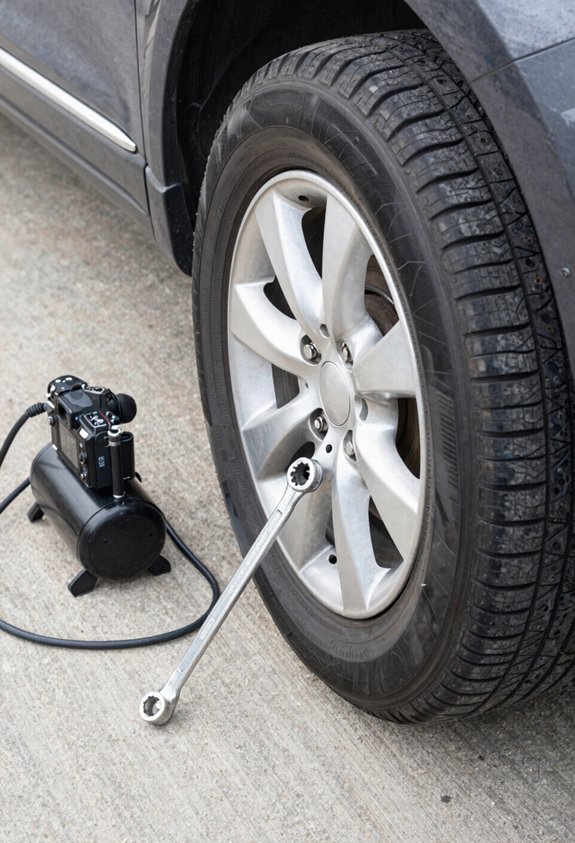
I examine what’s embedded: nail, screw, or shard? I check the surrounding tread depth, sidewall proximity, and damage pattern.
This repair assessment determines whether a plug-patch combination or professional service becomes necessary. Removing the object unprepared turns a manageable situation into an immediate roadside emergency I can’t fix.
Ream the Puncture Clean
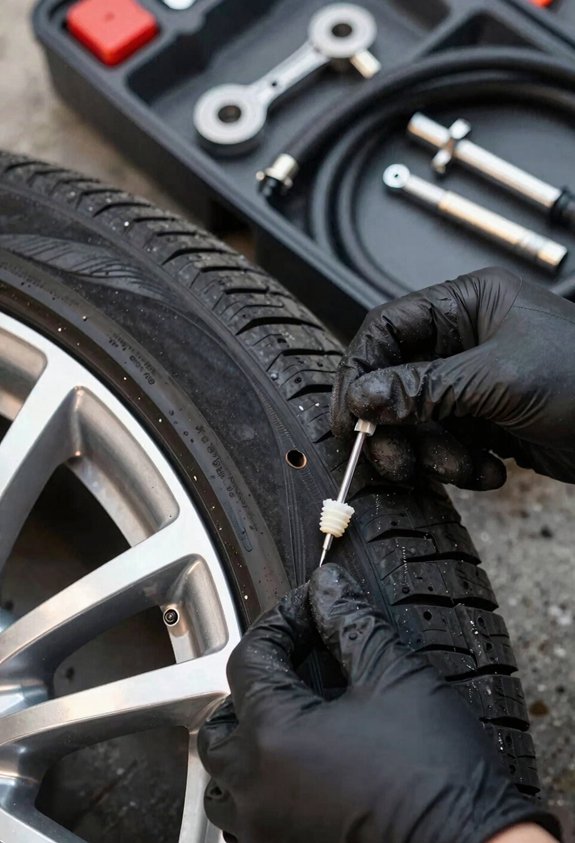
The spiral reamer, this grooved, corkscrew-shaped metal probe, becomes your primary instrument for transforming that jagged puncture into a clean, serviceable channel. During reaming, you’ll push and twist this tool through the tire puncture, widening it deliberately while stripping away debris, dust, and frayed rubber that compromise your leak seal.
Clearing obstructions guarantees the channel accepts plug insertion without resistance. Roughening interior walls creates textured surfaces where adhesive bonds mechanically. Uniform diameter matching your repair kit’s specifications guarantees compatibility.
Force the reamer through completely, then withdraw it smoothly; resist the urge to rush this preparation phase, as incomplete cleaning jeopardizes the entire repair. Once you’ve executed several firm strokes and feel consistent resistance, you’ve established the foundation for reliable sealing.
Insert the Plug Firmly and Trim Flush
Why does proper plug insertion technique matter so profoundly? Because incomplete seating creates catastrophic failure, transforming a temporary fix into roadside peril.
Prepare the Plug Path
Having reamed the puncture, I now select a vulcanized plug strip, threading it through the eye of my insertion tool. I coat the plug liberally with rubber cement, guaranteeing adhesive coverage from end to end.
Execute the Insertion
I position the tool perpendicular to the tread, then push steadily with a twisting motion until approximately 1/2 to 3/4 inch of plug material remains exposed. This length proves critical: too short prevents proper interior seal formation, while excessive material complicates subsequent steps.
Secure the Seal
I withdraw the tool smoothly, leaving the plug anchored within the puncture cavity. The twisted insertion compacts the plug, creating friction against the inner liner.
Trim Flush
Using sturdy cutters, I trim flush the excess material precisely level with the tread surface, eliminating protrusions that could snag, delaminate, or compromise rolling integrity.
Pump Up to Pressure and Test for Leaks
Once the insertion tool withdraws cleanly and the trimmed plug sits flush with the tread surface, I pull my air compressor hose from its storage case, ready to restore the structural integrity that compromised rubber demands. I reinflate the tire to the manufacturer-recommended PSI, monitoring the gauge carefully to avoid overpressurization, which can stress the fresh plug seal.
Mix soapy water and apply it liberally around the repair site, watching for bubble formation that indicates escaping air. Perform a thorough leak test by coating the entire tread surface, sidewalls, and valve stem with the solution. Move the vehicle slowly, then reapply soapy water to verify no additional punctures exist under rotational load.
If bubbles persist, the plug requires reinstallation. For lasting security, I schedule professional inspection to supplement this temporary repair with a proper patch.
How Far You Can Actually Drive on a Plug
Exactly how far can you safely travel after sealing a puncture with a roadside plug? I’ll break this down with the precision we all need when we’re stranded and making critical decisions.
Understanding Your Limitations
A tire plug constitutes a temporary repair, sealing punctures from the outside without addressing internal structural damage. I’ve learned the hard way: your safe driving distance remains severely restricted. Most guidance suggests short trips only; typically under 50-100 miles at moderate speeds (under 55 mph) until professional evaluation.
Critical Follow-Up Requirements
You absolutely must pursue a patch-plug combo for genuine security. This combined approach repairs both interior and exterior damage, unlike the plug alone. Sidewall or shoulder punctures? Unpluggable. Formal standards (RMA, TIA) emphasize this limitation explicitly.
Monitor pressure constantly; any loss demands immediate cessation. We’re talking survival here, not convenience.
4 Warning Signs Your Plug Won’t Hold
Knowing your distance limits means nothing if the plug itself is compromised from the start, and I’ve seen too many roadside repairs fail because the warning signs were missed.
Knowing your distance limits means nothing if the plug itself is compromised from the start.
Critical Failure Indicators
Watch for these red flags that compromise your repair:
- Sidewall or shoulder punctures, where structural flexing prevents any plug or patch from bonding properly
- Oversized or irregular holes exceeding 1/4 inch, which exceed standard plug-patch capacity
- Incomplete installation, including debris left in the wound or improper 1/2–3/4 inch plug protrusion
The durability of a standalone plug remains limited; it’s temporary by design. For trustworthy results, I need that puncture small, regularly shaped, and centered in the tread.
Even then, I’m planning a professional assessment. Most shops will recommend a proper plug-patch combination for lasting security against air loss.
When to Get a Shop to Finish Properly
I know when to admit my roadside fix isn’t enough, and that’s when you’re facing sidewall damage, multiple punctures, or any situation demanding a proper patch-plug combination.
You’ll need a professional shop whenever the puncture sits outside the repairable tread area, exceeds 1/4 inch, or joins a collection of existing repairs that can’t overlap without compromising structural integrity. A technician will remove the tire, inspect it thoroughly, and apply a cured interior patch combined with a filling plug, something I simply can’t replicate with basic tools in 10 minutes.
Patch-Plug Combo Needed
While a roadside plug can get you rolling again, I know I’m only applying a temporary measure that won’t match the integrity of a professional patch-plug combination. For true road safety, you’ll need a proper tire repair that seals the puncture from both directions.
Why the Combo Matters
- The interior patch bonds to the buffed liner, creating a permanent seal against air loss
- The exterior plug fills the wound path, blocking moisture and debris intrusion
- Combined, they withstand heat, flexing, and pressure cycles that single repairs cannot
I always head to a shop where technicians remove the tire, inspect the damage, and apply cement-cured materials meeting USTMA standards. This patch-plug combo transforms my temporary roadside solution into a durable, highway-ready repair I can rely on for thousands of miles.
Sidewall Damage Present
Nothing about a sidewall puncture is fixable, and recognizing this early saves you from a catastrophic failure on the road. I need you to understand that when damage hits the sidewall, no patch or plug I apply will hold, because the repair zone, the tread area, is the only region structurally designed to tolerate an intrusion and subsequent seal.
I’ve learned that sidewall flex during every rotation, corner, and load shift generates heat and stress no temporary repair withstands. If your puncture sits anywhere near this zone, I’m towing to a shop, period.
They’ll assess whether structural integrity remains intact through full inspection, determining replacement versus any salvageable option. Don’t risk a blowout with my plug here; sidewall compromise means professional evaluation, not my driveway fix, keeps all of us safe.
Multiple Repairs Required
A single puncture in the tread is one thing, but once I’m looking at multiple holes or damage that would force overlapping repairs, I’m stopping my work and heading to a shop. Multiple punctures complicate repair feasibility, since tire patches can’t overlap without compromising structural integrity.
- Plug-patch combo: The gold standard for lasting repairs, requiring professional installation
- Multiple punctures: Only permissible if separated by sufficient tread, never on sidewalls
- Professional assessment: Essential for evaluating hidden damage, remounting, and rebalancing
I’ve done my part getting home safely, but I’m not gambling with my family’s security. A shop determines whether my tire meets industry standards for multiple repairs or needs replacement. That inspection covers internal damage I can’t see, making my temporary repair into a durable solution.