
I’ll walk you through removing a bike tire methodically, because botching this repair leaves you stranded. You need proper technique, the right tools, and awareness of common failure points, like damaged beads or pinched tubes, that turn a simple fix into a recurring nightmare.
Let’s start with what you’ll actually do, step by step.
Remove the Wheel and Prepare Your Bike for Repair
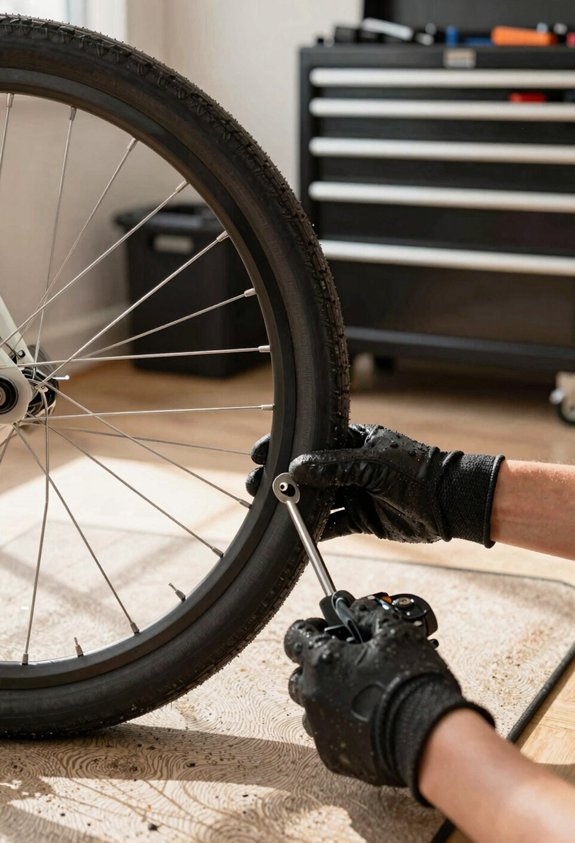
Where should you begin when preparing a bicycle for tire removal? I always start by securing the bike properly, either flipping it onto its side with the chain facing upward to prevent tipping, balancing it upside-down on the handlebars, or, when possible, working with a stand that provides excellent stability throughout the repair process.
To remove the wheel, particularly the rear wheel, I move the drivetrain into the smallest outer cog, which slackens the chain and simplifies detachment. I then address the brake, detaching any cables that might obstruct wheel removal, and proceed to either open the quick-release lever or, for nutted axles, use an appropriate wrench to loosen the hardware.
With tension eliminated, I lift the wheel from the forked slot, carefully guiding the chain aside. Before proceeding with tire lever insertion, rim inspection, tube deflation through the valve, or full tire separation, I record brake alignment and quick-release tension settings to guarantee smooth reinstallation.
Deflate the Tire and Release the First Bead With Levers
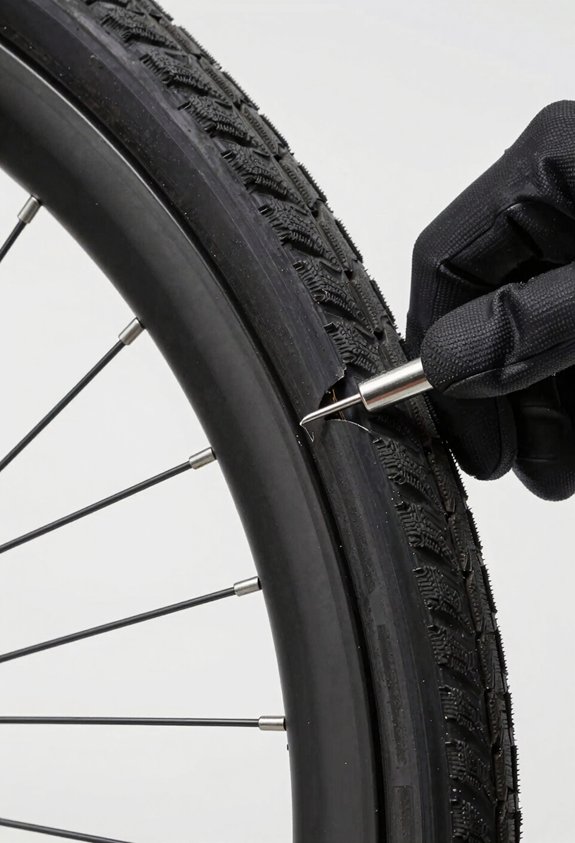
With the wheel now removed and secured before me, I’ll begin the deflation process by locating the valve stem, whether it’s the slender Presta type with its threaded locking nut or the wider Schrader variety resembling a car tire valve, and pressing upon it to expel every remaining ounce of air, followed by complete loosening of the valve mechanism (unscrewing the nut fully on Presta valves, or depressing the pin on Schrader until hissing ceases).
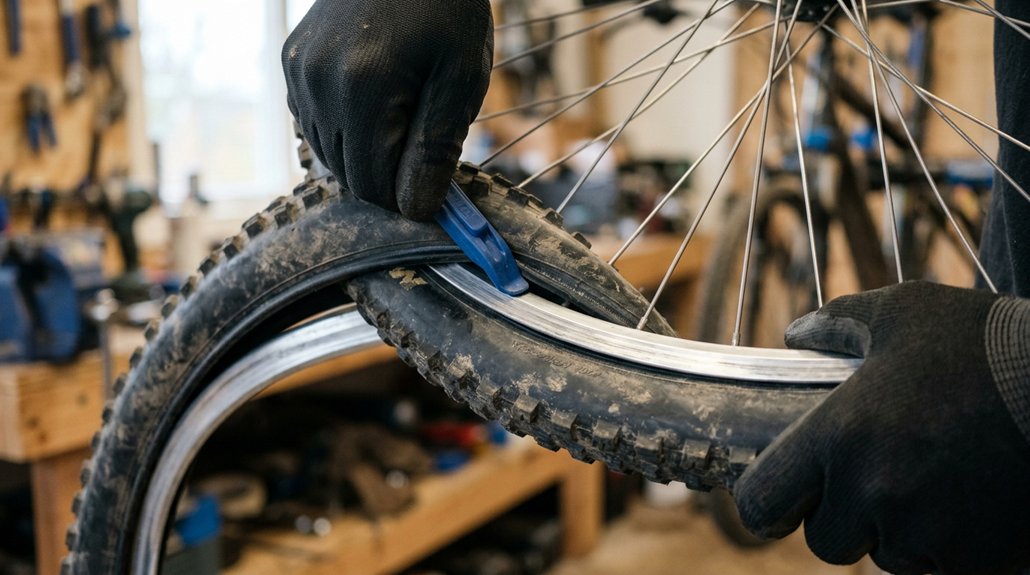
Once I’ve managed to deflate the tire completely, I’ll position my tire lever at the rim bead, working the curved end beneath the tire to pry the bead away from the rim. I’ll hook that first tire lever onto a spoke for stability, then I’ll grab my second of the two levers I’ll need, sliding it along the rim circumference to progressively lift, never force, the tire off its seat. This careful separation of bead from rim, working methodically around the wheel, prepares me to eventually remove the inner tube without damage.
Remove the Tire Completely and Extract the Inner Tube
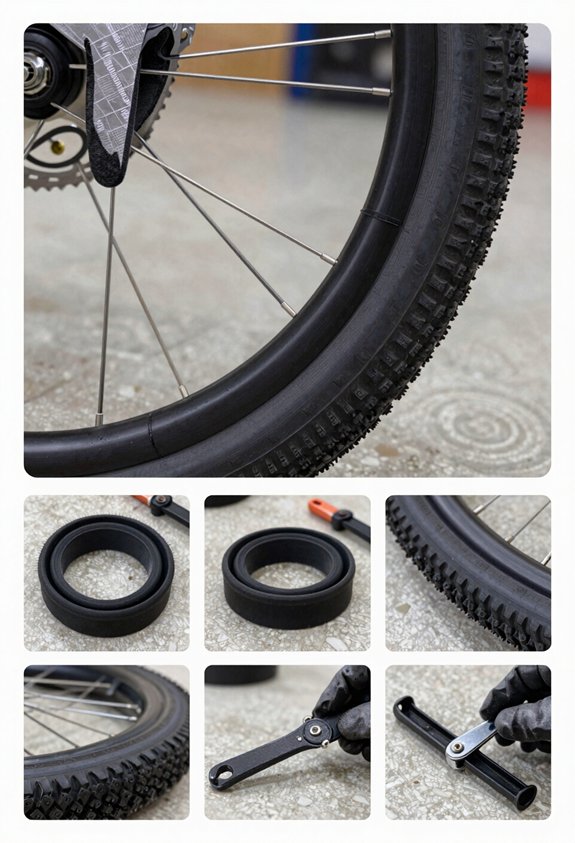
The first bead now hangs free from the rim’s edge, held in place by my hooked tire lever, and I’ll proceed to liberate the second bead so the tire may be fully separated from its rim. I grab a second tire lever, inserting it a few inches from the first, then work around the wheel’s circumference, prying the remaining bead over the rim until the tire loosens completely.
With both beads free, I locate the valve, push it through the rim hole, and carefully extract the inner tube, working it out from between tire and rim without snagging. I remove the tube fully, then inspect both it and the tire’s interior for any puncture, debris, or damage that could cause future flats before proceeding.
Inspect the Tube and Tire to Find the Puncture Cause
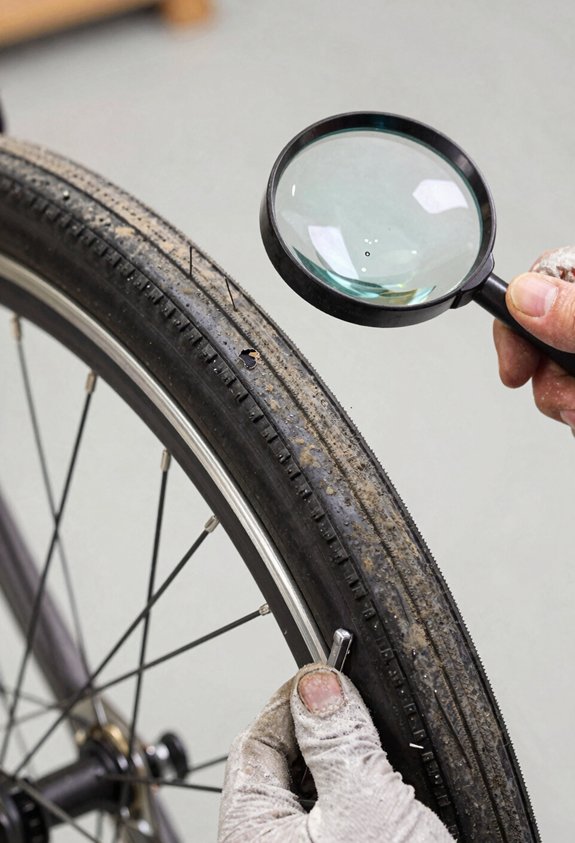
Why does a tire go flat? I’ve got the tube out, so now I need to find the puncture cause before I fix anything.
Inspect the Inner Tube
I’ll inflate the tube slightly or submerge it in water for leak identification at the valve stem and surface. This reveals bubbles where air escapes.
Check the Tire
I’ll inspect the tire inside wall for sharp objects still embedded, glass, metal, or thorns that caused the puncture. Running my fingers carefully, watching for cuts, finds hidden culprits.
Examine Rim Components
I’ll check the rim tape for tears or shifts exposing spoke holes, which create puncture paths. I’ll make sure the tire bead area had nothing trapped during removal, which complicates diagnosis.
Finding the true puncture source means I won’t repeat the same flat on my next ride with the crew.
Reinstall the Tire, Inflate, and Remount the Wheel
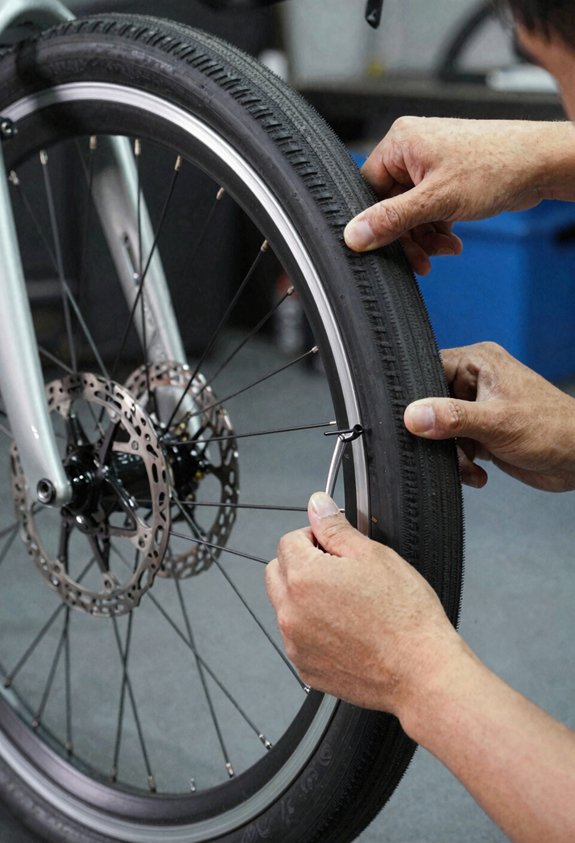
Since I’ve confirmed the tube and tire are free of damage, I’m ready to reinstall everything and get back on the road.
Reinstall the Tire and Seat the Bead
I’ll work the tire bead onto the rim by hand, pushing it into the rim bed to reduce tension, then I’ll use a tire lever only if necessary for that final stubborn section. For tubeless tires, I’ll make sure the bead pops into place with an audible snap.
Inflate and Check
I’ll attach my pump to the valve, inflating to the proper tire pressure listed on the sidewall, typically 80-130 PSI for road tires, lower for gravel or mountain applications. I’ll spin the wheel, checking that the tire sits evenly without bulges or pinches.
Remount the Wheel
I’ll slide the wheel into the fork, centering it between the blades, engaging the quick-release firmly. For rear wheels, I’ll route the chain onto the smallest cog first. I’ll reconnect brakes, squeeze to confirm pad clearance, and I’m ready to ride.