
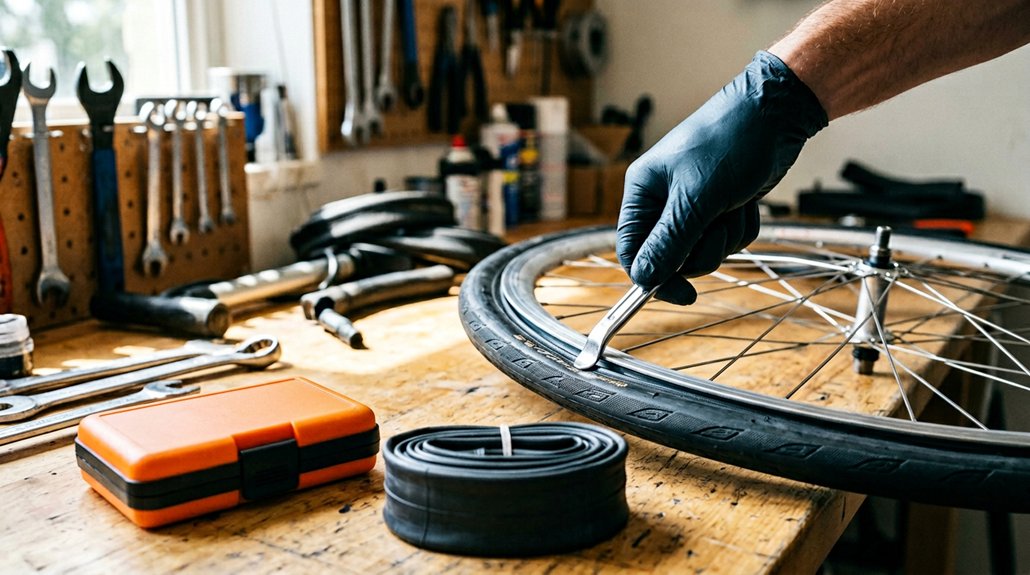
A flat tire is the cyclist’s inevitable betrayal: one moment you’re flying, the next you’re stranded. I’ve changed hundreds of tubes, and I’ll walk you through a process that’ll get you rolling again without the usual frustration.
You’ll need precision here, not panic.
Gather Your Tools and Supplies
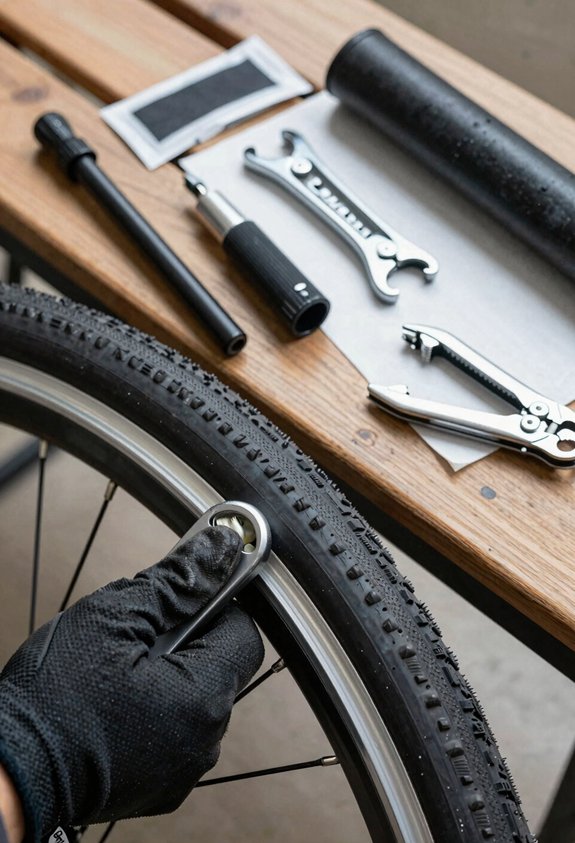
Proper preparation determines whether you’ll complete this repair efficiently or find yourself stranded with an incompatible tube, so I’ll walk you through assembling everything you’ll need before touching the wheel.
Proper preparation determines whether you’ll repair efficiently or find yourself stranded with incompatible parts, so assemble everything before touching the wheel.
Essential Tools
- Two tire levers (plastic prevents rim damage)
- Fresh inner tube matching your tire’s diameter and width (printed on sidewall: e.g., 700x25c, 26×2.0)
- Patch kit or spare tube
- Pump with pressure gauge
- Wrench or quick-release tool
Workspace Setup
Secure a bike stand or stable surface; inadequate support risks frame damage and complicates bead seating during reassembly.
Specialized Supplies
- Soapy water or tire lubricant (aids stubborn bead seating, especially with tight tubeless-ready rims)
- Flashlight for interior tire inspection
- Container for extracted debris
Critical Verification
Inspect your inner tube‘s valve stem length matches your rim depth, and confirm tire compatibility. Mismatched sizes guarantee failure regardless of technique.
Remove the Wheel From Your Bike
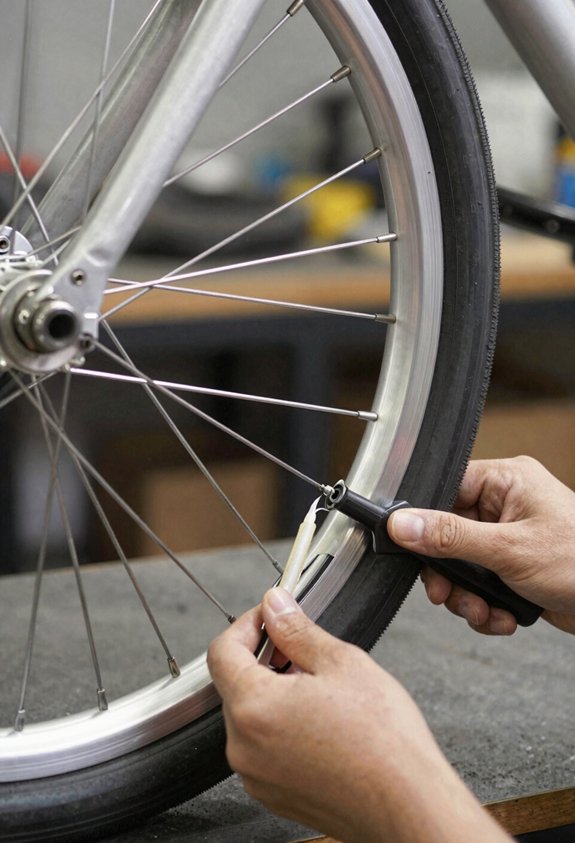
Before I’m able to touch the tire or tube, I’ve got to get the wheel free from the frame, and this initial extraction demands methodical attention since rushed handling risks derailleur damage, brake cable strain, or frame scratches that invite corrosion. You’ll want to stabilize the bike, shift to the outer gear, and either use a proper stand or carefully invert it for access. Precision here builds confidence, and confidence builds competent cyclists who belong on the road.
- Loosen axle nuts or quick-release just enough to free without fully removing
- Pull back the derailleur to create chain slack, guiding past the tire bead area
- Disengage brakes per manufacturer specs, then remove wheel past valve stem position
Deflate the Tire Completely
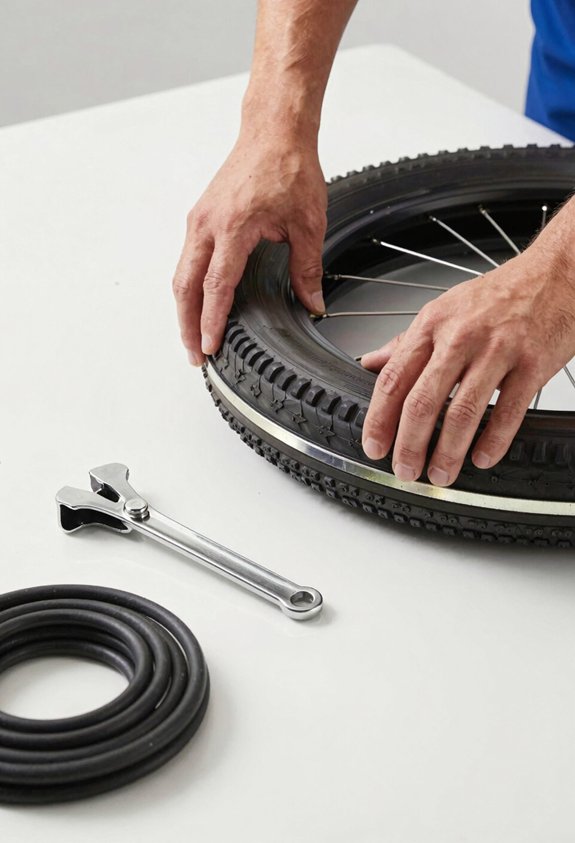
Why risk damaging your tube or struggling against pressurized resistance when complete deflation makes every subsequent step measurably easier? I always deflate the tire completely before touching the bead, and you should too: residual pressure creates dangerous tension that pinches tubes and warps rims when you force matters.
Valve-Specific Procedures
- Presta valve: Unthread that tiny locknut crowning the valve tip, then depress the exposed stem until airflow ceases entirely: never skip this unlocking step, or you’ll fight sealed resistance needlessly.
- Schrader: Simply press the inner plunger.
- Dunlop: Unscrew, then pull outward.
Verification Techniques
Press your weight onto the wheel while keeping the valve depressed. This mechanical advantage expels stubborn pockets hiding in thick-walled tubes. Though no pressure gauge reads absolute zero, sustained silence at the valve confirms satisfactory evacuation.
Fully deflated tires yield slack beads, protecting your investment and patience alike.
Pry One Tire Bead Off the Rim
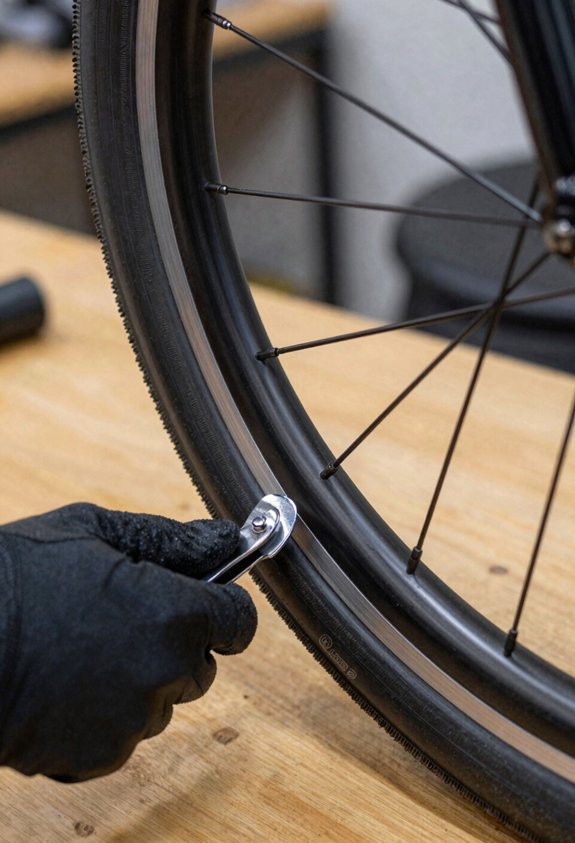
Lever Positioning Technique: I’ll push the tire bead toward the rim center first, creating slack that makes lever insertion far less risky. Skip this step and you’ll fight unnecessary resistance, possibly damaging the bead. I insert my first lever under the loosened bead, then place the second 1–2 inches away to establish a working gap, moving both progressively to pry the bead over the rim edge until it’s fully loosened.
Hand Pressure Method: Once the bead’s loose, I slide one lever beneath it and work methodically around the rim, no rushing, no sharp tools near your fingers, until the tire frees completely from that side.
Lever Positioning Technique
Where exactly should you place your tire levers to avoid damaging the tube or rim? I position my first lever under the bead, then place a second lever 1–2 inches away to create that crucial initial gap between bead and rim.
Here is the technique I follow:
- Push the bead toward the rim center with both levers while keeping them parallel to the rim, preventing any pinching of the inner tube
- Work in small, successive steps around the rim, progressively lifting the bead off the edge rather than forcing large sections
- Slide and repeat once a section frees, sliding the lever under the bead and continuing around the entire circumference
After freeing one side completely, I remove the inner tube first before addressing the remaining bead. This prevents unnecessary stress on both the tube and rim during removal.
Hand Pressure Method
The hand pressure method offers a lever-free alternative for separating the tire bead from the rim, though I’ll typically use it when the tire fits relatively loosely or when I’m working with delicate rim materials that could scratch under metal lever pressure.
Preparation and Initial Separation
First, I deflate the tire completely, pressing downward on the wheel while depressing the valve to eliminate residual air and reduce tube tension. I position one hand roughly four inches from the tire’s opposite edge, then use my thumbs to push the tire inward and upward, working the wall over the rim edge.
Completing the Bead Release
Keeping one hand outside the rim for stability, I continue the inward-outward pressing motion to lift and loosen the first bead. As separation begins, I slide a finger under the loosened portion, working it around the rim circumference.
Once one bead is free, I push the tube and remaining bead off by hand, avoiding pinches.
Remove the Old Tube
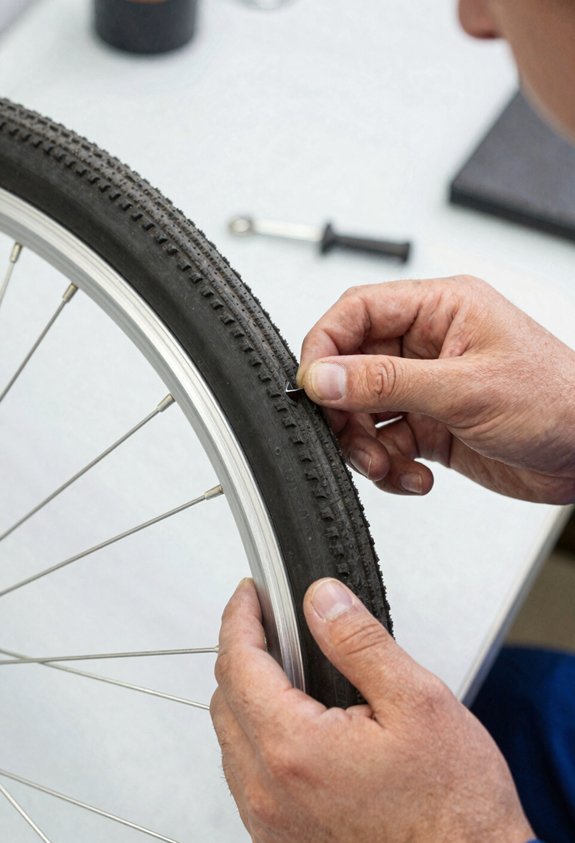
Begin by fully deflating the tire, a critical preliminary step that eliminates internal pressure and allows the bead to separate cleanly from the rim without resistance or risk of pinching the tube.
Once deflated, I’ll work the tire wall over the rim edge with both hands, keeping the opposite side seated. Here’s how I free the inner tube:
- Push the valve stem upward through the rim cavity, then extract it sideways once a tire section clears
- Pull the remaining tube from between tire and rim, making certain of complete detachment from all surfaces
- Use the tire lever only as final recourse, inserting it beneath the bead with extreme caution to prevent puncturing the inner tube
This methodical approach preserves my equipment while preparing me for the next phase of repair.
Find What Caused the Flat
How I’ll pinpoint the exact breach determines whether I’m merely patching a symptom or truly solving the problem. I begin by adding inflation to the tube, pumping it until it reaches twice its normal width, which expands the material and exposes hidden weaknesses.
For precise leak detection, I submerge the tube in water or apply soapy water, watching carefully for bubbles that betray the puncture‘s location. Once found, I mark the hole with four surrounding indicators to assess whether repair is viable or if replacement becomes necessary.
I then examine the tire casing, rim strip, and bead with equal scrutiny, searching for embedded debris, abrasions, or protrusions that threaten repeat failure. This thorough investigation prevents the frustration of recurring flats, so my repair investment lasts beyond the immediate fix.
Partially Inflate the New Tube
I partially inflate the new tube to give it just enough shape to hold its form, though I keep the pressure low enough that it remains pliable and easy to manipulate. This careful control of inflation amount prevents the tube from becoming rigid, which would complicate insertion and increase the risk of pinching or twisting between the tire and rim.
I also make sure the valve stem stays aligned with the rim hole during this process, as proper positioning now prevents kinking or uneven stretching that could compromise the installation.
Inflation Amount Control
Why struggle with a flaccid tube that collapses during installation when a controlled amount of air transforms it into a manageable, shape-holding component? I’ve found that adding just enough pressure to give the tube structural integrity, without creating resistance during placement, strikes the essential balance.
- Assess tube firmness: Inflate until the tube feels slightly resilient, allowing gentle squeezing without collapse
- Verify maneuverability: Confirm the tube bends easily while maintaining its circular cross-section
- Check for consistency: Make sure uniform firmness throughout, eliminating soft spots that indicate uneven inflation
This controlled approach prevents over-inflation that complicates the next steps, while providing sufficient shape retention. I always stop inflating once the tube holds its form, saving full pressure application for after proper tire seating.
Tube Shape Formation
A partially inflated tube transforms from a limp, unmanageable membrane into a structured component that installs cleanly without twisting or folding. I’ll add just enough air, roughly five to ten pumps, to establish basic tube shape without rigidity.
I position the valve stem straight or with a slight natural angle, then insert it through the rim hole before working the tube between tire and rim. I start at the valve, pushing the tube evenly into place to avoid trapping twists. I verify seating beads sit properly in rim beds, making sure no tube material protrudes beneath.
This preliminary inflation stage demands restraint; overinflation risks pinching during bead reseating, while underinflation permits fold formation. I perform final twist checks before progressing.
| Tube Condition | Air Volume | Risk Level |
|---|---|---|
| Flat/limp | Zero pumps | High twist potential |
| Basic shape formed | 5-10 pumps | Optimal for installation |
| Firm/overinflated | 15+ pumps | Pinch flat risk |
| Fully seated beads | Full inflation | Ready for use |
Install the Valve and Feed the Tube Into the Tire
Where exactly does the valve stem need to sit before you push anything through the rim?
Position the valve stem straight over the rim hole, never angled, to prevent leaks and ensure proper seating under pressure.
I align the valve stem directly over the rim hole, making sure it’s straight and not angled, which prevents future air leaks and guarantees proper seating. This positioning matters because a bent valve will fail under pressure.
Tube Insertion
Once aligned, I squeeze the tire sides to push the valve stem through the rim hole, pulling until most of it appears on the tire side. I inflate the tube minimally, just enough to hold its shape, before beginning tube insertion.
Feeding the Tube
- Start inserting the tube near the valve, working outward evenly
- Avoid twists by maintaining consistent tension as you progress around the rim
- Rotate the wheel gently to confirm the valve stem sits straight and the tube isn’t pinched
Seat Both Tire Beads on the Rim
I check for uniform bead placement by spinning the wheel slowly, watching for any section where the bead line sits unevenly relative to the rim wall. When I spot a shallow spot, I massage the tire laterally to coax the bead deeper into the rim bed, making sure no inner tube material protrudes before proceeding.
Inflate, Check Bead Seating, and Test
With full inflation comes the critical verification phase, where meticulous attention prevents catastrophic failure on the road. I’ll guide you through this process, checking your tire’s integrity before you ride.
Here’s my systematic approach:
- Inflate partially: I pump to low pressure first, stopping to inspect bead seating on both sides, watching for bulging upward or dipping downward lines that signal improper seating.
- Verify position: I rotate the tire, checking that bead seat lines sit evenly above the rim edge. If I spot irregularities, I deflate and reseat, applying soapy water as lubricant when stubborn spots resist.
- Confirm integrity: I inflate fully through the valve, then wait, checking with a pressure gauge that the tire holds stable pressure, confirming no hidden twists or pinches remain trapped inside.