
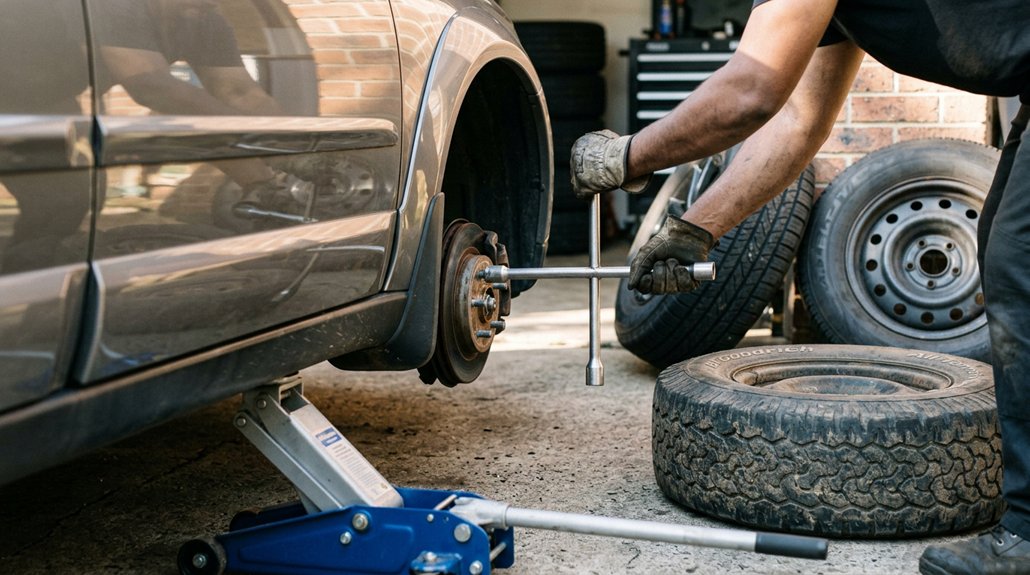
I’ll walk you through removing a tire safely, but first, you need to understand that skipping even one preparatory step risks serious injury or vehicle damage. Most drivers don’t realize their factory jack has specific lift points; ignore them, and you’ll crush a frame rail or worse.
I’m going to show you exactly where to find those points, why loosening lug nuts before lifting matters, and what most instruction manuals leave out about securing your vehicle on anything less than perfectly level ground. The first step isn’t what you’d expect.
Park on Flat, Firm Ground Away From Traffic
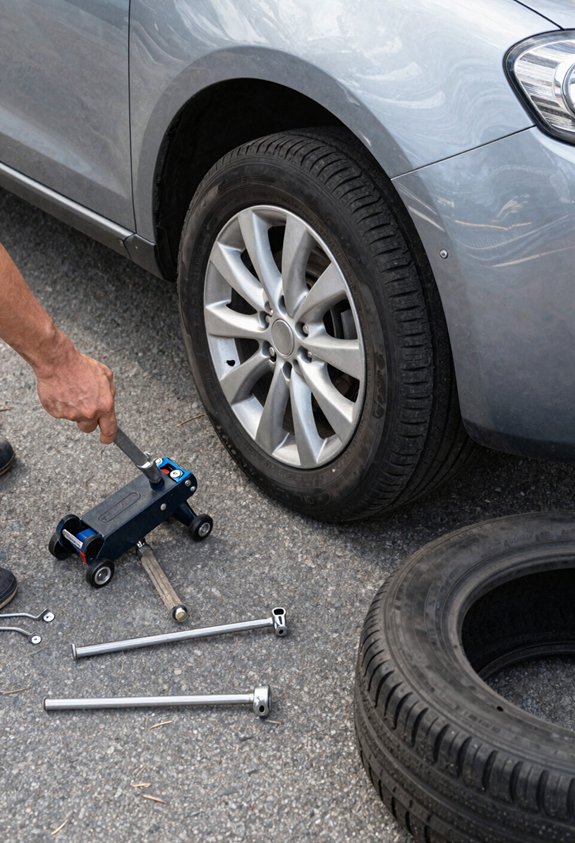
The first thing I’ll do when I realize I’ve got a flat is find a place where my vehicle won’t roll, and that means seeking out flat, firm ground well away from moving traffic, because nothing matters more than preventing the car from shifting while I’m working underneath it. I’ll look for a level parking lot or wide shoulder, avoiding hills and curves where visibility drops and my workspace becomes unstable.
Once I’ve stopped, I’ll activate my hazard lights immediately to warn approaching drivers. Then I’ll apply the parking brake fully and position wheel wedges (or sturdy blocks, rocks, or lumber) against the tires opposite my flat to eliminate any rolling risk.
This flat ground foundation gives me room for my tools and spare without blocking lanes or endangering pedestrians nearby.
Gather Your Tire Change Tools First
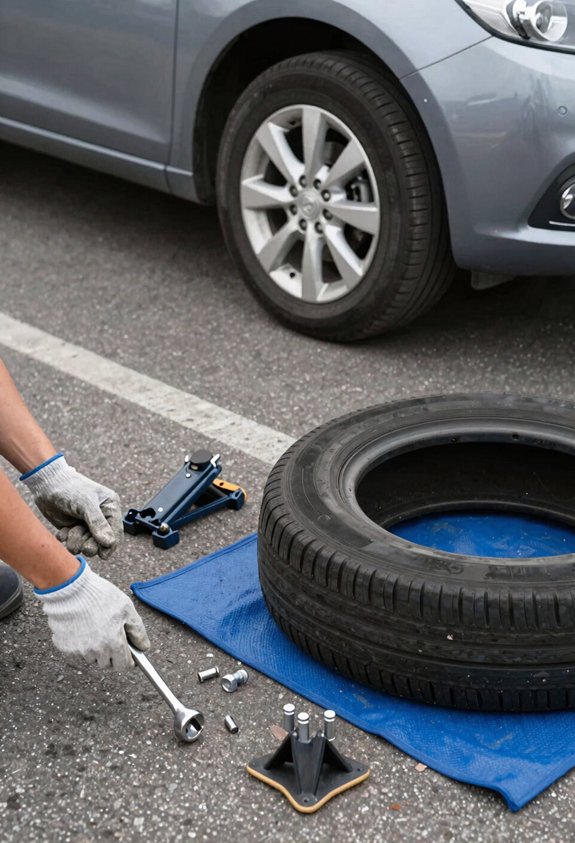
Essential Tools
- Spare tire (inflated, checked for cracks)
- Lug wrench (proper size for your bolts)
- Jack (with wooden block, if terrain is soft)
- Owner’s manual (for locating jack points)
- Working flashlight (for low-light conditions)
I check the owner’s manual to confirm jack points, these reinforced metal ribs, usually behind front wheels or ahead of rear wheels, prevent frame damage. I also prepare signaling gear for visibility, so I’m ready before any lifting begins.
Secure the Vehicle With Brake and Wedges
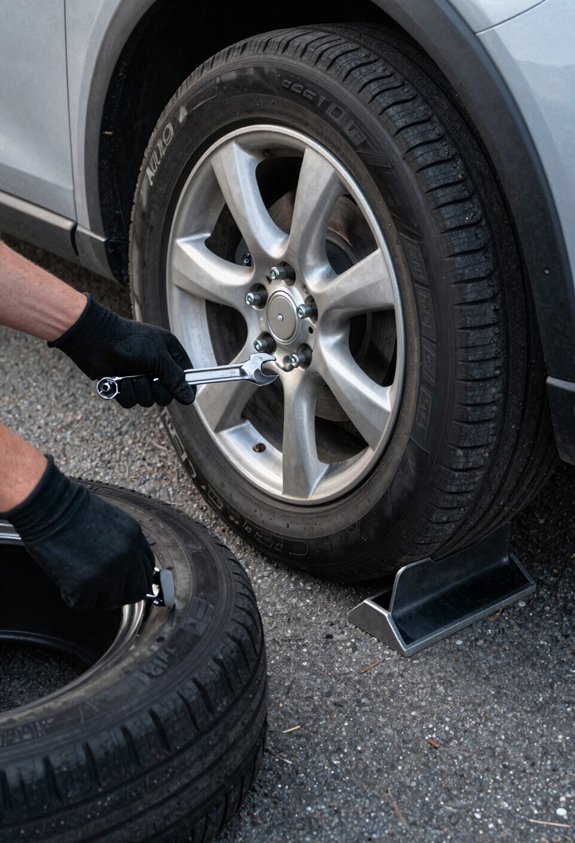
With my tools arranged and jack points confirmed from the manual, I now turn my attention to immobilizing the vehicle completely, because even a slight shift in weight distribution during lifting can create catastrophic instability. I engage the parking brake firmly, feeling the resistance as the mechanism locks the rear wheels, then I position wheel wedges against the tire opposite my working corner; stone or timber substitutes suffice if commercial wedges aren’t available.
I verify the vehicle is secure, not rolling, by rocking the bumper gently before proceeding.
| Safety Component | Function & Verification |
|---|---|
| Parking brake | Locks drivetrain to prevent wheel rotation under load |
| Wheel wedges | Create physical barrier against gravitational roll on inclines |
| Combined systems | Redundant protection ensuring zero movement during lifting |
I check that both systems engage properly, protecting us from harm.
Loosen Lug Nuts Before Lifting the Car
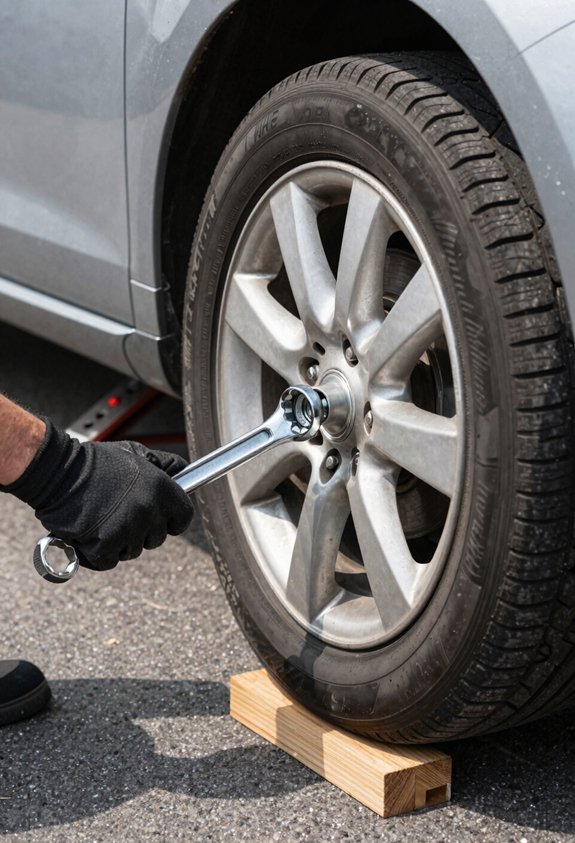
Why would one attempt to loosen fasteners on a freely rotating wheel suspended in mid-air? You wouldn’t, and that’s why I always loosen lug nuts with the wheel on ground.
Preparation Steps:
- Pry off the hubcap (if present) to access the hardware
- Engage your lug wrench (or special adapter for wheel locks)
Execution:
I position the wrench on each nut, then apply steady counter-clockwise force. Sometimes I’ll use my body weight to break stubborn ones free. The wheel on ground prevents rotation, giving me purchase I couldn’t get otherwise.
Critical Warning: I loosen only until resistance eases, never fully remove them here. Once the car’s lifted, that partially freed hardware spins off by hand, keeping me safely between stepwise progression and avoidable hazard.
Position the Jack at the Correct Lift Point
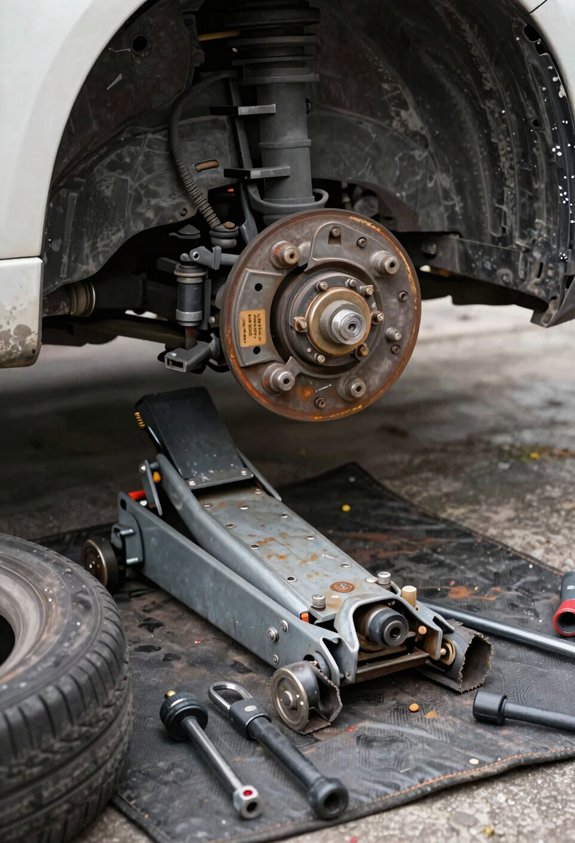
Although the ground provides stability when I’m loosening hardware, I cannot reach the tire once I’m done, which is why proper jack placement becomes my immediate priority before lifting begins.
I locate the Designated Lift Point by checking my owner’s manual, then find the matching spot on the chassis or frame, never on panels, plastic, or corroded metal. I position the jack so it contacts solid, non-corrosive structure, making certain of full surface contact for stability. I raise it slowly until supporting weight (not lifting fully), giving clearance to finish removing lug nuts.
I verify stability—wiggle testing, checking angles—before proceeding. I keep no body part beneath the vehicle; jack stands are essential for under-car work. Correct lift point placement prevents chassis damage and injury.
Raise the Vehicle Until the Tire Clears the Ground
I raise the vehicle by pumping the jack handle with steady, controlled force, stopping once the tire hangs approximately 4-6 inches above the ground, enough clearance to slide it off without scraping the fender or pavement. I verify the jack remains seated firmly on its designated lift point throughout this process, watching for any shifting or settling that might compromise stability.
If I have jack stands available, I position one under a secure frame section before proceeding, since relying solely on the hydraulic jack introduces unnecessary risk during the wheel removal phase.
Proper Jack Placement
The correct jack placement begins with identifying the precise lift point designated by your vehicle’s manufacturer, a detail I’ll typically find in the owner’s manual (often marked with a diagram in the roadside emergency section) or stamped directly into the chassis frame rail. I can’t stress enough that positioning the jack on a body panel, such as a rocker panel seam, floor pan, or suspension component, risks crushing the structural element or creating an unstable fulcrum that’ll shift during lifting.
- Position your jack at approved lift points on the frame, never on body panels, making certain the saddle seats flat against the reinforced pinch weld or designated structural member.
- Verify ground stability by confirming level, solid surfaces; soft ground causes sinking and catastrophic tip-overs.
- Raise slowly until the tire clears 4-6 inches, maintaining jack stability for safe wheel removal.
Safe Lifting Height
Why risk instability when precision matters most? I raise the jack steadily until the tire clears the ground roughly 4–6 inches, 10–15 cm, above the surface, making sure there’s adequate clearance for removal without obstruction from the ground or nearby fenders.
Ground Stability
I check that the ground beneath the jack remains level and firm throughout lifting, since shifting terrain compromises vehicle support when I need it most. I stop immediately once sufficient clearance exists. Excessive height destroys stability and invites dangerous tipping.
Additional Safety Measures
If I’m using jack stands, I place them beneath secure frame points immediately after reaching target clearance, creating redundant support. I never gamble with height: just enough clearance protects me, my vehicle, and everyone relying on solid technique.
Remove Lug Nuts and Pull Off the Flat Tire
- Examine wheel studs for bending, rust, or thread damage before proceeding
- Check the brake surface and hub area for debris, corrosion, or fluid leaks
- Verify no obstructions remain that would prevent proper seating of the replacement
I take this moment to inspect everything thoroughly; rushing here compromises safety.
Mount the Spare Tire Onto the Wheel Studs
With the wheel studs, brake surfaces, and hub area now inspected and cleared of any debris or damage, I position the spare tire so its bolt holes line up with the wheel studs, noting that proper alignment prevents cross-threading and supports even seating. I mount the spare tire by pushing it firmly onto the hub until it seats fully on all wheel studs, engaging each stud through the corresponding bolt hole.
I grab the lug nuts and thread them onto the wheel studs by hand, tightening each one just enough to hold the spare tire securely while the car remains raised. I’m careful not to use a lug wrench at this stage; hand-tightening suffices until the vehicle lowers. If I’m using a donut spare, I check its speed and distance limits before proceeding.
| Spare Type | Critical Precaution |
|---|---|
| Full-size spare | Verify tire pressure matches other tires (typically 30-35 PSI) |
| Donut/Temporary | Observe speed limits (usually 50 mph maximum) |
| Compact spare | Replace within manufacturer distance (often 50-70 miles) |
| All types | Hand-tighten lug nuts only; no wrench until grounded |
| Mounting check | Confirm all wheel studs engage before lowering vehicle |
Tighten Lug Nuts by Hand in a Crisscross Pattern
Now that the spare tire is seated on the hub and each lug nut is started by hand, how do I guarantee the wheel won’t warp or seat unevenly when I apply final torque? I use a crisscross pattern, which evenly distributes pressure across the wheel face, preventing distortion that could compromise safety during subsequent wheel removal procedures.
- Thread each lug nut by hand first, ensuring cross-threading doesn’t occur, which I’d notice during the initial loosen phase of tire changes past.
- Apply firm hand-tightening in a star sequence, moving across the hub diagonally rather than circling adjacent studs, maintaining balanced contact pressure.
- Verify each nut is equally snug before stopping, since uneven tightening causes rotor runout and vibration, complicating future lug nut loosen operations when roadside repairs become necessary again.
Lower the Car and Tighten Lug Nuts Fully
How does one transition from hand-tightened hardware to a fully secured wheel assembly without introducing the very runout risks I’ve just worked to prevent? I lower the car carefully, letting the tire contact the ground while the jack still supports partial weight, never fully removing jack placement until I’ve completed the initial securing phase.
At this critical midpoint, I tighten lug nuts in a criss-cross pattern, bringing them to snug contact with consistent, controlled force that seats the wheel evenly against the hub. Once satisfied with this preliminary tension, I fully lower the car, withdraw the jack, and then perform my definitive tightening sequence.
I verify each lug nut meets proper torque specification, understanding that uneven clamping invites distortion. I’ll revisit tightness after 40–60 km, when thermal cycling may have affected my work.
Check Spare Tire Pressure and Driving Limits
Before you install the spare, verify its pressure with a reliable gauge, ensuring it meets the manufacturer’s specified PSI (typically 30–60 psi for compact temporaries, 35–38 psi for full-size spares), since an underinflated spare compromises vehicle stability and your safety.
Also identify whether you’re dealing with a temporary donut, restricted to 50–80 km/h (30–50 mph) and 70–110 km total distance, or a full-size spare permitting normal operation. Exceeding these Driving Limit Guidelines risks tire failure, differential damage, or loss of control.
These Pressure Verification Steps and operational boundaries aren’t suggestions; they’re mandatory constraints to follow to prevent catastrophic outcomes when your vehicle relies on compromised equipment.
Pressure Verification Steps
Why risk a second breakdown when a quick pressure check could save your trip? I’ve learned that verifying spare tire pressure keeps our whole crew rolling safely, so I always check before stowing that tire jack.
Pressure Verification Steps
- I grab my air pump, portable or station-mounted, and inflate the spare to the manufacturer-listed PSI, typically 60 psi for compact spares, before I ever loosen those lug nuts.
- Once I’ve tightened everything and lowered the vehicle, I recheck pressure after driving one to two miles, since temperature buildup from friction alters readings noticeably.
- I mark my calendar for immediate tire shop inspection, knowing temporary spares demand prompt replacement.
We drivers stick together through smart preparation. A properly inflated spare, verified twice, prevents roadside vulnerability and preserves vehicle handling integrity under load-bearing operation.
Driving Limit Guidelines
Where exactly can you drive once that spare is mounted, and for how long? I always check my spare tire pressure before installing it, since an under-inflated spare compromises handling and vehicle safety. My driving limits are strict: temporary spares, commonly called donuts, demand reduced speeds, typically 50 mph maximum, and limited distances, often 50-70 miles. I don’t exceed speed recommendations because these smaller tires carry reduced loads and wear rapidly.
Critical Post-Installation Steps
Recheck lug nut tightness after the vehicle cools and the tire settles. Monitor for vibration or unusual handling.
If I notice anomalies, I stop immediately and seek professional assistance rather than risking continued operation. Following manufacturer guidelines protects everyone sharing the road.
Recheck Lug Nut Tightness After a Short Drive
How frequently should critical fasteners be revisited after initial installation? I know you’ll want to get this right, so here’s what I do after every drive after change.
Once I’ve lowered the car and tightened my lug nuts in a crisscross pattern, I perform a second pass to make sure of proper torque. But I don’t stop there, I make it a point to recheck everything after the wheel goes through its first heat cycle.
- Drive 25–37 miles (40–60 km) to let the wheel expand from heat before checking
- Verify all lug nuts remain fully tightened, using a torque wrench for accuracy
- Complete this final check as part of your post-change safety routine before continuing
I never skip this step, it keeps us all safe on the road together.
Stow Your Tools and Flat Tire Properly
I’ll organize my tools and flat tire with the same care I took during the removal process, knowing that a haphazardly stowed jack or unsecured spare can become lethal projectiles in a collision. Tool Organization Tips, which I’ll outline next, include securing the jack, lug wrench, and wheel chocks in their designated compartments or with cargo straps to prevent shifting during abrupt stops or turns.
For Flat Tire Storage, I’ll position the removed tire flat or upright against a stable surface, avoiding heat sources like exhaust components that can accelerate rubber degradation. I’ll also verify that my spare maintains proper inflation, typically 60 psi for compact temporary spares, though I’ll consult my owner’s manual, before closing the trunk.
Tool Organization Tips
When preparing for a tire change, why risk delays or misplaced equipment? I keep my spare, lug wrench, jack, and tools together in a designated spot so we’re ready to roll as a team.
Here’s how I stay organized:
- Corral your hardware: I stash lug nuts in an upturned hubcap or small container so nothing scatters across the pavement.
- Secure your foundation: I verify my jack sits flat and stable before lifting, preventing dangerous shifts that could compromise the entire operation.
- Return everything home: I immediately stow my lug wrench, jack, and tools back in their storage location after lowering the vehicle, eliminating movement hazards while driving.
We’re in this together. Check that your spare holds proper inflation, confirm tool accessibility, and never leave equipment loose. Precision now prevents catastrophe later.
Flat Tire Storage
The moment a flat tire comes off, my priority shifts immediately to proper storage, because a loose wheel bouncing in your trunk or tools scattered across the cargo area creates hazards that compound an already stressful situation. I secure every lug and tool in their designated compartments, keeping nothing from becoming a projectile during transit. I place the removed tire flat in the cargo area or, when applicable, reposition it where the spare originated.
Spare Tire Accessibility and Pressure Maintenance
I verify my spare tire remains properly inflated, typically 60 psi for donut spares, though full-size spares match standard tire pressure, checking with a gauge before storing equipment. I note whether I’m running a temporary donut, which carries strict speed limits near 50 mph and range restrictions around 70 miles, or a full-size replacement allowing normal operation, scheduling mechanic service to restore my original equipment tire.
Wheel Position Documentation
I label each tire’s original position before storage, making certain future rotations and reinstallation follow proper patterns.