
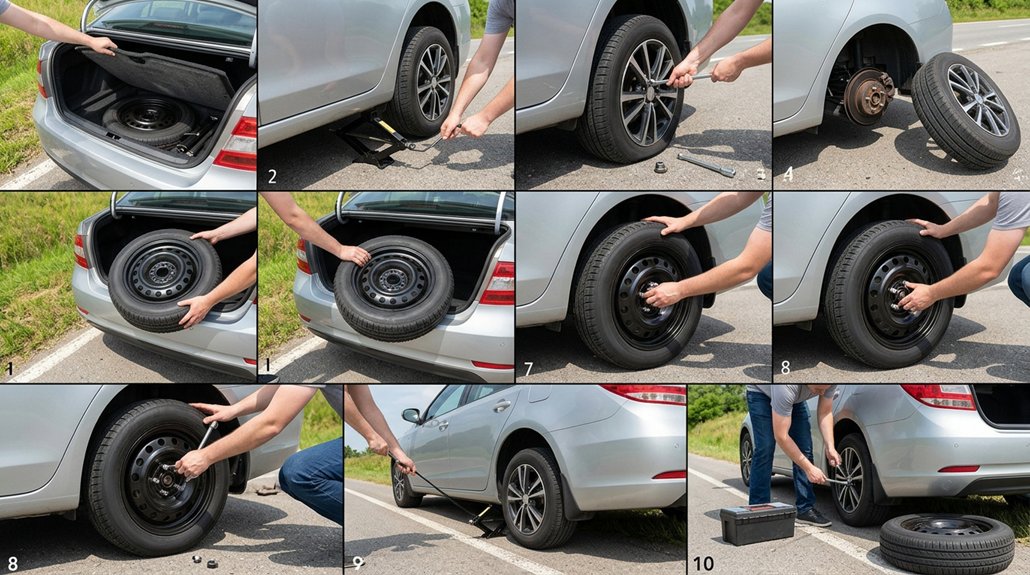
I’ve changed more tires than I care to count, and I’ll tell you this: most failures happen before the jack ever touches metal. You need level ground, engaged parking brake, and wheel chocks; skip any one, and you’re risking thousands in bodywork or worse.
The sequence matters, torque specs matters, and that donut in your trunk? It’s not built for speed. I’ll walk you through exactly what I do, step by step, because getting this wrong can strand you, or put you in the path of traffic when the car slips.
Safety First: Secure Your Spot Before Any Tools Come Out

Before I loosen a single lug nut or position the jack beneath the frame, I must establish a controlled environment that eliminates the variables most likely to cause injury or equipment damage. I park on level, solid ground, never soft shoulders or inclines, and immediately engage the parking brake, which locks the rear wheels against unintended movement while I work.
I activate my hazard lights, alerting passing motorists that my vehicle is temporarily disabled, and I scan my surroundings for traffic patterns, visibility conditions, and stable footing before proceeding. If I have a wheel chock, I wedge it firmly against the tire opposite my work area; otherwise, I improvise with a rock or wooden block.
I retrieve my spare tire, jack, and lug wrench, arranging them within arm’s reach so I never place my body beneath an unsupported vehicle. When conditions compromise my safety, poor lighting, unstable ground, or proximity to moving traffic, I stop and seek professional assistance rather than risk catastrophic failure.
Gather These Four Must-Have Items (and Skip the Extras)
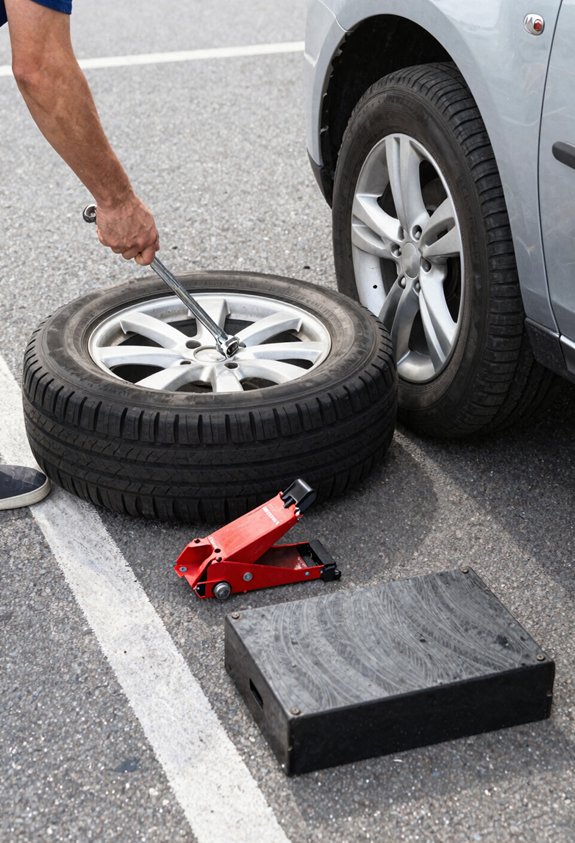
I gather four mandatory items before I touch a single wheel component, and I’ll ignore every accessory that doesn’t directly contribute to completing the tire change.
Required Equipment
- Spare tire, I verify it’s inflated, damage-free, and matches my vehicle’s specs before relying on it.
- Lug wrench, I confirm it fits my lug nut pattern; if locking lug nuts exist, I locate the key immediately.
- Jack, I identify proper jack points in my owner’s manual to prevent frame damage.
- Owner’s manual, I review it for hubcap removal procedures and tool locations.
Optional Items I Skip
Wheel chocks and portable tire inflators help, but I won’t delay my task gathering non-essentials. I retrieve these four items, confirm I understand each tool’s function, and position everything within arm’s reach before proceeding.
Loosen Lug Nuts Now: While the Tire Still Touches Ground
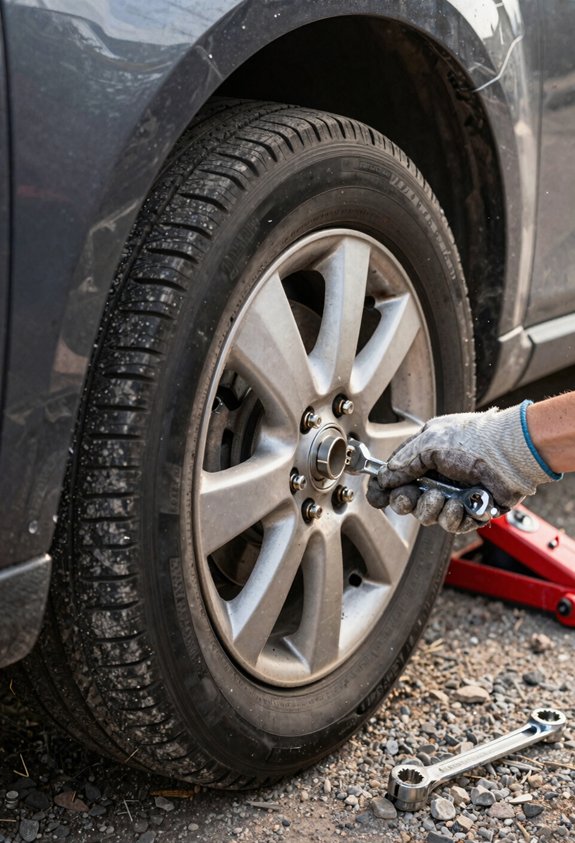
The critical first step in the actual tire-changing process demands that I loosen the lug nuts while the tire maintains full contact with the ground, a precaution that prevents the wheel from spinning freely once the vehicle is elevated.
Ground Contact: Your Stability Advantage
With the vehicle stable, I position my lug wrench on the lowest bolt first, applying steady counterclockwise pressure to break resistance. Gravity works with me here, giving me leverage I won’t have later. I work in a star pattern, loosening each nut partially, perhaps half a turn, without complete removal. This preserves safety during wheel removal preparation.
Essential Access Steps
If hubcaps conceal my hardware, I pry them off carefully before attempting to loosen lug nuts. I collect these partially freed fasteners immediately, securing them in my pocket or a designated container. Losing even one piece of critical hardware strands the entire operation, leaving me stranded without recourse.
Find Your Jack Point (Wrong Spot Risks Serious Damage)
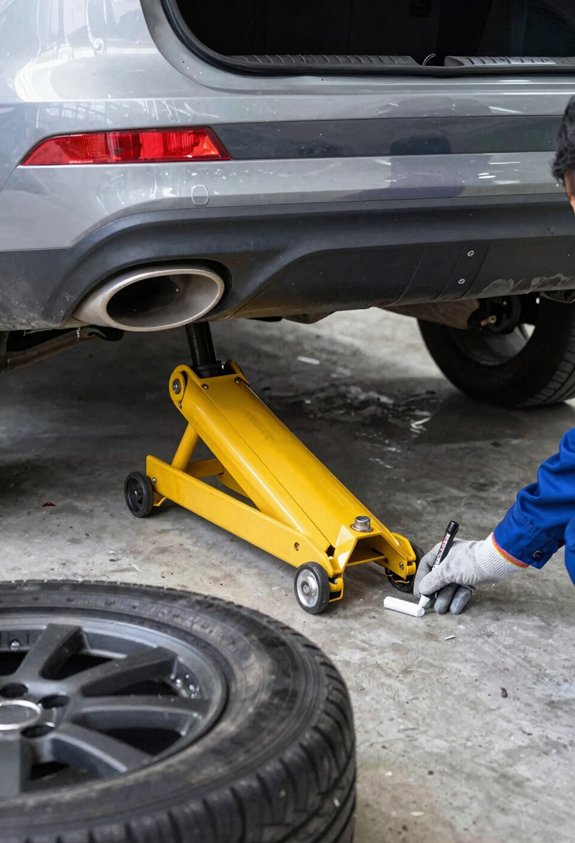
I always consult my owner’s manual first, since manufacturers place specific frame markings: often notches, arrows, or reinforced pinch welds, at engineered load-bearing points designed to withstand concentrated hydraulic pressure without compromising structural integrity.
When I locate these indicators, typically positioned behind front wheels or ahead of rear wheels along the rocker panel seams, I’m making sure the jack seats flush against double-layered steel rather than thin floor pans or fuel lines that would crush, puncture, or destabilize under 3,000–4,000 pounds of distributed vehicle weight.
Misidentification risks aren’t merely cosmetic: I’ve seen misplaced jacks punch through unibody rails, sever brake lines, or slip entirely, dropping the vehicle onto rotors, suspension components, or worse, myself, so I verify the ground contact patch visually and physically before pumping a single stroke.
Consult Owner’s Manual
Where exactly should you position your jack before lifting thousands of pounds of metal? I grab my owner’s manual first, because every vehicle hides its jack points in specific locations I can’t guess. The manual shows exactly where reinforced metal meets the frame, spots engineered to bear compression without buckling.
| Manual Section | What I Verify | Risk If Ignored |
|---|---|---|
| Jack Point Diagram | Position near wheel being lifted | Suspension damage, frame twist |
| Weight Rating | Pinch weld flush against saddle | Jack collapse, vehicle fall |
| Pre-Lift Check | Stability before full raise | Spare tire installation failure |
I follow the diagram religiously, never improvising on untested components. After loosening lug nuts, I recheck my placement before committing to the lift. We’re in this together, getting that spare tire mounted safely without costly mistakes.
Locate Frame Markings
I verify my chosen jack point rests level on flat ground, aligning the jack directly beneath the marked indicator. This precision maintains structural integrity throughout the lift, turning proper safety protocol into shared mechanical competence every driver deserves.
Raise the Car Until Your Flat Tire Clears the Ground
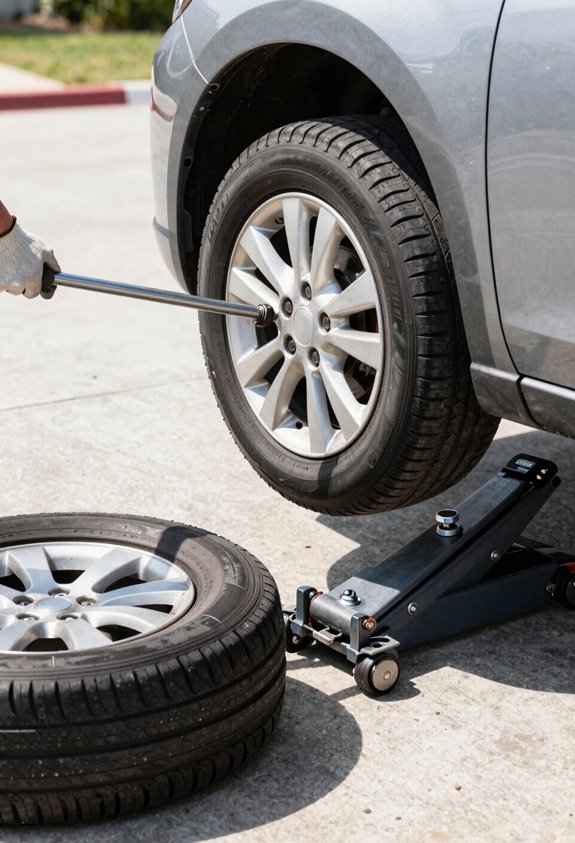
How much lift does your vehicle actually need? You’re targeting 3–6 inches (7.5–15 cm) of ground clearance, enough to let that flat tire swing free without scraping asphalt.
I position my jack beneath the marked frame point nearest the wheel, cranking steadily until I feel the chassis settle firmly. Before that tire dangles airborne, I verify the jack bites solid metal, not plastic trim or vulnerable lines.
| Lift Checkpoint | Safety Action |
|---|---|
| Frame contact confirmed | Visual inspection before pumping |
| 3 inches achieved | Pause, test stability with gentle push |
| 6 inches maximum | Stop; excessive height risks tipping |
| Tire fully clear | Keep body out from under vehicle |
Once I’ve got reliable separation, no wobble, no grinding, I know I’ve prepared the workspace properly. Your spare needs identical clearance when this process reverses, so commit that measurement to memory.
Pull the Flat and Hang the Spare (Don’t Drop the Lug Nuts)
I’ll carefully remove the flat tire by loosening those lug nuts while the wheel’s still grounded, then lift it straight off the studs and immediately secure those fasteners in a pocket or cup holder where they can’t roll away.
Next, I’ll align the spare’s valve stem outward, position it onto the hub, and hand-tighten the lug nuts just enough to hold it steady while the car remains elevated. Once I’ve lowered the vehicle completely, I’ll tighten those nuts in a star pattern to full torque, keeping everything organized and planning my visit to a tire shop for proper repair or replacement.
Safely Remove Flat Tire
Once the vehicle is securely elevated and stabilized with jack stands, I begin the final removal of the lug nuts, working counterclockwise with the lug wrench until each nut detaches completely from the wheel studs. I place each lug nut in my hubcap, which I’ve turned upside down to serve as a tray, making sure I don’t lose critical hardware in the gravel or roadside debris.
To remove flat tire safely, I grip the wheel firmly and pull it straight toward me, guiding it evenly off the wheel studs without tilting or twisting; this prevents damage to the brake rotor or caliper behind it.
Critical Steps for Spare Tire Preparation:
- Verify all lug nuts are accounted for before proceeding with wheel removal
- Inspect the hub area for rust, debris, or damage that could impede spare tire installation
- Position the flat tire aside where it won’t roll into traffic or obstruct your workspace
- Confirm brake components are intact and undisturbed by the removal process
Secure Spare Installation
Because the flat tire is now fully detached from the wheel studs, I grip it firmly with both hands and pull it straight toward me, maintaining a level trajectory that prevents the rim from scraping against the brake caliper or suspension components. I set the flat aside, keeping those lug nuts secure for what’s coming next.
Wheel Installation Begins
I lift the spare tire, align it with the wheel studs, and slide it onto the hub, valve stem facing outward, always outward. I thread each lug nut by hand, tightening just enough to hold the spare in place. I don’t touch the lug wrench yet; that comes after lowering the vehicle. Once grounded, I’ll tighten in a star pattern, crisscrossing for even pressure distribution. This spare tire installation demands precision, not haste.
Organize Lug Nuts
Where do the lug nuts go when the flat tire is halfway off the hub and your hands are full? I’ve learned the hard way that losing them in the wheel well means crawling through gravel, so here’s how we keep our hardware together.
Lug Nut Management Protocol
- Pre-position your container, I flip the hubcap upside down before starting, creating a shallow bowl that won’t roll away.
- Maintain physical contact, I thread each lug nut onto the nearest stud by hand, keeping them suspended above the wheel well’s void.
- Verify retention, I double-check that no hardware has slipped between brake components or suspension arms.
- Transfer systematically, Once the spare tire lines up with the hub, I retrieve each lug nut for immediate hand-tightening in a crisscross pattern.
Hand-Tighten First, Then Lower Before the Final Twist
Why risk cross-threading your lug nuts or watching your spare wobble loose miles down the road? I’ve learned that patience, here, saves us from costly repairs and dangerous roadside failures.
I start by threading all lug nuts by hand while the jack still holds the vehicle aloft, turning each one until I feel resistance without forcing anything. I keep them deliberately loose, finger-tight only, because the wheel needs freedom to seat properly against the hub once weight shifts onto it.
Next, I lower the jack slowly, controlling the descent until the spare tire presses firmly against the ground and bears real weight. I remove the jack completely, letting the car rest on its own four corners.
With the vehicle grounded, I’m ready for final tightening, but that crisscross pattern comes next.
Crisscross Pattern: Tighten Lug Nuts to Spec
I tighten the lug nuts in a crisscross pattern, alternating across from each other in a star sequence, so the wheel seats evenly against the hub and torque distributes uniformly across all five (or four) studs. This prevents the brake rotor from warping or the wheel from mounting crooked.
After hand-tightening to secure the spare while it’s still airborne, I lower the vehicle until the tire just touches ground, then finish tightening to the manufacturer’s specified torque, typically 75-100 lb-ft for most passenger vehicles, using the same crisscross sequence to avoid uneven clamping force.
I don’t skip the final recheck once the vehicle’s full weight rests on the tire, since vibration and settlement can loosen nuts that felt tight when partially unloaded. I verify everything with a torque wrench if available, or by pressing firmly on a standard lug wrench to confirm no perceptible movement remains.
Tightening Sequence
How do we guarantee the spare stays secure once it’s mounted? I’ll walk you through the proper tightening sequence I’ve learned through experience, making sure we prevent wheel damage or dangerous loosening.
The star pattern (also called the crisscross method) is essential when tightening lug nuts, as it distributes clamping force evenly across the wheel hub, preventing warping of brake rotors or the wheel itself. This isn’t optional; it’s the difference between a safe repair and a roadside catastrophe.
Here’s how I execute this properly:
- Hand-tighten lug nuts snugly while tire’s off ground
- Lower vehicle until tire contacts ground, then apply initial torque in star pattern
- Finish tightening with full weight on tire, maintaining strict star sequence
- Recheck lug nuts after 25-50 miles, especially with temporary spares
This tightening sequence protects us all.
Torque Specifications
Just how critical are precise torque values when you’re securing a spare tire? I’ll tell you: they’re absolutely essential to your safety and your wheel’s integrity.
Why Torque Specifications Matter
Over-tightened lug nuts strip threads, warp brake rotors, and crack wheels; under-tightened ones loosen gradually, causing catastrophic wheel separation. I always follow the vehicle manufacturer’s torque specifications, typically ranging from 80–140 lb-ft for passenger vehicles, though you’ll find exact values in your owner’s manual or door jamb sticker.
Proper Technique
After hand-tightening and partially lowering the vehicle, I tighten lug nuts in a crisscross pattern, never circular, to distribute clamping force evenly. Once fully lowered, I recheck tightness. Ideally, you’ll use a torque wrench calibrated in foot-pounds, applying steady pressure until the mechanism clicks, confirming you’ve reached specification without guesswork.
Donut vs. Full-Size: Know Your Spare’s Real Limits
Whether you’re staring at a compact donut or a full-size spare in your trunk, what you’re really looking at determines how far and how fast you can safely travel. Each spare type carries distinct operational constraints, and understanding these limits protects you from roadside failures.
- Donut spare constraints: These temporary tires impose strict driving limits, typically capping speed at 50 mph with a maximum distance of roughly 50 miles before requiring replacement.
- Full-size spare capabilities: These match regular tires for speed and distance, though tread depth mismatches demand cautious handling.
- Pre-installation verification: Check air pressure and tread depth before relying on any spare.
- Post-installation protocol: Drive cautiously toward immediate service, regardless of spare type, because prolonged use risks compromised stability and potential blowouts.
How Long Can You Drive? Our Post-Change Safety Checklist
Your spare tire’s installation marks only the beginning of a carefully measured return to the road, not a return to normal driving. I’ve learned that how long you can drive depends entirely on which spare you’re riding on.
| Spare Type | Maximum Speed | Safe Distance |
|---|---|---|
| Donut (Temporary) | 50 mph | 50 miles |
| Full-Size | Normal speeds | Until serviced |
| Run-Flat | 50 mph | 50 miles |
My safety checklist keeps us moving without gambling on our wellbeing. First, I tighten those lug nuts in a crisscross pattern, then recheck once the vehicle’s weight settles. I inflate the spare tire to manufacturer pressure before rolling. I drive cautiously, avoiding sharp turns and abrupt stops.
Whether your spare tire’s a donut or full-size, I’m getting to a repair facility immediately. Donuts demand replacement within those strict limits, while full-size spares need prompt inspection. We’re in this together, but temporary solutions require temporary behavior.