
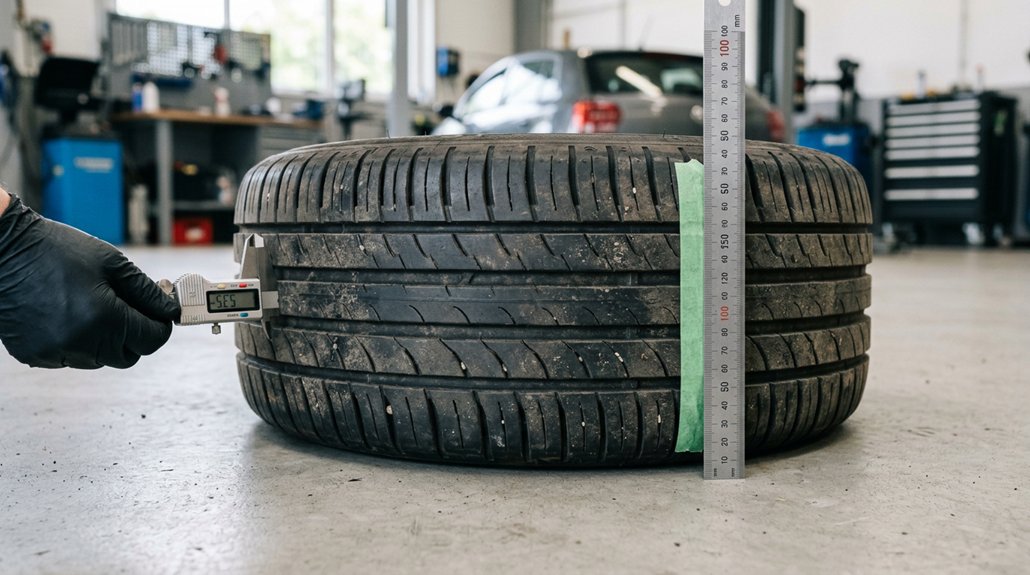
I measure tire tread depth regularly because uneven wear patterns compromise traction, hydroplaning resistance, and overall vehicle control.
You’ll need three tools: a penny for the 2/32″ legal minimum, a quarter for the 4/32″ wet-weather warning threshold, and a depth gauge for precise readings across inner shoulder, center ribs, and outer edge locations.
The shallowest measurement, not the average, determines when replacement is necessary.
Yet most drivers overlook this critical distinction with dangerous consequences.
Prep Your Tire for Accurate Tread Depth Measurement
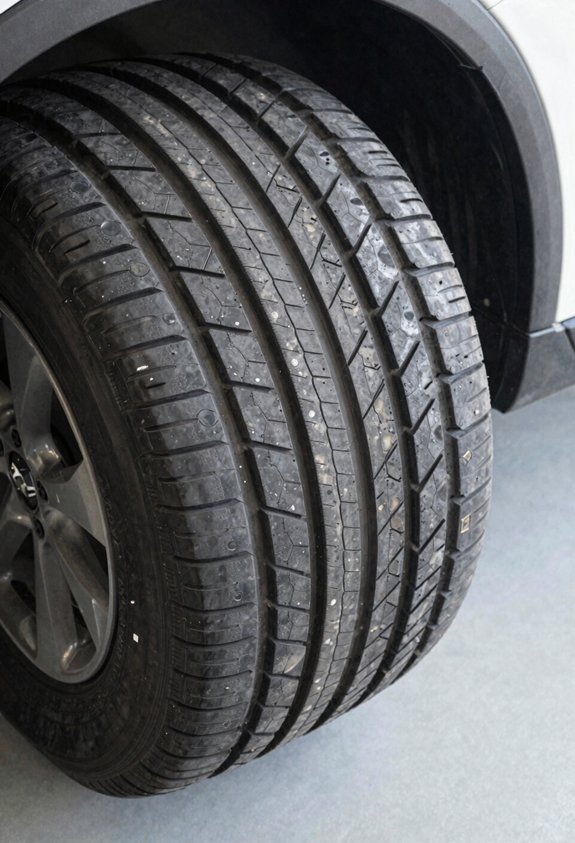
Why risk an inaccurate reading when a few minutes of preparation can guarantee reliable results? I always start by cleaning dirt and debris from my tire surface and grooves, because even small particles skew readings from my tread depth gauge. Next, I locate the shallowest groove across the tire tread, since this area reveals true remaining depth, not the deeper sections that hide uneven wear patterns.
I inspect wear indicators molded into the rubber, which appear as raised bars at 2/32″. Before using any tool, whether my gauge, penny test, or quarter, I identify multiple measurement spots: inner shoulder, center ribs, and outer edge. Uneven wear demands this thoroughness. I record every reading, knowing the lowest value determines my tire’s fate, not an average that masks dangerous thinning.
Use the Penny Test to Check for Legal Minimum Tread (2/32)
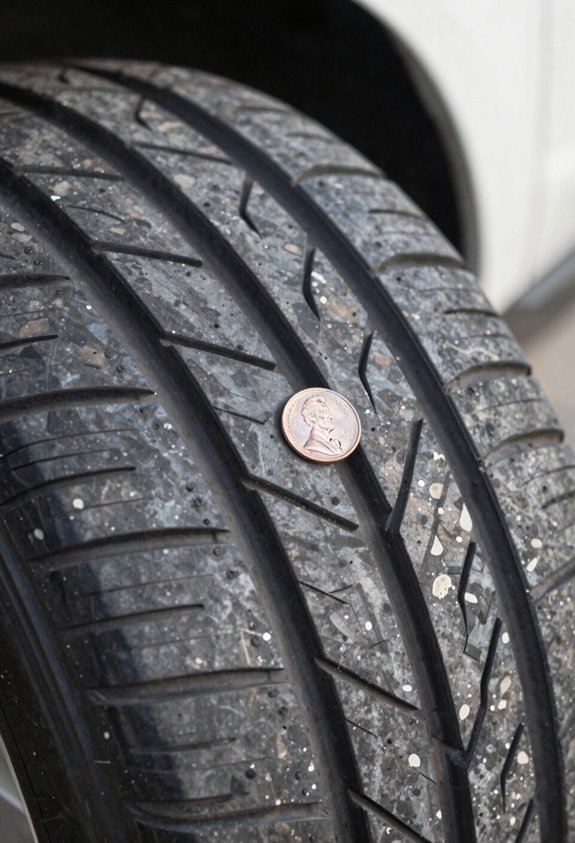
How can you quickly determine if your tires have reached the legal limit without any specialized tools? I rely on the Penny test, a straightforward method that requires only a U.S. penny.
Performing the Test
Insert the penny, Lincoln’s head upside down, between the tread ribs. If the top of Lincoln’s head remains visible, your tread depth has worn to the 2/32 inch legal minimum, or below. This indicates wear indicators have likely surfaced, compromising tire safety. I always check multiple locations around each tire because uneven wear demands thorough assessment.
Understanding the Results
A “pass” means more than 2/32 inch remains, though this doesn’t guarantee top performance. The Penny test provides rapid screening, not precision; I complement it with a tread depth gauge for definitive measurements. Remember, legal baldness (2/32 inch or less) mandates immediate replacement, so don’t risk it.
Use the Quarter Test to Catch Unsafe Wear Early (4/32)
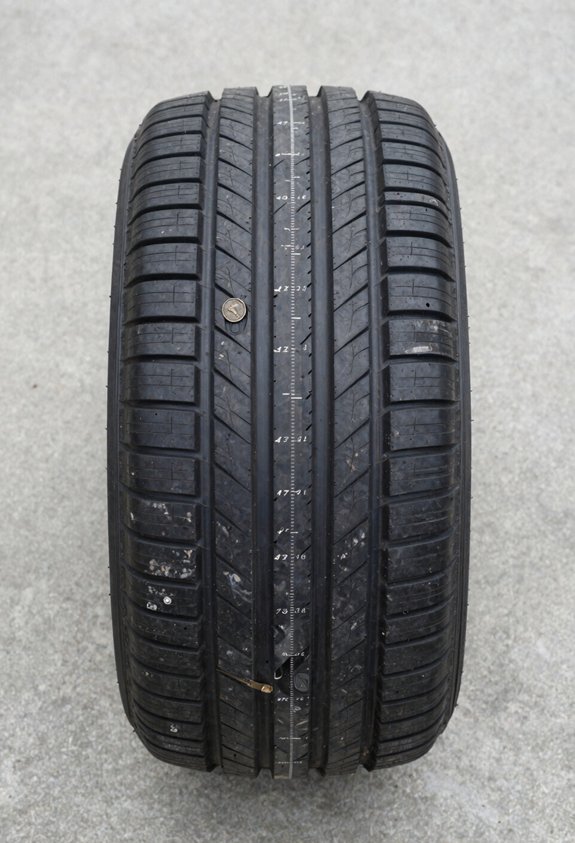
I recommend moving from the penny test to the quarter test when you want to assess Wet Weather Safety before hitting critical minimums, since catching tread wear at the 4/32-inch threshold gives you advance warning of hydroplaning risks and diminished stopping power on rain-slicked pavement. This Gauge-Free Checking method requires only a standard U.S. quarter: insert it upside-down into multiple grooves across all four tires, and if Washington’s head remains fully exposed, your tread has slipped below that 4/32-inch mark where wet-performance degradation accelerates sharply.
I always check several points per tire; uneven wear patterns, common on front-wheel-drive vehicles and misaligned suspensions, can hide localized trouble spots that a single insertion might miss.
Wet Weather Safety
When you’re checking whether your tires can handle wet roads, the quarter test gives you a critical early warning that the penny test simply misses. While the penny test identifies legally bald tires at 2/32 inch, I’ve learned it leaves you vulnerable in wet conditions long before that point.
Understanding the 4/32 Inch Threshold
The quarter test measures tread depth at 4/32 inch, a critical benchmark for wet-weather safety. Insert a quarter, Washington’s head upside down, into the deepest groove. If you see his entire head, your hydroplaning risk has increased dramatically, and tread wear indicator bars are likely visible.
Research confirms tires at or below 4/32 inch suffer serious loss of stopping power and hydroplaning resistance. I run this quick check before rainy drives, because catching unsafe wear early keeps us all safer on wet pavement.
Gauge-Free Checking
Moving from wet-weather considerations toward practical, tool-free evaluation, I’ll start with the quarter test because it gives me actionable information without requiring any specialized equipment. This method of gauge-free checking targets the critical 4/32″ threshold where safety and performance decline measurably in wet conditions.
Performing the Quarter Test
I insert a US quarter, Washington’s head upside down, into multiple grooves across the tire: center, inner, and outer positions. If any portion of Washington’s head remains visible, my tread depth has reached or fallen below 4/32″, signaling replacement should be considered. When the entire head appears, I’ve crossed into unsafe territory.
Complementary Methods
While the penny test identifies the 2/32″ legal minimum, the quarter test catches problems earlier. I combine these approaches with visual tire wear indicators for a thorough assessment. Approaching the 4/32″ mark warrants professional inspection.
Spot the Wear Bars That Signal Immediate Replacement
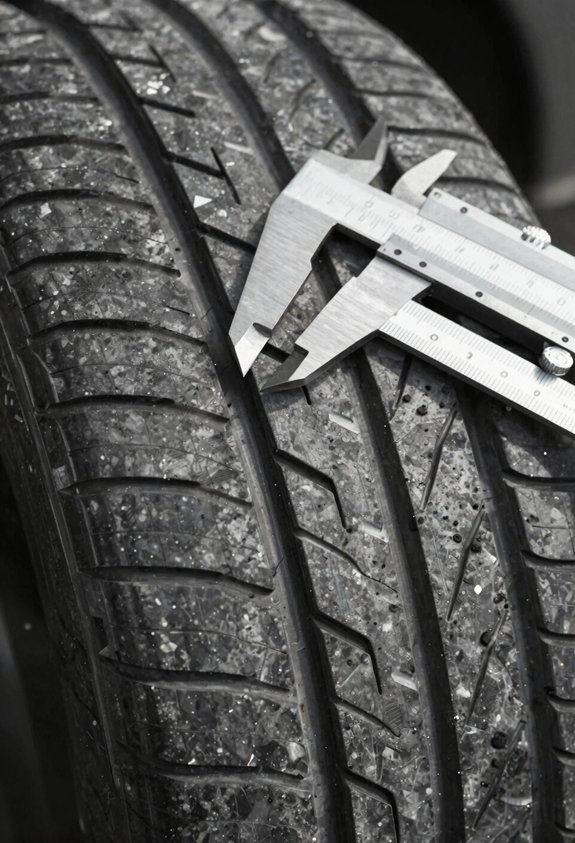
Tire tread wear indicator bars are molded directly into the circumferential grooves of every passenger tire, positioned precisely 2/32 of an inch above the deepest point of each groove, and I’ll show you exactly how to locate and interpret these critical safety signals before they leave you vulnerable to hydroplaning or blowouts.
Locate Your Wear Bars
I scan the tread grooves, finding small raised bridges running perpendicular across the main channels; these flush indicators sit at the bottom, evenly spaced around the circumference.
Read the Replacement Signal
When my tread depth wears down to meet these bars, I’ve reached the critical threshold. I know tire replacement is immediate because the bars become level with surrounding rubber, eliminating any guesswork from depth measurement.
Make Checking Habitual
I inspect these wear bars monthly, making certain I never miss the visual cue that demands action.
Measure Tread Depth Precisely With a Depth Gauge
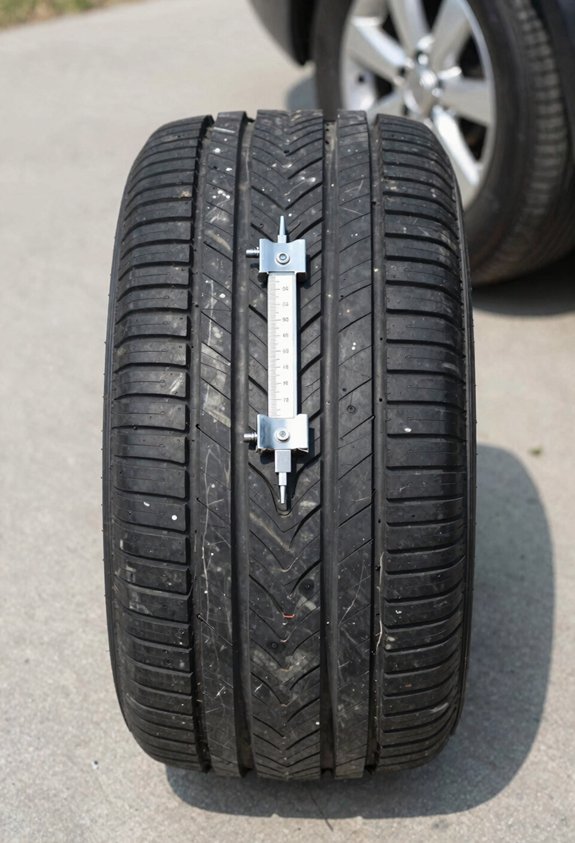
I recommend investing in a tread depth gauge, whether digital or analog, since these tools provide precise measurements in 32nds of an inch or millimeters that visual inspections simply cannot match. When I measure, I brace the gauge against a tread block, press the probe firmly to the groove’s base, and record the reading, repeating this process across the inner, center, and outer tread regions to catch uneven wear patterns.
You’ll want to compare your lowest measurement against critical thresholds; 6/32″ or above indicates safe tread, while anything approaching 2/32″ demands immediate replacement before hydroplaning risks escalate.
Gauge Types Available
Why settle for guesswork when a tread depth gauge can deliver precise, repeatable measurements you can act on? I’ve found three main types worth your consideration.
Digital Tread Depth Gauge
I prefer this for speed, its screen displays readings instantly, eliminating interpretation errors.
Probe-Style Gauge
I lower the probe into the groove’s bottom, then read the marked scale; it’s mechanical, reliable, and needs no batteries.
Built-In Tread Wear Indicator
I watch for these bars, which emerge at 2/32″ from the groove bottom, when flush with tread, replacement is mandatory.
Critical Practice
I always take measurements across multiple locations, inner, center, outer edges, and I treat the lowest reading as my decisive figure, since uneven wear masks true remaining life.
Proper Measurement Technique
| Step | Tool Position | Action |
|---|---|---|
| 1 | Inner groove | Brace handles against tire tread blocks |
| 2 | Center groove | Push probe to groove base, read barrel |
| 3 | Outer groove | Record multiple locations carefully |
| 4 | Compare | Cross-reference against wear indicators |
| 5 | Decide | Use lowest reading for replacement timing |
New tires typically carry 10/32″ to 12/32″ of depth, while wear indicators sit at 2/32″. I always check multiple locations because uneven wear compromises accuracy.
At 6/32″ or above, you’re generally safe; drop to 4/32″ or below, and I’ll urge immediate replacement before wet conditions become hazardous.
Check Multiple Locations to Find Your Lowest Reading
- Press your tread depth gauge into the inner shoulder groove, where camber wear often hides.
- Slide it to the center rib, the contact patch’s workhorse, recording precise millimeters or 32nds.
- Measure the outer edge, where cornering scrubs away rubber fastest on performance tires.
- Inspect each wear indicators bar; if flush anywhere, you’ve hit replacement threshold regardless of other spots.
I record every number, then circle the smallest. That single figure guides my decision; never average them, never assume uniformity. Your safety depends on that worst-case measurement, so I treat it with absolute seriousness.
Compare Your Results to Tread Depth Safety Guidelines
Once you’ve identified your lowest tread depth measurement, you must immediately contextualize it against established safety benchmarks, because that single number determines whether you’re driving on adequate rubber or gambling with hydroplaning risk and extended stopping distances.
Key Safety Thresholds
- New tires: 10/32″–12/32″
- Quarter test fail: 4/32″ (wet braking compromised)
- Legal minimum: 2/32″ (penny test fail; tread wear indicator flush)
I recommend scheduling replacement at 4/32 inch, not waiting for tread wear indicators. The quarter test reveals this critical drop; the penny test only catches legally bald 2/32 inch. Your lowest reading governs all decisions, regardless of other spots.