
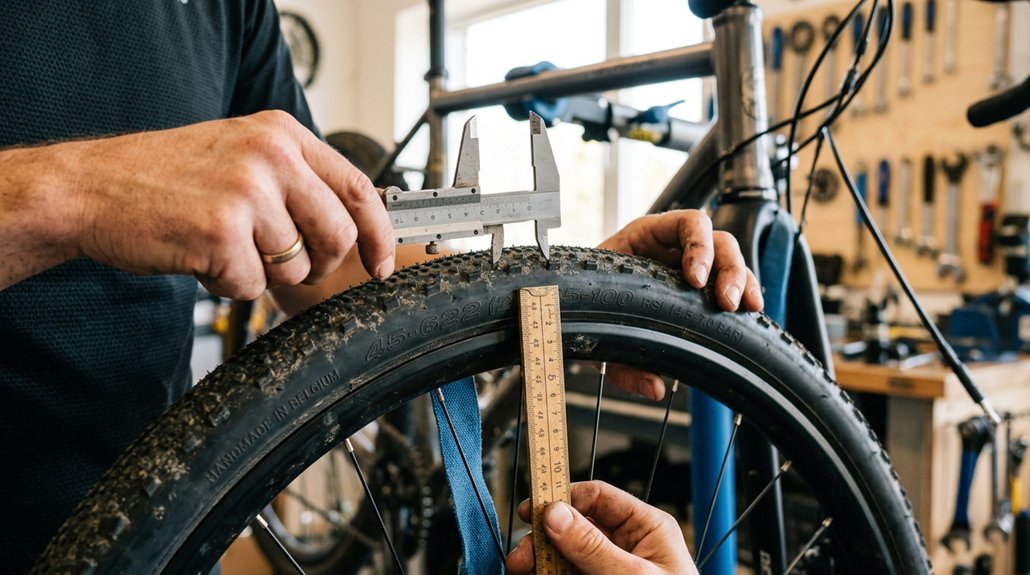
As it happens, I measured my own tires just last week when a blowout left me stranded halfway through my commute. You might think tire sizing is straightforward, but the numbers on your sidewall, those markings like “700x28c” or “29×2.1”, are only your starting point, and misreading them could cost you a perfectly good rim.
I’m going to show you why the bead seat diameter matters more than any other measurement, what happens when that sidewall wears smooth, and the exact millimeter ranges that separate a safe fit from a dangerous mismatch, because one wrong calculation, and…
Read the Bike Tire Size on Your Sidewall First
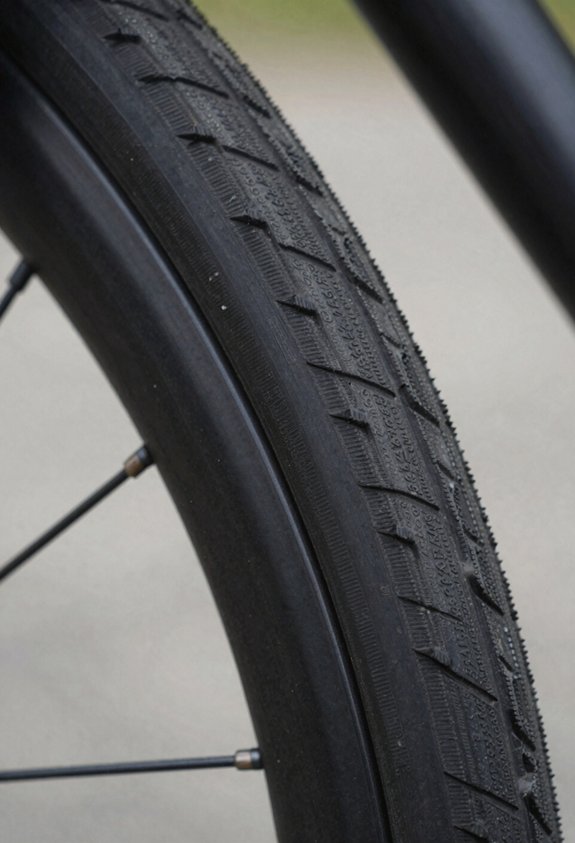
Sometimes I need to rotate the wheel or deflate the tire to read obscured digits. Critical caution: sidewall numbers wear away over time, so I photograph readable markings immediately.
If digits fade, cross-reference partial data against manufacturer charts before purchasing replacements.
Measure the Bead Seat Diameter if the Sidewall Is Worn
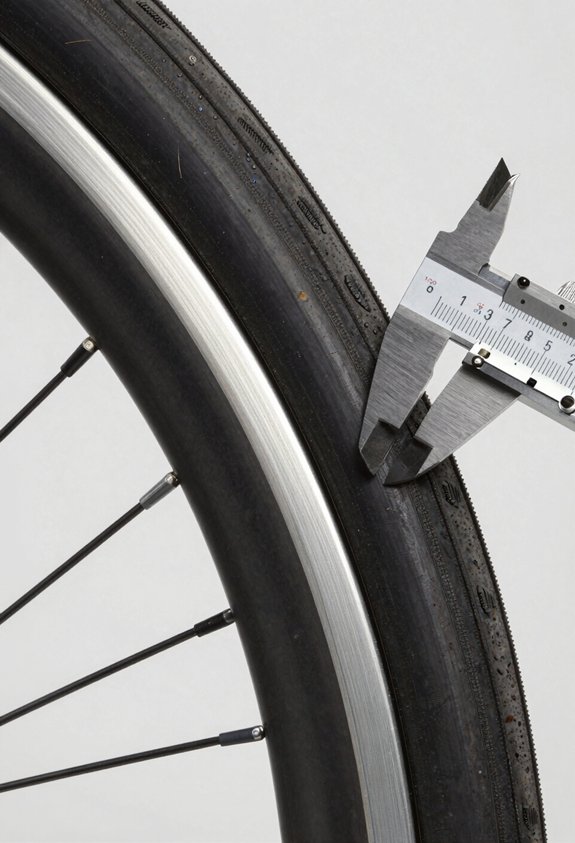
Rim Measurement Procedure
I remove the tire completely to expose the inner bead seat diameter, not the outer rim edge. Using calipers or a precise ruler, I measure across the rim’s inner seating surface in millimeters.
Common BSD Values for Tire Compatibility
- 622 mm (700c/29″ road and hybrid)
- 584 mm (650B/27.5″ touring and mountain)
- 559 mm (26″ mountain bike)
Rims vary, so I never assume. If my rim measurement seems ambiguous or the rim shows damage, I visit a professional mechanic to confirm the exact BSD before purchasing; this guarantees safe, compatible replacement.
Measure Bike Tire Diameter From the Wheel Center
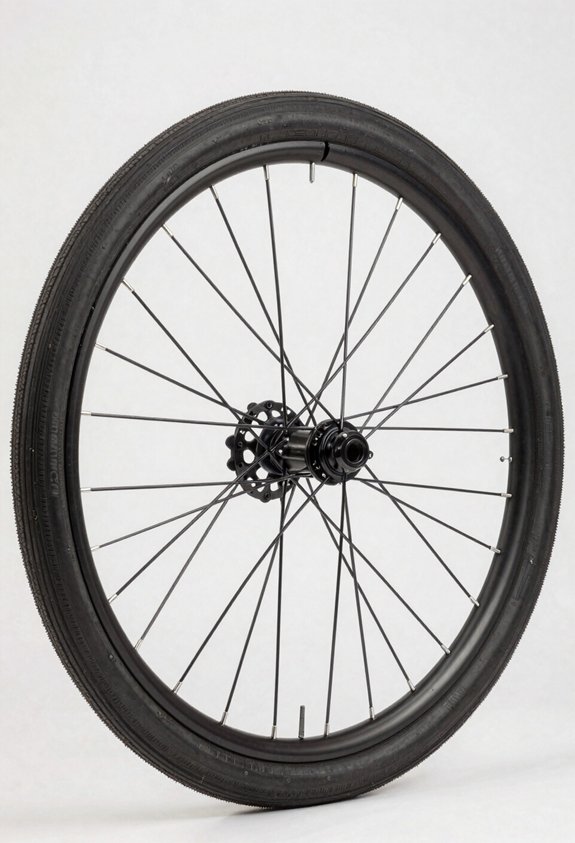
I place the tape measure’s end squarely at the Wheel Center Position, ensuring it sits flush against the hub axle, then extend it outward in a straight line that maintains Tape Measure Alignment perpendicular to the rim plane until I reach the tire’s outer tread edge. For traditional inch-based sizing, I’ll apply the Doubling Radius Calculation to convert this single radius measurement into full diameter.
I must remain careful, since inflation pressure slightly alters tire shape, to measure at consistent pressure and verify my result against sidewall markings or manufacturer specifications.
Wheel Center Positioning
Why does a single, immovable reference matter when you’re sizing up a tire that’ll carry you through a descent? I’ll tell you: consistency saves you from mismatching replacements that compromise handling. I position my tape measure’s end precisely at the wheel center, extending straight outward to capture diameter measurement accurately. This fixed point eliminates variables: tread wear, sidewall flex, manufacturing tolerances that’d otherwise skew readings.
| Measurement Type | Reference Point | Calculation |
|---|---|---|
| Traditional sizing | Outer edge of mounted tire | Double in inches |
| ISO/ETRTO sizing | Inner bead edge | Double in millimeters |
| Wheel center anchor | Fixed hub axis | Guarantees repeatability |
I always verify I’m measuring from the true geometric center, not an offset spoke hole or axle nut edge. For ISO/ETRTO sizing, I shift my endpoint inward to the bead seat, doubling that radius for standardized bead-diameter reporting. Your wheel center doesn’t shift; neither should your methodology.
Tape Measure Alignment
How precisely must you align your tape to capture a diameter that won’t mislead you when you’re barreling toward a hairpin? I guide you through tape measure alignment, the critical step that separates accurate diameter measurement from costly guesswork.
I place my tape’s end squarely at the wheel center, that fixed reference point we established, then extend outward in an unwavering path. The straight measurement demands discipline: any curve around the tire’s arc, any deviation from radial truth, inflates your reading with phantom millimeters. I keep the tape taut, I keep it true.
For traditional sizing, I measure to the tire’s outer edge; the double comes later. For ISO bead-seat diameter, I’d note the inner rim edge, but that’s a parallel path.
Your wheel center anchors everything. Deviations here cascade through every calculation.
Doubling Radius Calculation
With the tape locked in proper alignment from that anchored wheel center, you’re now positioned to extract the single most consequential figure in tire replacement: the diameter itself. I measure the radius first, extending my tape straight from hub to outer tread edge, then double that measurement to yield the full diameter; simple multiplication, yet precision demands vigilance.
Anchor your tape dead-center in the hub axle, not adjacent spokes, to establish true geometric origin. Maintain absolute perpendicularity; any camber introduces compound error into your radius measurement.
For traditional sizing, double the outer-edge radius in inches (13″ becomes 26″). For ISO sizing, measure to the bead seat, not the tread, then double for bead-seat diameter in millimeters.
Cross-reference your resulting diameter against tire width to confirm replacement compatibility. One skewed radius corrupts every downstream calculation.
Measure the Exact Width Across the Tire Tread
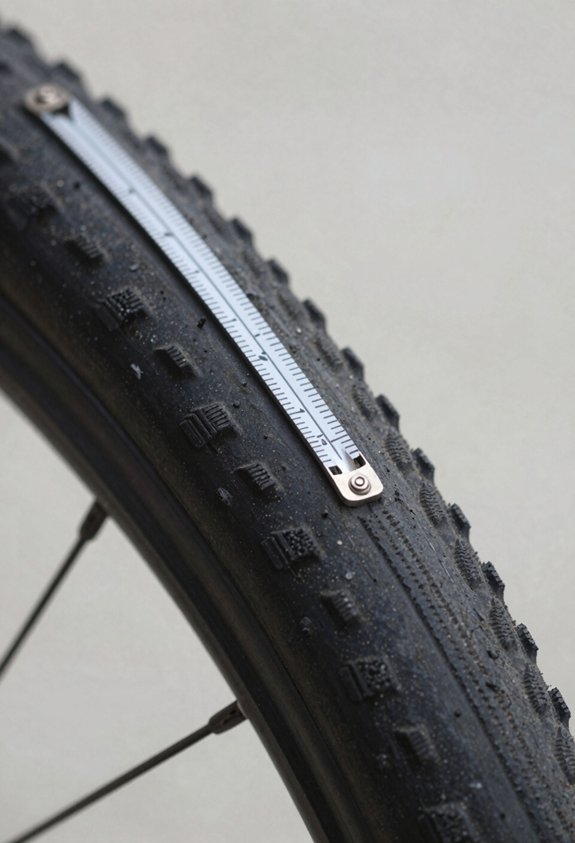
I position my tape measure perpendicular to the mounted tire, capturing the widest point of the flat tread surface while deliberately excluding the sidewalls, since this yields the most consistent dimension for replacement purposes. You’ll record this measurement in millimeters when referencing ISO/ETRTO sizing (where width appears first in formats like 25-622), or in inches for traditional systems.
I should note that tire width remains a nominal figure susceptible to variation from inflation pressure and rim width. This distinction between millimeter and inch width matters critically, as mismatched units between your measurement and the replacement tire’s labeling will lead to incompatible purchases.
Tread Width Measurement
Where exactly should you position your measuring tape to capture an accurate tread width? I’ll show you how to nail this tire width measurement so you’re never second-guessing your replacement choice.
Key Steps for Precise Tread Width
- Lay your tape flat across the widest tread section, perpendicular to the wheel, keeping it flush without lifting the tread surface
- Maintain a straight, level line to prevent slant errors from curvature or rim bulge distortion
- Record in millimeters for ISO/ETRTO sizing, road tires typically span 23–32 mm, while MTB setups run 48–66 mm (≈1.9–2.6 inches)
- Inflate to normal riding pressure before measuring, since underinflation yields a falsely narrow mounted width
- For aggressive tread patterns, measure the central flat only, excluding sideknobs or protective sidewalls that inflate apparent size
Master this, and we’ll get you rolling on properly fitted rubber every time.
Millimeter vs Inch Width
Precision Matters
- Mount and inflate the tire fully.
- Measure across the tread’s widest flat section, excluding decorative sidewalls.
Critical Variables
Actual width changes with rim width and pressure: narrow rims stretch tires taller, wide rims flatten them wider. A labeled 28mm tire might measure 26mm or 30mm mounted, depending on these factors.
Practical Comparison
Inch labels (“1.1 inches”) lack standardization. ISO specifications help compatibility: matching bead diameter locks the tire to your rim, while millimeter width clarifies clearance. Always verify bead diameter first, then account for rim width effects on final tire shape.
Convert Inch Measurements to ETRTO Format
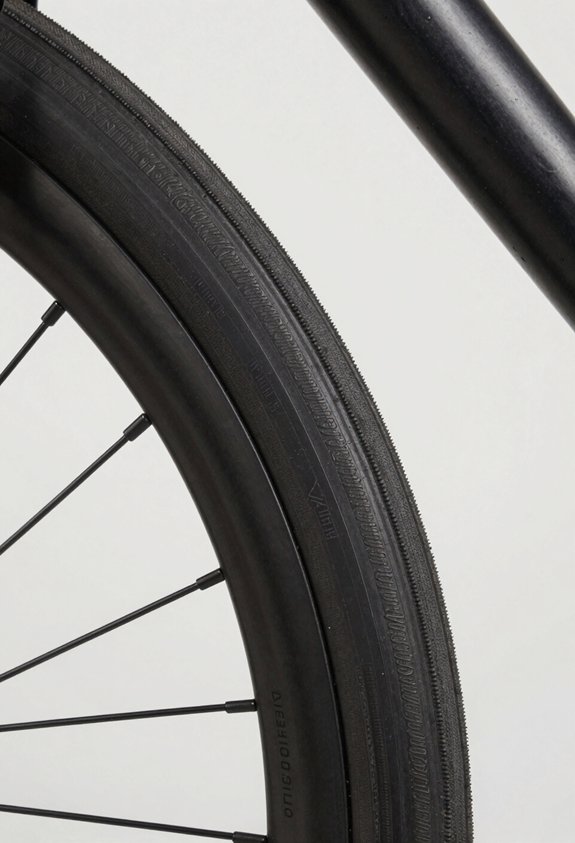
Converting inch-based tire measurements to ETRTO format requires careful attention to how the numbers map onto ISO standards, particularly when you’re working with common mountain bike and road tire designations.
I start every tire size conversion by noting the overall diameter and width from the inch measurements. For 29 x 2.10 tires, I match that to ETRTO 52-622, where 622 mm is the bead seat diameter. When I see traditional formats like 22 x 1 3/8 x 1 1/4, I identify each position: overall diameter, tire height, then width.
I always consult a reference chart, since 700c and 29″ families both share ISO 622. Before I buy, I cross-check the ISO size against my frame and rim clearances.
Handle Non-Standard and In-Between Tire Sizes
Three distinct challenges emerge when you’re confronted with tire sizes that don’t align neatly with common standards: worn or conflicting markings, fractional versus decimal inch designations, and the subtle dimensional drift that occurs across manufacturing eras. When I face these ambiguities, I always prioritize the ISO designation, measuring tire width and bead diameter in millimeters, to cut through the confusion.
If labels are illegible, I measure from bead seat to bead seat across the rim, then check the inflated tire’s width, deriving equivalents like 32-622 or 37-622. Rim compatibility demands attention, since newer tires often appear narrower on vintage rims despite similar labeling. I consult my local shop when pairings seem uncertain, so that braking, clearance, and performance remain reliable.
Check That Your New Tire Fits Your Rim and Frame
- Verify rim width against tire manufacturer recommendations for safe bead seating
- Confirm ISO designation matches exactly between tire bead and rim bed
- Measure frame clearance at fork crown, seat stays, and brake bridges with tire inflated
- Check tire width compatibility ranges published by rim and frame manufacturers
- Consult a professional mechanic when tire width, rim width, or frame clearance create uncertainty