
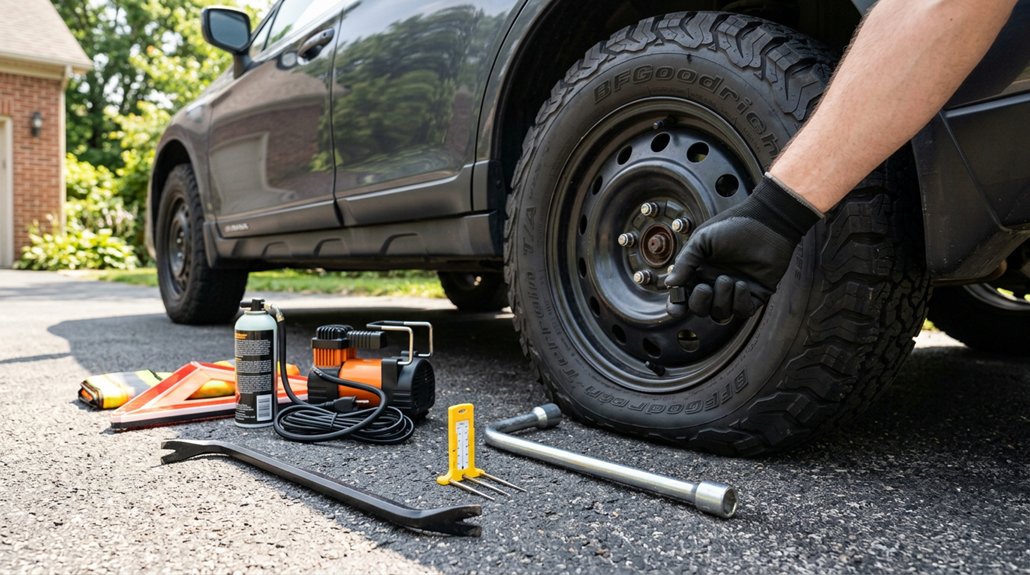
I can’t count how many times a nail has turned a routine commute into a roadside crisis.
Fixing a tire puncture yourself isn’t just possible, it’s a skill that’ll save you hours of waiting and hundreds in towing fees.
But there’s one critical mistake that’ll ruin your tire completely, and I’ll show you exactly how to avoid it.
Gather Your Tools and Safety Gear
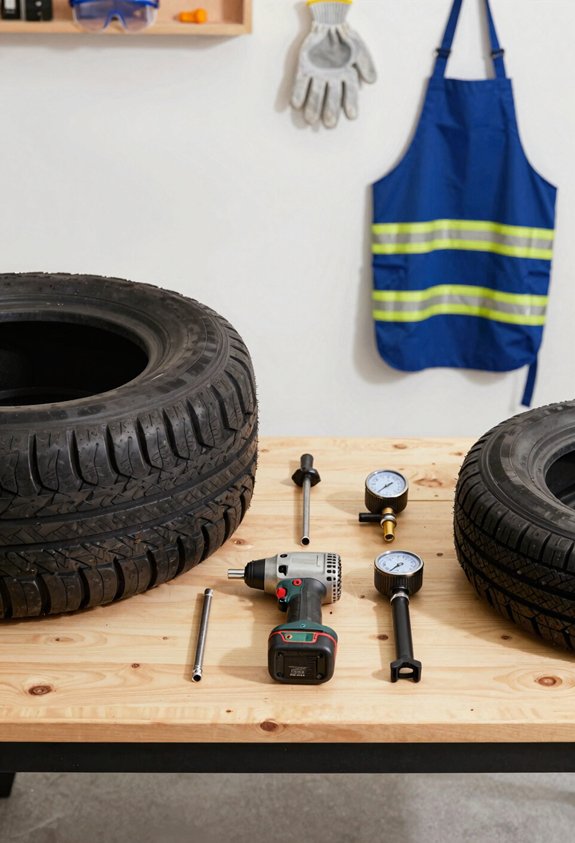
- Tire repair kit: plug kit, patch, vulcanizing glue, tire pressure gauge
- Lifting and securing tools: car jack, lug wrench, wheel chocks
- Safety gear: safety glasses, gloves, work light for interior inspection
Leak Detection and Standards
I keep soap and water (or bubble solution) ready to identify puncture locations precisely. You’ll also need USTMA/TIA reference guidelines to determine whether damage falls within repairable parameters: location and size thresholds matter critically.
Work Environment
Prepare a clean, flat surface where safe vehicle lifting and tire access remain unobstructed throughout the entire procedure.
Secure Your Vehicle and Remove the Tire
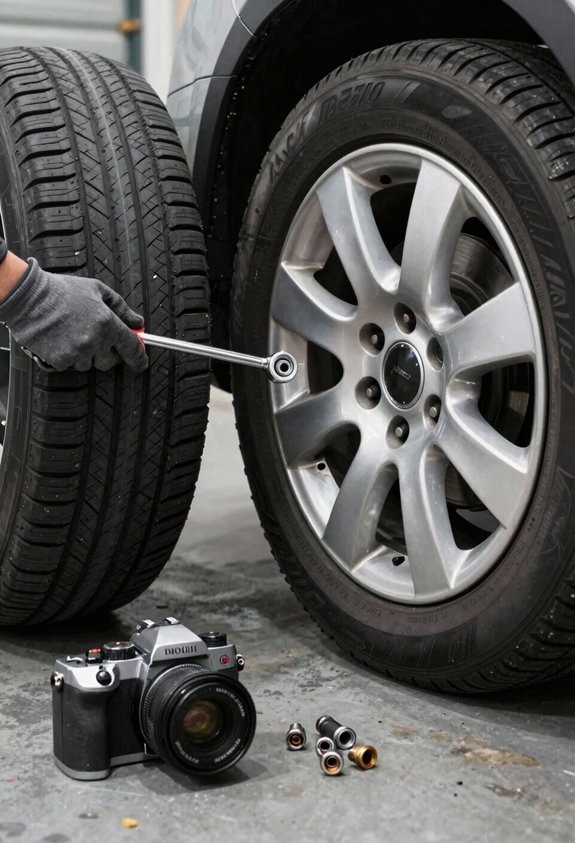
The critical first phase of any tire repair demands methodical vehicle stabilization before I attempt wheel removal, since an unsecured car presents severe crush hazards that compound exponentially with even minor elevation changes. I park on flat, solid ground, engage my parking brake, and place wheel chocks behind opposite tires to eliminate horizontal drift.
Critical Pre-Lift Protocol
I loosen my lug nuts approximately one-quarter turn while the tire remains grounded, preventing uncontrolled wheel spin that strips threads or damages studs. This counter-torque preparation proves essential, as airborne wheels offer zero resistance.
Position your jack at manufacturer-specified lift points (consult your manual). Raise the vehicle until the tire clears the ground by 2-6 inches. Complete lug nuts removal, then execute wheel removal with controlled horizontal extraction.
I inspect the exposed hub, brake assembly, and tire interior for embedded objects, gashes, or structural compromise before proceeding.
Check If Your Tire Puncture Is Fixable at Home?
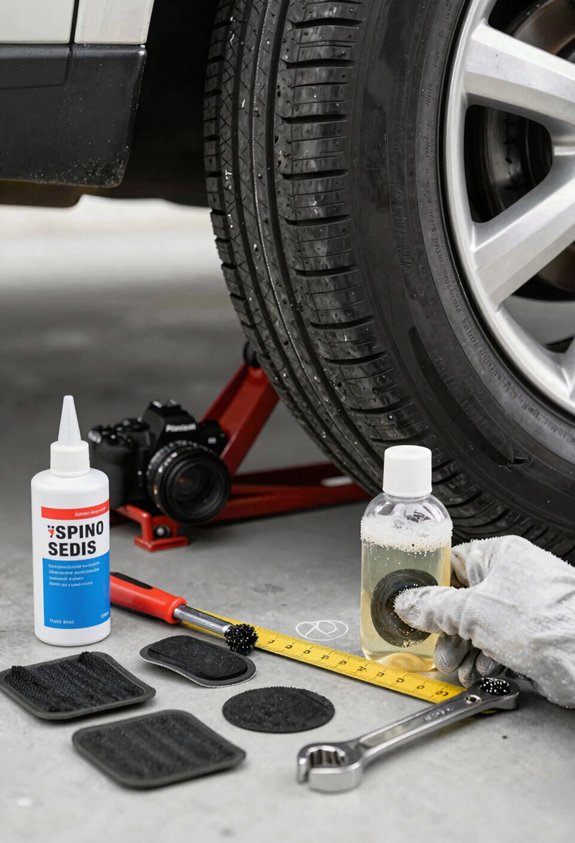
Where exactly has your tire sustained damage, and can you actually fix it yourself without compromising safety? I need to help you figure this out before we proceed.
Location Determines If It’s Repairable
Punctures must sit inside the crown, the center tread area, to qualify for DIY repair. Sidewall or shoulder damage? That isn’t repairable, period. I learned this distinction matters immensely.
Size Limitations
For standard passenger tires, we’re looking at 1/4 inch (6 mm) maximum. Steel-belted light truck tires might accommodate up to 3/8 inch (10 mm), depending on construction.
What Proper Repair Actually Requires
A single plug won’t suffice; safety demands a plug-and-patch combination that seals the inner liner completely. Even when punctures appear repairable, I always remove the tire from the wheel for internal inspection following established repair protocols.
Spot a bulge or bubble? That tire’s finished; no exceptions.
Know When to Seek Professional Help
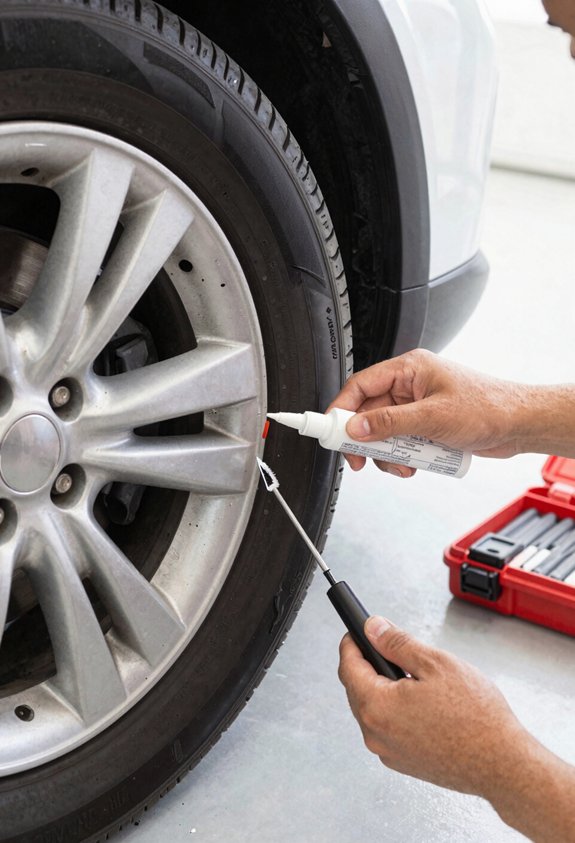
I recognize clear boundaries between manageable repairs and those requiring expert intervention, particularly when sidewall damage or specific professional service triggers appear. You cannot safely plug a puncture located in the sidewall; that zone flexes too much and any compromise there demands immediate tire replacement, not attempted repair.
When I encounter multiple punctures, cuts exceeding ¼ inch (6 mm), or damage to run-flat and high-performance tires, I’m heading to a certified technician who possesses the specialized equipment and training to assess repair viability against replacement necessity.
Sidewall Damage Warnings
Surface-level punctures in this zone cannot be repaired by any method, regardless of depth or apparent severity. When you spot these issues, you’re facing scenarios requiring immediate professional assessment:
- Bulging, bubbling, or visible cord exposure on the sidewall surface
- Cuts deeper than 1/4 inch penetrating the rubber layers
- Any damage to run-flat, high-performance, or specialty tire constructions
Professional evaluation confirms whether replacement is necessary, keeping you safe.
Professional Service Triggers
How do you know when a puncture has moved beyond your driveway capabilities?
If you’ve spotted sidewall damage, stop immediately; that area flexes too much for any patch to hold, so you’ll need a full replacement, no exceptions. I’m serious about puncture size, too: anything exceeding 1/4 inch (6 mm) in your passenger or light truck tires crosses into territory where my plug kit won’t cut it, and you’ll need that professional assessment to determine repair viability or mandatory replacement.
Multiple punctures clustered close together? Run-flats, high-performance rubber, or specialty construction? These scenarios carry hidden structural compromises I’m not equipped to evaluate, and the blowout risk isn’t worth it. When uncertainty creeps in, I head to the pros; we’re protecting everyone on the road.
Ream the Hole and Apply Rubber Cement
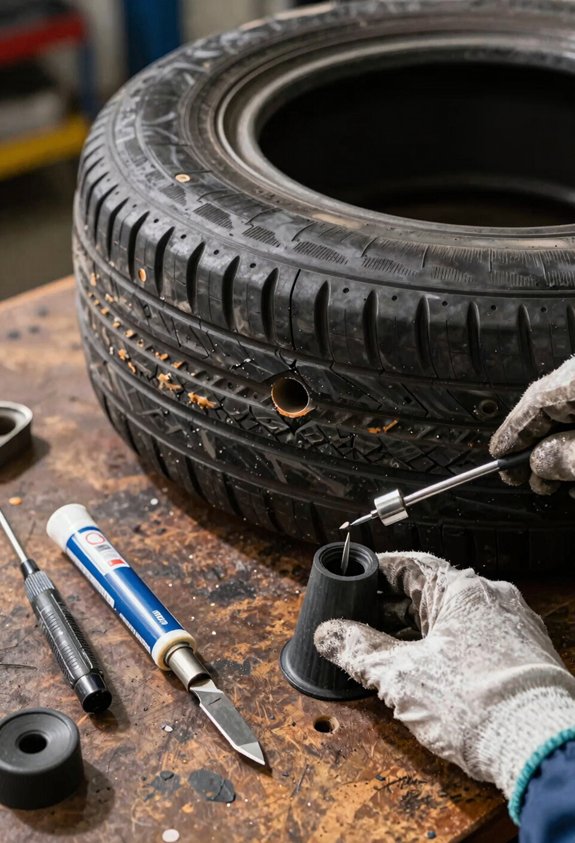
The reaming of a puncture hole represents a critical preparatory phase that directly determines the integrity of your subsequent repair, demanding precise technique and appropriate tooling to transform jagged, irregular injury channels into clean, uniformly cylindrical openings ready for chemical bonding.
I recommend you complete this step with the tire removed from the wheel, allowing internal inspection for cord or belt damage before proceeding. Here’s what proper preparation requires:
- Reaming the injury with controlled drilling to achieve uniform, round openings within manufacturer-specified repair zones
- Puncture repair standards require exposing clean inner liner surfaces for optimal adhesion
- Rubber cement application promotes vulcanizing bonds between the prepared cavity and subsequent sealing materials
I apply the adhesive liberally, coating both the hole interior and the repair material itself, guaranteeing complete coverage for chemical bonding that withstands operational stresses.
Plug the Hole as a Temporary Fix
I’ll grab a tire plug kit, which typically includes rubber plugs, an insertion tool, and sometimes a reaming tool, and I’ll show you how to thread that sticky plug through the eye of the needle-like inserter before pushing it firmly into the puncture wound until about half an inch remains visible outside the tire. You’ll then need to pull the tool straight out with a quick, steady motion, leaving the plug wedged tightly in place as the rubber compresses and seals against the hole’s interior walls.
Once trimmed flush with the tread surface, this temporary repair should hold air long enough to reach a professional, though I’ll remind you that it cannot seal the inner liner or prevent moisture from creeping between the plies, which is why you shouldn’t delay that service center visit.
Tire Plug Kits
A tire plug kit serves as one roadside option I’m prepared to use when I’ve caught a puncture early and need to reach a shop without mounting a spare, though I never treat this approach as anything more than a brief, stopgap measure. I understand that this temporary puncture repair demands proper technique: locating the puncture, removing the tire for inspection, and preparing the inner liner before applying any plug.
I rely on my kit because it keeps me moving, but I know the limits:
- A plug alone won’t seal both surfaces like a proper combination plug-and-patch
- Moisture can seep past the plug, causing hidden damage over time
- Only a professional evaluation confirms whether the tire remains safe
After any plug application, I recheck air pressure, test with soap solution, and head straight for a shop.
Plug Insertion Steps
Critical limitations: An emergency tire plug alone constitutes an incomplete two-piece repair, as it cannot establish the inner liner seal required to block moisture ingress. I treat this solely as a temporary measure, scheduling immediate professional inspection where a certified technician will complete the proper two-piece repair with an interior patch.
Reinflate, Test for Leaks, and Reinstall
Once I’ve confirmed the repair patch has cured or the plug is properly seated, I reattach the wheel to the hub, aligning the lug bolt holes carefully before threading each fastener by hand to prevent cross-threading, then I lower the vehicle until the tire just touches the ground to allow initial torque application. I tighten the lug nuts to the manufacturer’s specified torque, typically between 76-112 ft-lbs depending on vehicle class, using a calibrated torque wrench in a star pattern to make sure of even wheel seating.
I tighten lug nuts to manufacturer torque specs in a star pattern using a calibrated wrench for even wheel seating.
To complete this tire repair phase, I:
- Inflate to the exact PSI listed on the driver’s door jamb placard or tire sidewall, never exceeding maximum cold pressure ratings
- Test for leaks by applying soap solution; bubbles indicate failure requiring immediate rework
- Reinstall the valve cap, then recheck wheel seating before a brief 5-10 mph test drive
Get a Permanent Patch-Plug Repair at a Shop
While a temporary roadside fix gets me rolling again, I recognize that only a professional patch-plug repair meets industry standards for long-term safety and structural integrity. I head to a reputable shop (Sullivan Tire and Auto Service follows USTMA/TIA guidelines) for proper tire repair.
R.E.P.A.I.R. Steps for Professional Service
Technicians perform complete R.E.P.A.I.R. steps: Remove the tire from the wheel, Evaluate internal damage, Prepare the injury, Apply vulcanizing adhesive, Install the repair unit, and Trim excess. The permanent patch-plug combines a plug with back patch, sealing the inner liner while restoring structural integrity.
Repairable Damage Criteria
Punctures must sit within the crown (center tread), measuring up to 1/4 inch (6mm); sidewall damage requires replacement. Angled punctures exceeding 35 degrees need two-piece repairs. Shops demount tires for internal inspection, following RIST wheel securement procedures, critical steps I cannot replicate roadside.