
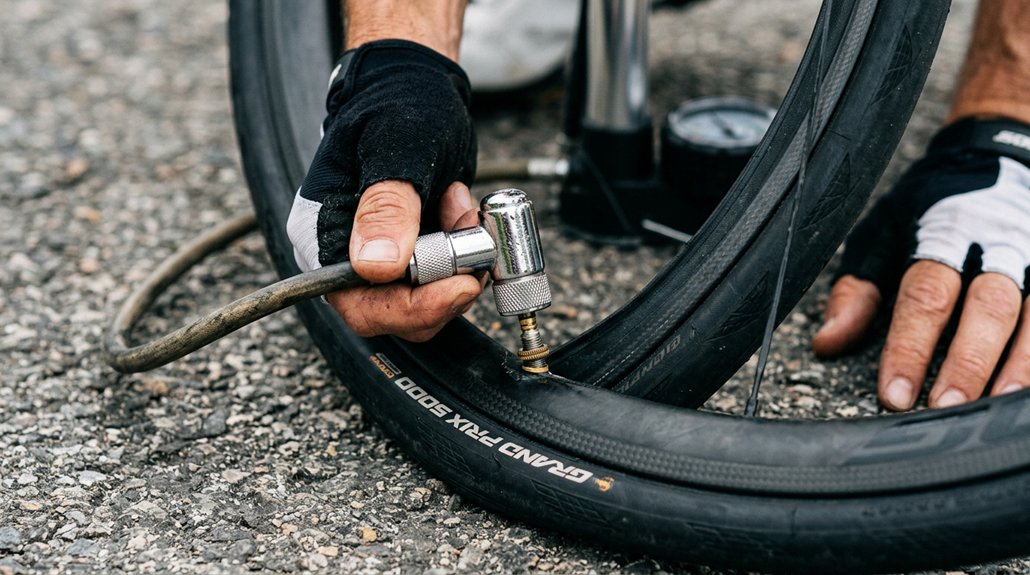
Like Achilles needing armor before Troy, I’ll show you why proper inflation technique isn’t optional. It’s the foundation of every safe ride, and one misstep can strand you miles from home.
Identify Your Valve Type: Presta or Schrader
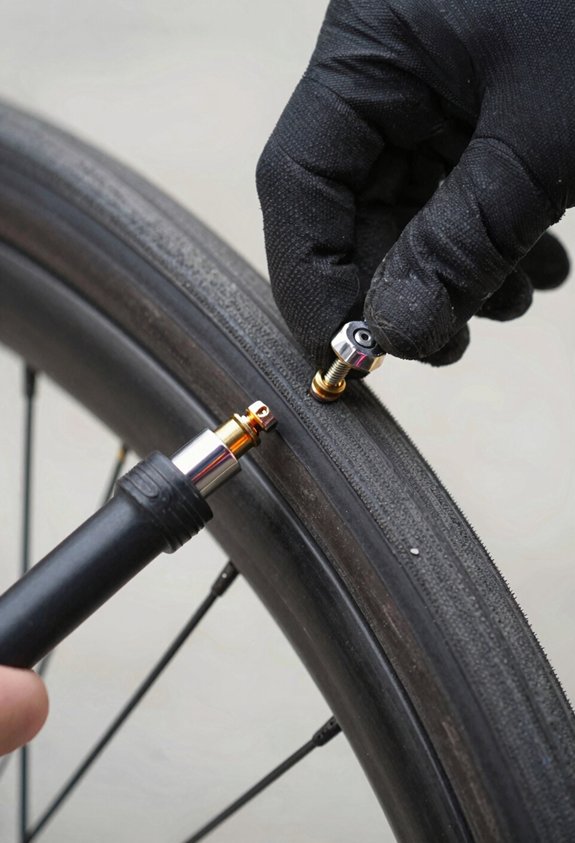
- Presta valve: The slender, threaded stem with a small nut you unscrew before inflation, common on road bikes and higher-performance wheels.
- Schrader valve: The thicker, car-style valve with no locking nut, found on most hybrids and mountain bikes.
Practical Solutions for Compatibility
I always carry a Presta-to-Schrader adapter in my saddle bag, since many public pumps and gas station compressors accept only Schrader valves. This small brass cylinder threads onto your Presta valve, converting it instantly for universal pump compatibility.
Knowing your valve type eliminates roadside frustration, helps you inflate properly, and keeps you rolling with the group you belong to.
Find Your Recommended Tire Pressure
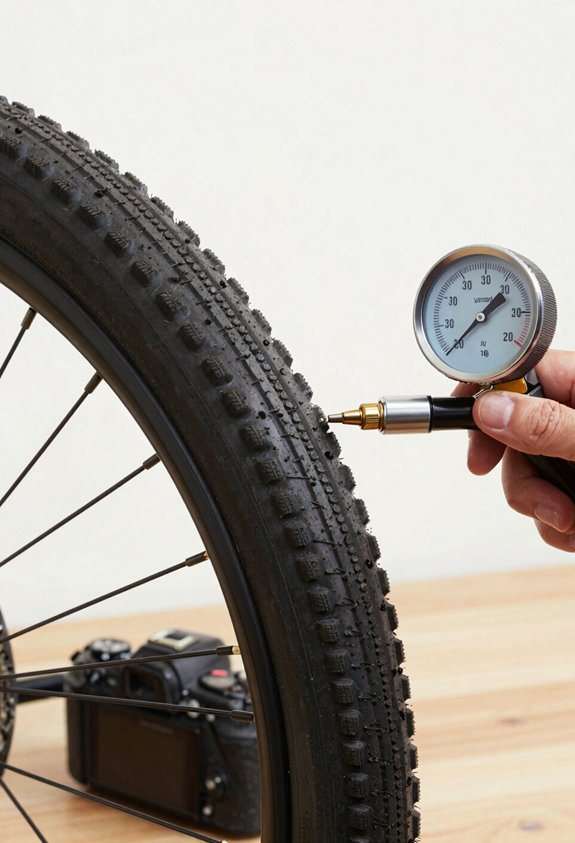
How do you know when your tire’s ready for the road? I check the sidewall or my bike manual first to find the recommended pressure range, since every tire’s different.
- Road bikes need 85–110 PSI for smooth asphalt, while mountain bikes use 25–35 PSI for grip on rough terrain
- I always use a pump with a built-in gauge, or grab a separate tire pressure gauge if mine lacks one
- Wider tires and heavier riders need adjustments. Wider tires run lower PSI than narrow ones.
Your tire pressure affects every ride, so don’t guess. I factor in my weight, tire width, and conditions before inflating. Getting this right keeps us rolling safely and efficiently, whether we’re climbing trails or cruising pavement together.
Prep the Valve and Connect Your Pump
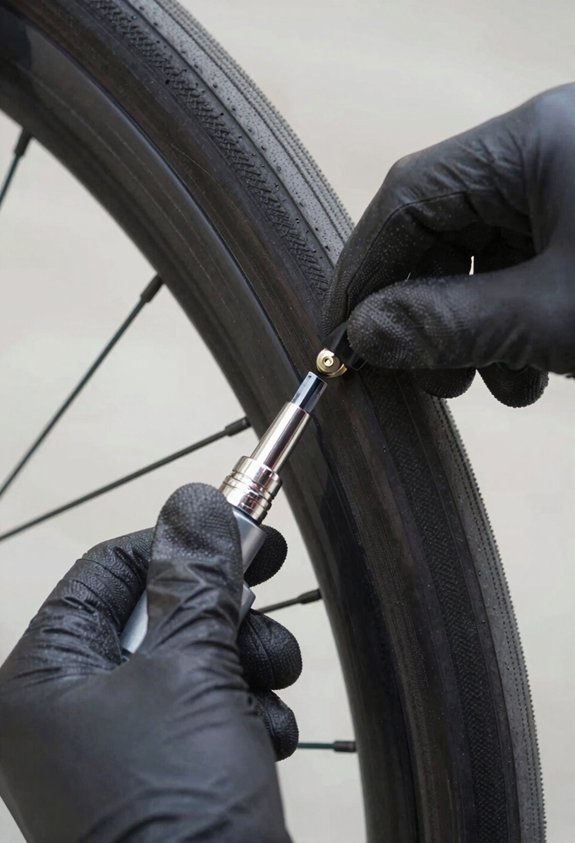
- For Presta configurations, I remove the valve cap, then unscrew the diminutive top nut several counterclockwise rotations to permit airflow; neglecting this step guarantees pump failure.
- When my pump accommodates only Schrader fittings, I thread a Presta-to-Schrader adapter onto the open valve before proceeding.
- Dual-head pumps typically incorporate a reversible or switchable pump head. I verify correct port selection via embossed icons or a thumb-activated selector.
Securing Your Connection
I maintain strict valve alignment, pressing the pump head squarely onto the stem to prevent angular leakage or core damage. If my pump features a locking lever, I engage it firmly, yet I avoid excessive force that might strip threads or dislodge the tube from its seated rim cavity. Once secured, I’m prepared to inflate.
Fill Your Tire to Target Pressure
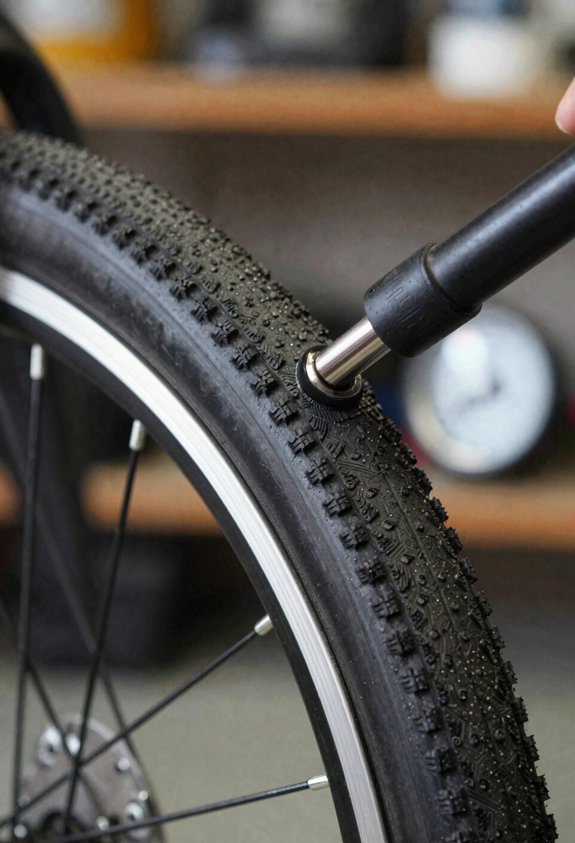
Once I’ve secured my pump connection, I begin inflating with deliberate attention to my target pressure, which I’ve verified by consulting the embossed PSI range on my tire sidewall or my bike’s technical manual: typically 25–35 PSI for mountain bike tires designed for traction and shock absorption, or 85–110 PSI for road bike tires requiring minimal rolling resistance.
Know your numbers: check your tire’s sidewall or manual for the right PSI before you start pumping.
I always use a Presta Schrader pump gauge or a separate pressure gauge to track PSI accurately, since guessing risks dangerous over-inflation. I inflate gradually, checking my pressure gauge every few pumps, particularly with sensitive tire valve types that respond quickly.
If my pump lacks a built-in gauge, I attach a standalone pressure gauge to confirm I’ve reached my target pressure without exceeding it.
I avoid car tire machines entirely; they’re incompatible and can burst my tire.
Remove the Pump Without Losing Air
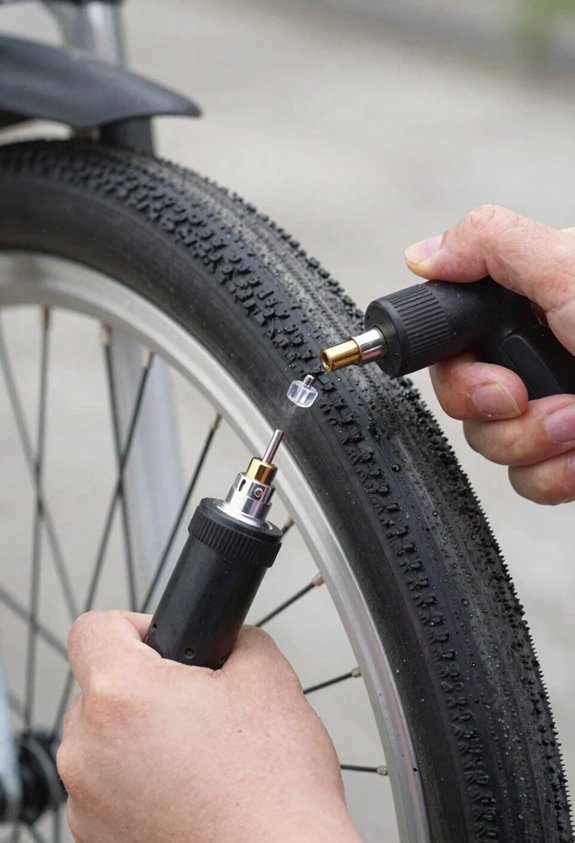
When you’ve hit your target pressure, why risk losing that hard-won PSI during pump removal? I brace the valve steady with one hand while detaching the pump with the other, minimizing air loss through precise, deliberate motion. For valves with locking levers, I open the lever fully before pulling away; this releases pressure on the seal, preventing that sharp hiss of escaping air.
Key considerations by valve type:
- Presta: I detach carefully, then twist the tiny nut clockwise to reseat the valve core, stopping any residual leak.
- Schrader: I make sure the spring-loaded valve core snaps shut instantly, its sturdy design tolerating quicker removal.
If I hear air escaping mid-removal, I immediately reseat the pump head, preventing pressure drop, then verify with a gauge. Swift, controlled technique protects every precious PSI I’ve worked to achieve.
Seal the Valve and Replace the Cap
With the pump successfully removed and pressure intact, I now turn my attention to sealing the valve and securing its protective components, a step I’ll skimp on at my own peril.
- Presta valve seal: I tighten the tip until snug, making certain no air escapes this inflation step.
- Dust cap placement: I thread the valve cap carefully, protecting against grit and moisture intrusion.
- Adapter removal: If I’ve used one, I take it off now, then reseal the Presta valve properly.
I perform a brief pressure check, confirming no loss occurred during sealing. This final inflation step completes our work together. Whether you’re running Presta or Schraeder, that dust cap matters more than you’d think. We’re almost ready to roll; just one last verification, and we’ve got this.
Troubleshoot Leaks and Poor Seals
Because even the most careful inflation can reveal hidden problems, I begin my leak troubleshooting with systematic sensory inspection, recognizing that small compromises in sealing can escalate into complete pressure failure during operation.
Inspect Valves and Listen for Escape
I first check that valve cores are tight and undamaged, tightening valve nuts on Presta types, then install dust caps to block debris.
Locate Persistent Leaks
For slow pressure loss, I apply soapy water to tires, beads, and valves. Bubbles pinpoint exactly where air escapes, whether from damaged rubber or poor seating.
Address Bead and Tubeless Issues
I reseat uneven beads to eliminate pinching. For tubeless setups, I add fresh sealant or insert tire plugs when sealant fails to clot punctures.