
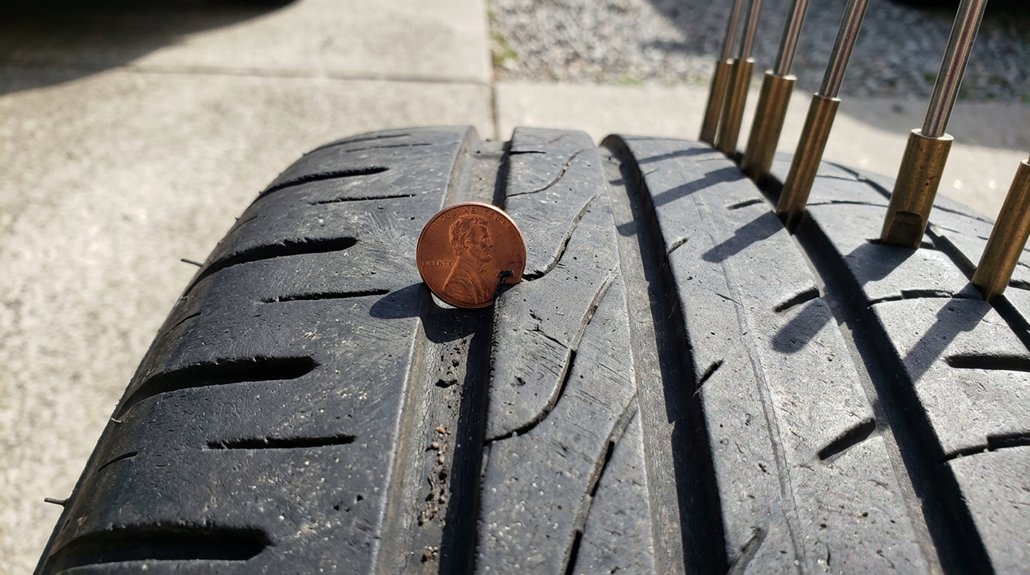
Nearly 11,000 tire-related crashes occur annually in the United States, and a significant portion involve tread depths below safe thresholds, a preventable failure that costs lives.
I’m going to show you why a single penny remains the most accessible diagnostic tool for this critical measurement, and what most drivers miss when they perform this test incorrectly.
What 2/32 Inch Means (and Why Lincoln’s Head Is the Perfect Measure)
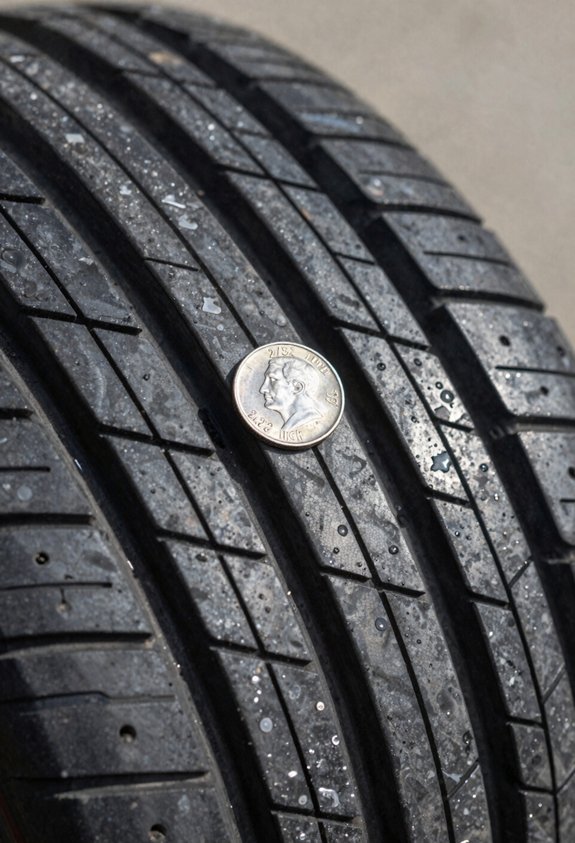
Why does a 2/32 inch measurement matter so much when I’m standing in my garage, penny in hand, wondering if my tires are still roadworthy? I’ve learned that this precise tread depth threshold represents the legal minimum in most jurisdictions, the point where tire safety becomes critically compromised.
The penny test works because Lincoln’s head sits exactly 2/32 inch from the penny’s edge; no special tools required. I insert the penny upside down into my tire’s grooves; if I can see all of Lincoln’s head, my tread has worn to that dangerous minimum.
However, I must caution you: passing this test only confirms I’m above the legal limit, not that I’m safe. Wet-weather performance degrades long before reaching 2/32 inch, meaning hydroplaning risks persist even when Lincoln’s head remains partially hidden.
Before You Start: Grab a Penny and Check These 3 Things
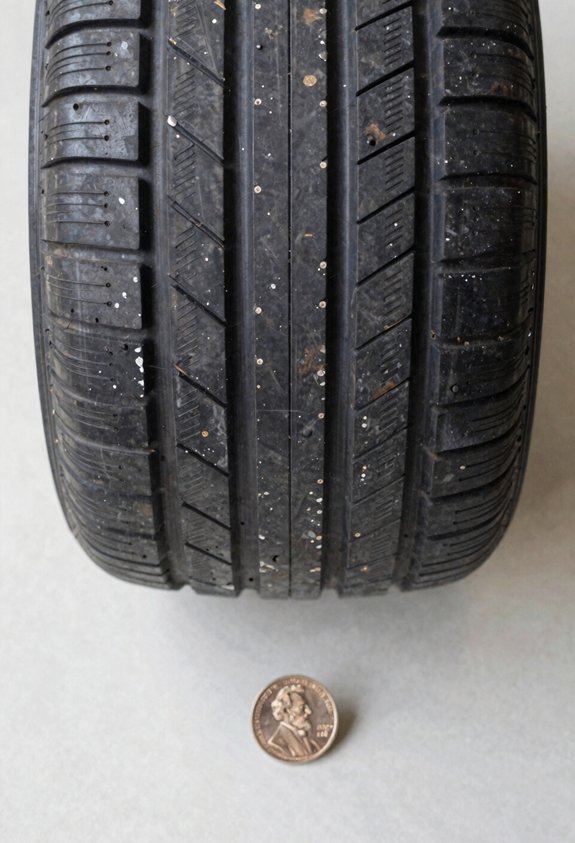
Before inserting that penny into your tire’s grooves, I’ll walk you through three critical preparatory checks that help you test the right spot, use an appropriate coin, and gather sufficient data points across the tire’s surface. You’ll need to verify your penny’s mint date isn’t excessively worn (which could distort Lincoln’s head profile), identify the primary circumferential grooves where water evacuation occurs rather than secondary tread features, and commit to testing at least three positions: inner shoulder, center rib, and outer shoulder.
Since uneven wear patterns can mask localized bald spots that compromise wet-weather performance, these steps matter. A hasty, single-point measurement might miss dangerous thin areas while giving false confidence about overall tire condition.
Penny Date Check
Where exactly should you position a penny to get an accurate reading, and how can you be certain your coin hasn’t become too worn to trust? I’ll walk you through the Penny Test, a straightforward method millions of drivers rely on.
Executing the Test
Insert your penny, Lincoln’s head facing downward and upside down, between two tread ribs. This positioning guarantees you’re measuring the deepest portion of the groove, not the raised wear indicators.
Interpreting Lincoln’s Head Visibility
- Visible head: You’ve hit the 2/32 inch threshold; replacement is urgent
- Hidden head: Tread depth exceeds minimums, though vigilance remains essential
Critical Verification Steps
I always check multiple locations: inner shoulder, center, outer shoulder. Uneven wear patterns develop from misalignment or improper inflation. One spot’s reading proves insufficient; thorough assessment prevents dangerous surprises on wet pavement.
Tread Groove Location
Once you’ve confirmed your penny hasn’t worn smooth enough to distort the measurement, you’ll need to know precisely where to insert it. The tread groove location matters immensely, because uneven wear patterns can mislead your assessment.
Identifying the Primary Groove
I insert Lincoln’s head into the deepest tread groove, the circumferential channel running parallel to the tire’s rotation. This isn’t merely convenient placement. It’s where tread depth measurements matter most, since shallow grooves here signal compromised wet traction and hydroplaning risk.
Avoiding Wear Indicators
I steer clear of the raised wear indicators (those 2/32 inch minimum bars molded between ribs), positioning the penny in untouched rubber valleys instead. The penny test fails entirely if you rest it atop these built-in markers rather than true groove bottoms.
Why Location Errors Occur
Some drivers mistakenly check decorative sidewall grooves or superficial siping, obtaining falsely reassuring readings. I focus exclusively on the main circumferential grooves, typically four to five per tire, where remaining tread depth actually determines performance.
Multiple Test Points
- Center groove: Insert the penny, Lincoln’s head down, between two tread ribs
- Inner edge: Repeat the penny test, watching for uneven thinning
- Outer edge: Final check, noting any disparity in tread depth
- Visible full head = legal minimum met, safety compromised
- Partial visibility = tread between 2/32 and 4/32 inch; monitor weekly, plan replacement within months
- Check if Lincoln’s head barely hides, this signals you’re above 2/32 inch but approaching the 4/32 inch threshold
- Recognize that reduced tread depth between 2/32 and 4/32 inch dramatically increases hydroplaning risk and stopping distances on wet pavement
- Schedule a professional tire inspection when you’re near that 4/32 inch mark, even if your penny test technically passed
- Tread depth at or below 4/32 inch, where wet stopping distances increase dramatically
- Wear indicators flush with the tread surface, signaling manufacturer-defined replacement thresholds
- Regional requirements below 2/32 inch, which may legally mandate earlier replacement than federal minimums
If Lincoln’s head shows anywhere, you’re at or below 2/32″. Even partial coverage doesn’t guarantee wet-weather safety; 4/32″ is my minimum for rain. I document all multiple test points to track wear patterns and decide: replace now, or seek professional evaluation?
Do the Penny Test Right in 7 Simple Steps
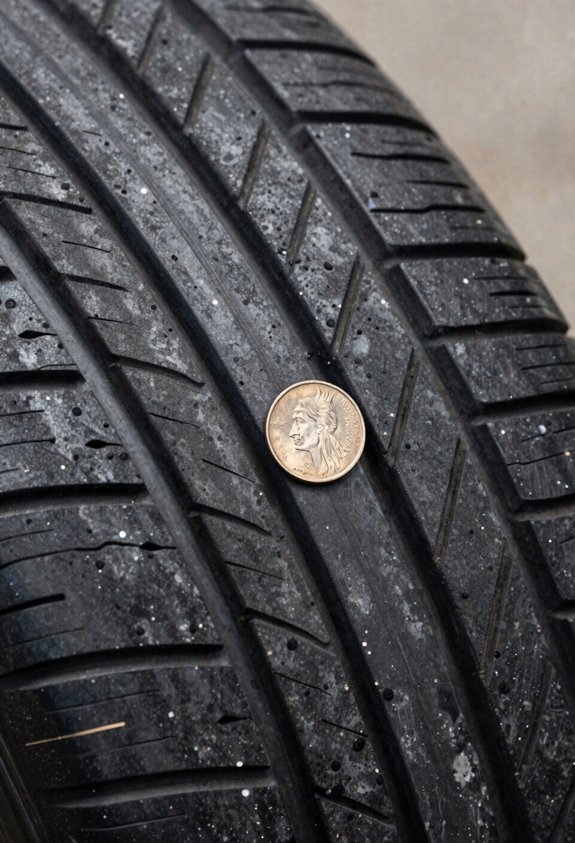
How exactly does one translate a simple coin into a reliable diagnostic tool? I insert a penny into the tread groove, positioning Lincoln’s head upside down and facing the tire surface—this orientation matters, as it aligns the top of his head with the 2/32 inches threshold that constitutes legal minimums in most jurisdictions. When I perform the penny test, I observe whether the top of Lincoln’s head remains visible between the ribs; if so, tread depth has reached critical levels, and replacement becomes advisable.
However, tire wear rarely distributes evenly, so I never rely on isolated measurements. Instead, I systematically check multiple locations around each tire, examining different ribs to identify irregular patterns that wear indicators might miss. Even when the penny test suggests adequacy, I recognize that remaining tread may still fall below safer thresholds for wet-weather performance.
—
Wait, I need to re-read the rules more carefully. The em dash rule says to replace with comma, colon, semicolon, or delete entirely. Let me revise:
How exactly does one translate a simple coin into a reliable diagnostic tool? I insert a penny into the tread groove, positioning Lincoln’s head upside down and facing the tire surface, as this orientation matters: it aligns the top of his head with the 2/32 inches threshold that constitutes legal minimums in most jurisdictions. When I perform the penny test, I observe whether the top of Lincoln’s head remains visible between the ribs; if so, tread depth has reached critical levels, and replacement becomes advisable.
However, tire wear rarely distributes evenly, so I never rely on isolated measurements. Instead, I systematically check multiple locations around each tire, examining different ribs to identify irregular patterns that wear indicators might miss. Even when the penny test suggests adequacy, I recognize that remaining tread may still fall below safer thresholds for wet-weather performance.
What Your Result Actually Means for Driving Safety
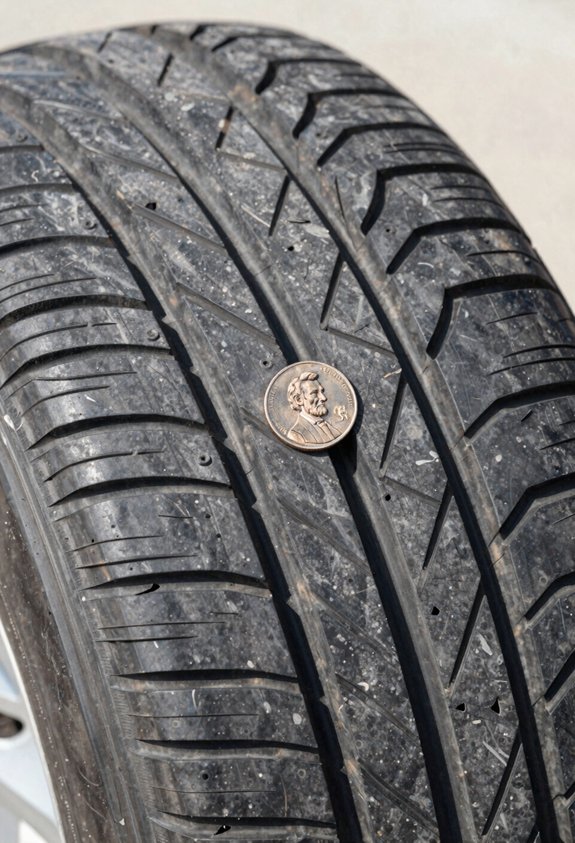
If Lincoln’s head shows completely through your tread, you’re at or below 2/32″ and need new tires immediately. But even when his head stays partially hidden, indicating depths between 2/32″ and 4/32″, you’re not entirely in the clear for wet-weather safety. I’ll break down exactly what each outcome means for your stopping distances, hydroplaning risk, and when that “pass” still warrants closer inspection or replacement before the next rainy season hits.
When Tires Fail the Penny Test
Even “passing” results near 4/32 inch reduce wet braking and increase hydroplaning risk. Check multiple grooves, inspect wear indicators (those raised bars between treads), and don’t ignore sidewall damage.
When tread fails the penny, your vehicle’s connection to the road fails too.
When Tires Pass Yet Need Attention
You might think you’re in the clear when Lincoln’s head disappears beneath the tread, but I’m here to tell you that “passing” doesn’t always mean “safe.” The penny test only confirms you’ve got more than 2/32 inch of rubber remaining, that’s the bare legal minimum, not the threshold for confident wet-weather performance.
Here’s what we need to watch for together:
We’re protecting everyone on the road when we look deeper than the minimum.
Why the Penny Test Misses the Full Picture
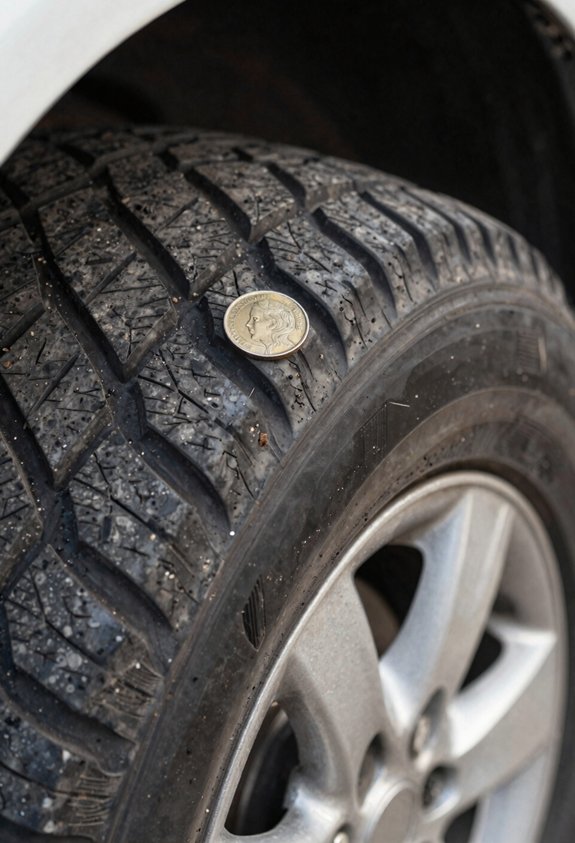
While the penny test remains a widely circulated method for gauging minimum legal tread depth, I’ve found through years of vehicle maintenance that relying solely on this 2/32-inch threshold creates significant blind spots in my safety assessment. Penny test accuracy suffers because this benchmark represents bare-minimum legality, not optimal protection.
When I measure tread depth at multiple points, I often discover uneven wear patterns, camber issues, toe misalignment, or inflation problems that the single-point penny check completely overlooks. The 2/32-inch standard also fails wet/winter safety requirements; hydroplaning resistance and snow traction degrade substantially before reaching this limit.
I treat these safety indicators as warning signals, not endpoints. True vigilance demands a thorough inspection across all four tires, recognizing that legal compliance and genuine road security represent fundamentally different standards.
When to Replace Tires (Even If You Pass the Test)
Most drivers assume passing the penny test means their tires are road-ready, yet I’ve learned this assumption creates dangerous gaps in my safety protocol. The penny test only reveals whether tread depth exceeds 2/32 inch, but I’ve discovered that wet braking performance degrades noticeably once tread reaches 4/32 inch, creating hydroplaning risks the penny test cannot detect.
Critical Replacement Triggers
I replace tires when any condition appears, regardless of penny test results, because my safety, and yours, demands proactive intervention before catastrophic failure.
3 More Reliable Ways to Check Tread Depth
Relying solely on Lincoln’s profile leaves me vulnerable to uneven wear patterns and premature hydroplaning risks, so I’ve adopted three complementary methods that expose what the penny test obscures.
The Quarter Test
I insert a quarter, Washington’s head down, into my tread grooves; visible hairline means I’ve hit 4/32 inches, the threshold where wet-weather performance degrades notably before the penny test’s 2/32-inch danger zone.
Multiple Measurements
I never trust single-point checks. I take multiple measurements across inner, center, and outer tread areas on all four tires, documenting variations that reveal alignment issues or inflation problems the penny test conceals.
Tread Depth Gauge
I pair visual shortcuts with a tread depth gauge for precision. This tool delivers readings in 32nds or millimeters, eliminating guesswork and confirming whether wear patterns warrant immediate replacement or merely closer monitoring.