
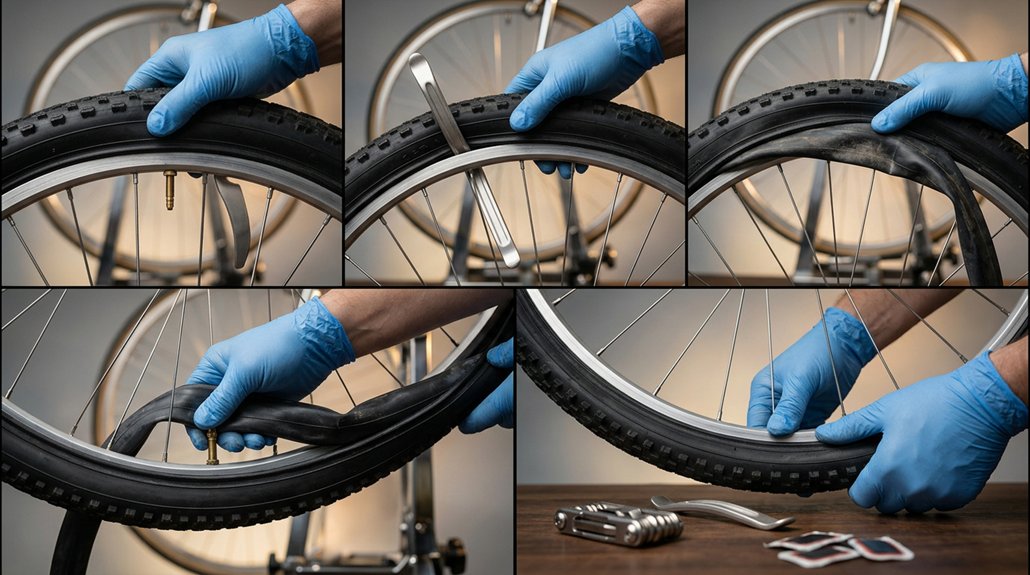
I’ll walk you through changing a bike tire tube in five critical steps, each one building on proper technique to prevent roadside failure. First, you’ll completely deflate the tire and unseat one bead (typically the side opposite your drivetrain on rear wheels) to extract the old tube without damaging the rim tape.
Next, this step is non-negotiable: you’ll inspect every inch of tire casing, rim bed, and the punctured tube itself, tracing leaks by inflation or submersion to locate embedded glass, wire, or spoke protrusions that caused the flat. You’ll then partially inflate your replacement tube to give it shape, align the valve with the rim hole (angled valves for deep rims require particular attention), and work both beads onto the rim by hand; never use tire levers here, as they’ll pinch or tear the fresh tube.
Inflation comes fourth: you’ll pump in bursts of 10–20 PSI, pausing to massage the tire into place and verify both beads seat evenly below the rim hook, checking for dangerous pinch points before reaching full pressure (typically 60–120 PSI for road tires, 30–50 for mountain).
Finally, you’ll reinstall the wheel, torque quick-release or thru-axle to manufacturer spec (usually 5–10 Nm), spin-check brake clearance, and verify pressure after five minutes of settling.
What most riders miss, specifically, the inspection phase, determines whether you’ll be repeating this repair in three miles or three thousand.
Take the Wheel Off and Let Out All Air
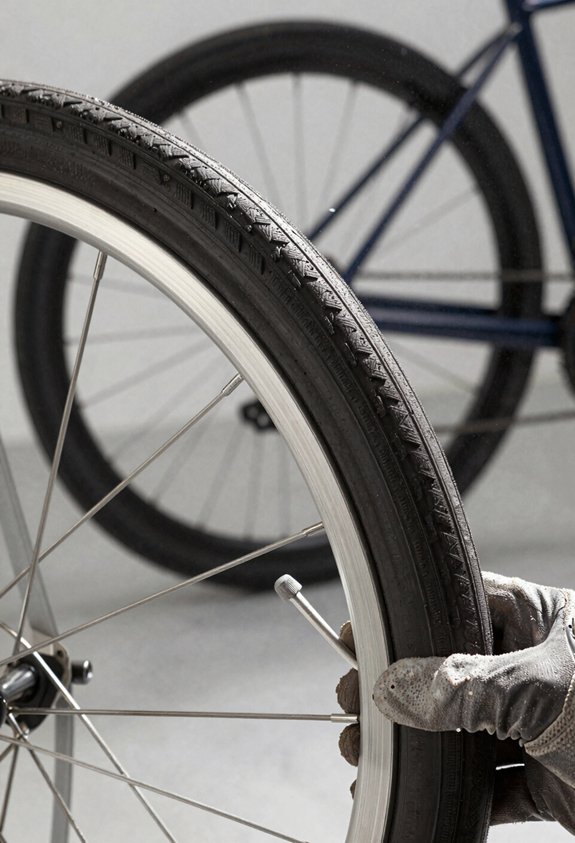
Before I can pull the tire off of its rim, I’ll start by letting out every last bit of air from the tube, since even residual pressure will fight me during bead removal and increase my risk of pinching the tube. I deflate completely by loosening the Presta valve barrel and pressing down, or depressing the Schrader valve pin to release air.
Once the tire is soft, I remove the wheel from the bicycle, making certain the bike stays stable so I can safely access the tire and tube. With the wheel free, I unseat the bead to create slack around the rim, which enables easier bead removal and tube access. If resistance persists, I partially deflate further to ease bead removal. I keep my hands clear of the rim bed during this process to avoid injury and allow safe tire separation, protecting against secondary puncture risks.
Find What Caused the Flat Before You Remove the Tube
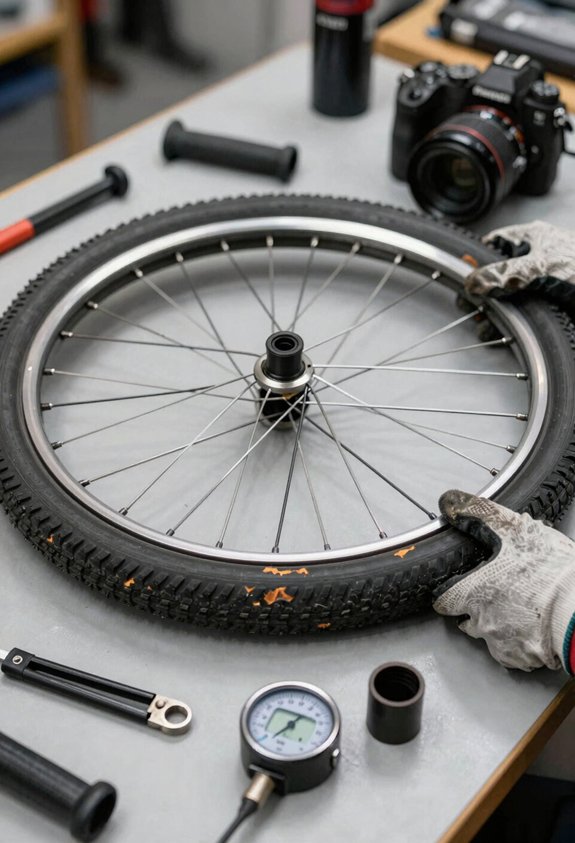
Why risk another flat within minutes of installation? I’ll inspect everything systematically, because finding the cause now saves us from repeating this ordeal.
First, I’ll run my fingers carefully inside the tire, feeling for debris: glass shards, wire fragments, or thorns that embedded during the ride. I’ll check the tire bead for proper seating and examine sidewalls for rips or rim/sidewall damage that could worsen under pressure. The rim tape demands attention too; I’ll verify it’s intact, covering spoke holes completely, since exposed edges mean certain puncture.
Once I’ve removed the inner tube, I’ll inflate it slightly, listening for escaping air or submerging it to spot bubbles. Two holes side-by-side mean I’ve found a pinch flat, the telltale signature of under-inflation.
Pop the Tire Off the Rim and Remove the Old Tube
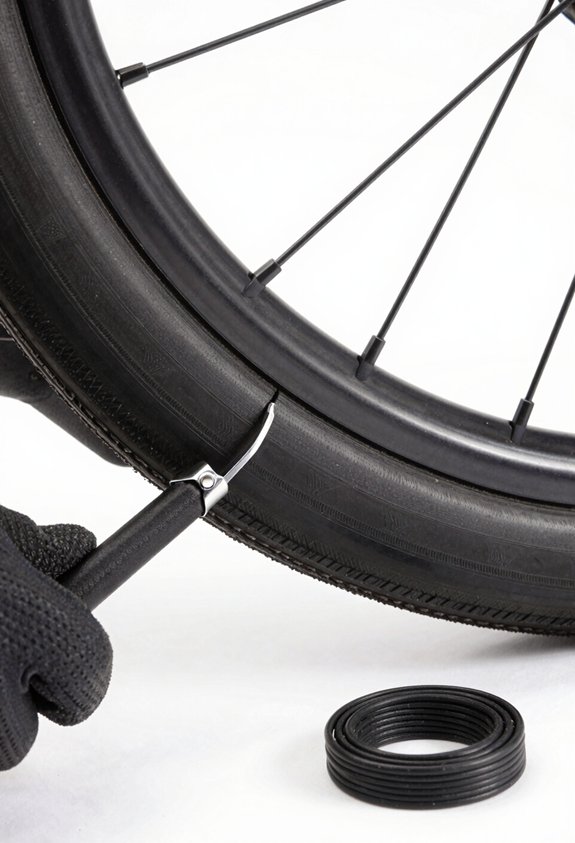
How do we get this tire off without damaging the rim or injuring ourselves? First, I deflate the tire completely, depress the valve, and remove the wheel to create slack for bead removal. I unseat the tire bead from the rim by loosening one side first, starting away from the valve, which gives me access for tube removal.
I push the bead toward the rim center with both thumbs to create slack, then use a tire lever as needed to lift the bead over the rim edge. I work around the wheel until one side of the bead is free, then pull the old inner tube out starting at the valve area. I remove debris, check the tyre for embedded objects, inspect the tube for the puncture cause, and set it aside. I’ll inflate the tube later to find the leak.
Push the New Tube and Tire Onto the Rim by Hand
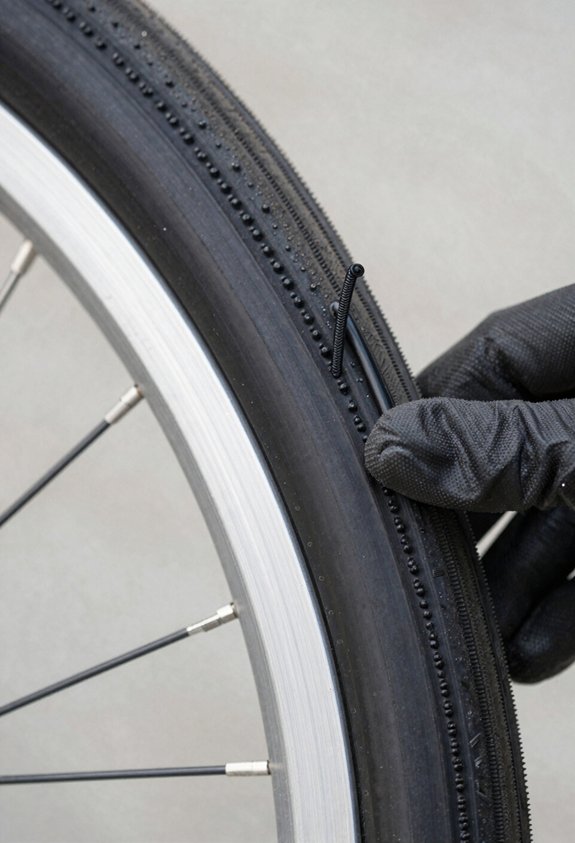
I’ll inflate the new tube just enough, roughly 10-15 PSI, to give it structure without making it rigid, then thread the valve stem through the rim hole, making certain it sits flush and aligned toward the hub.
Hand Installation Technique
I nest the inner tube inside the tire, working it evenly around the rim bed while keeping the tube centered between the tire bead and rim wall. Starting opposite the valve, I roll the first tire bead onto the rim using both thumbs, moving gradually toward the valve. I check frequently, every few inches, that no tube material pinches beneath the bead, which would cause immediate puncture repair failure upon inflation.
Critical Checks
I verify the valve stem stays straight toward the hub, critical for proper bead seating later. Unlike tubeless tolerance setups, this hand installation demands precision; I avoid tire lever use here, as levers risk tube damage.
When both beads sit partially seated, I pause, confirming uniform placement before final inflation.
Inflate to Seat the Beads, Check Both Sides, Then Remount
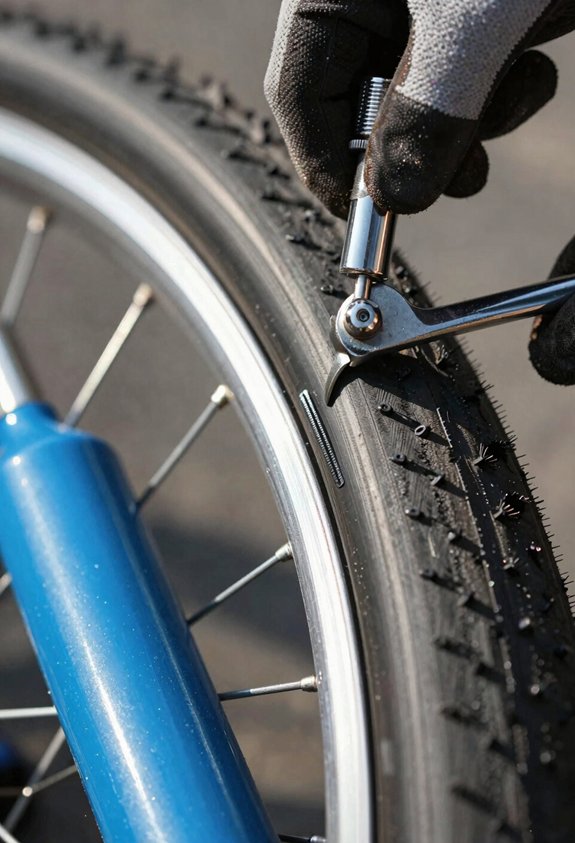
Where precisely should initial inflation stop? I inflate the tire tube just enough to hold its shape, which lets me work the tire bead onto the rim evenly on both sides.
Bead Seating and Verification
I check bead seating by watching for a consistent bead seating line above the rim, plus that molding line manufacturers include; if I spot bulges or dips, I deflate partially before proceeding. When a stubborn tire bead resists, I’ll apply soapy water, never oil or grease, since lubricants that stay slippery cause the bead to slip and ruin proper seating.
Final Inflation and Remount
Once both sides show even bead seating, I reinstall the valve nut finger-tight, then inflate to final pressure. I inspect again: any tube pinching between bead and rim means starting over. After confirmation, I remount the wheel.