
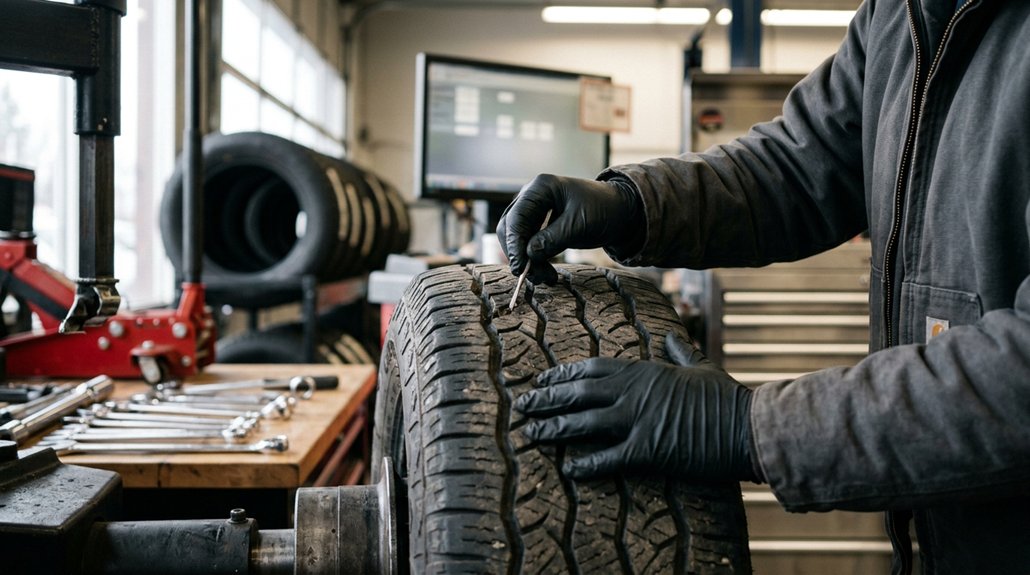
I’ll tell you what you’re actually paying for when you roll into a shop with a nail in your tread. In 2026, a proper repair runs you $20–$50, but that number hides what separates a five-year fix from a dangerous shortcut. Most drivers don’t realize the method matters more than the price, and one choice could leave you stranded, or worse.
Can Your Tire Be Repaired? Or Do You Need a New Tire?
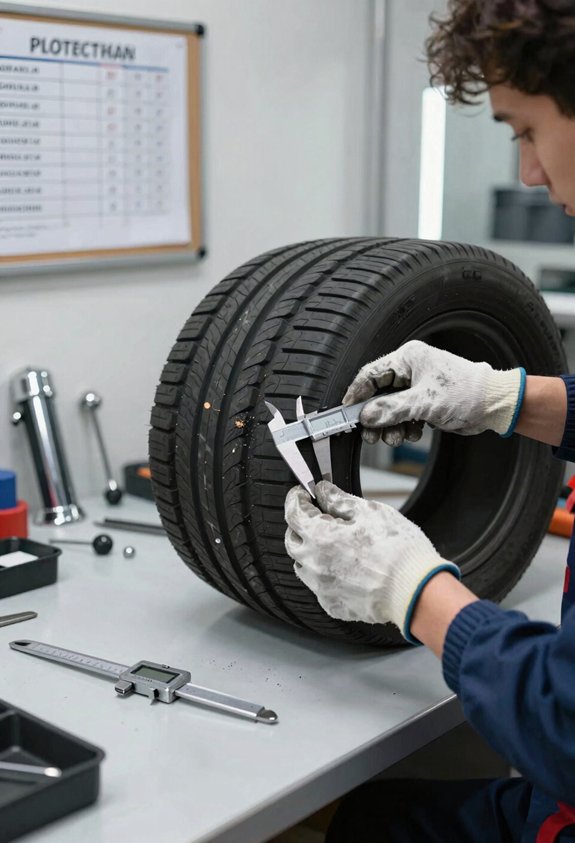
Whether you’ve just discovered a nail in your tread or heard the telltale hiss of escaping air, your first question is inevitably whether this damage spells a quick repair or a costly replacement. Not all punctures qualify for salvation, and knowing the difference keeps you safe and saves money.
The Repairable Zone: Your tire’s repairable zone is strictly limited to the tread face, excluding sidewalls and shoulders where flexing destroys any fix. Damage there demands immediate replacement.
Tread Depth Matters: When I measure less than 4/32 inch remaining, I always recommend replacement over repair since shallow tires perform poorly regardless of patching.
Proper Patch Technique: Inside patch-plug repairs, involving tire removal, internal inspection, sealing, and rebalancing, provide permanent solutions that outlast plug-only alternatives.
Tire Repair Costs: DIY Kits vs. Shop Service
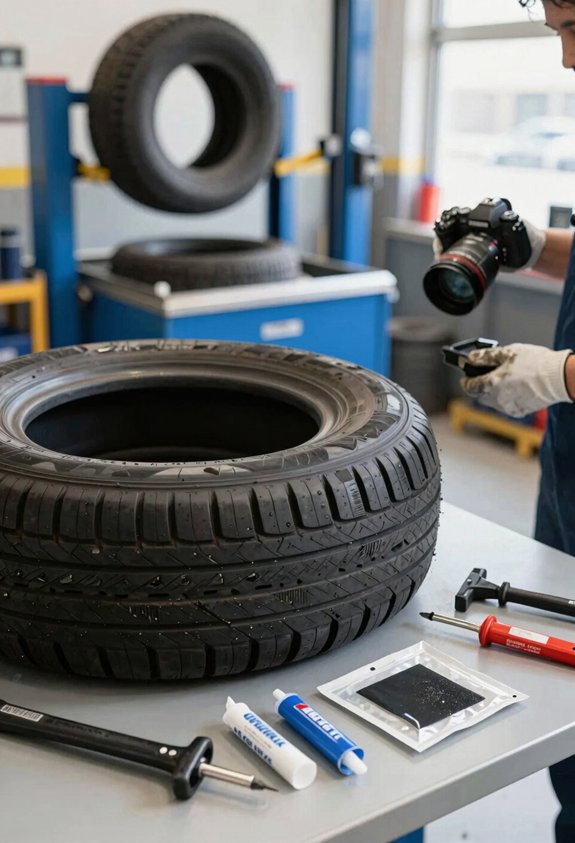
There’s no universal answer to what tire repair will cost you, since I’ve watched prices fluctuate dramatically based on whether you’re patching the tire yourself in your driveway or handing it off to a professional shop with specialized equipment.
DIY Kit Costs
A DIY kit runs $2–$17, covering the tire patch material, cement, and tools; you’ll supply the labor and jack. No shop fees, no waiting.
Shop Service Pricing
Professional repairs average $30–35, where labor dominates: technicians remove the tire, apply internal patches, reseal, remount, and rebalance. Some shops waive fees if you bought tires there; others add $10–20 for low-profile or run-flat configurations.
Critical Consideration
Regarding patch vs plug, I’ve learned that plugs offer quick roadside fixes, but shops prefer internal patches for lasting integrity. Your choice between DIY kit convenience and professional thoroughness depends on your skill level and safety priorities.
Patch, Plug, or Patch-Plug: Which Method Lasts?
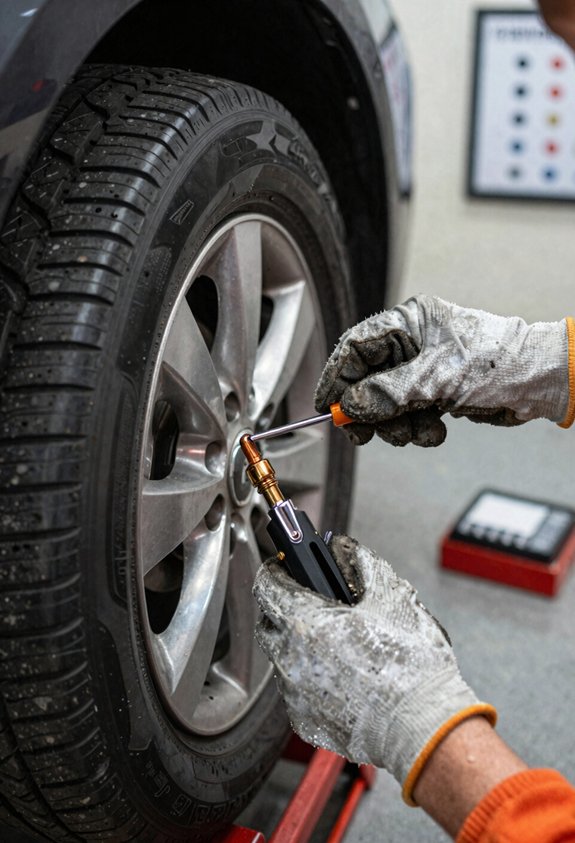
Your decision between handling a repair yourself or visiting a shop shapes which method you’ll actually end up using, and I want to walk you through why that distinction matters more than most drivers realize.
- Patch-plug combination delivers the strongest repair durability, bonding an interior patch with a through-the-hole plug for permanent sealing.
- Patch-only repairs require tire removal, inspection, grinding, and sealing, typically lasting up to five years when properly executed.
- Plug-only fixes run $5–$10, offering short-term solutions for simple tire puncture scenarios.
- Sidewall damage permanently disqualifies any repair method; replacement becomes mandatory.
I always recommend professional patch-plug service. Unlike plugs alone, quality repairs include rebalancing and resealing, with the interior patch providing better structural integrity. Never gamble with sidewall damage; safety demands replacement, not compromise.
Why Larger Tires Cost More to Fix
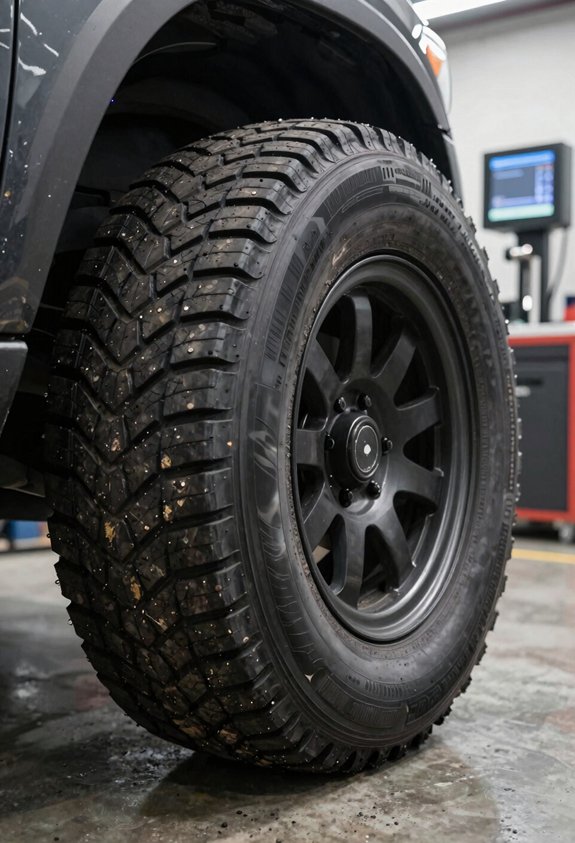
Why do larger tires drain your wallet faster at the repair shop?
Heavier Components, Longer Labor Time
Larger tires, especially 18-inch diameters and beyond, demand considerably more physical effort and labor time during removal, reseating, and mounting procedures. Large truck and SUV tires weigh substantially more than standard passenger sizes, which extends technician hours and increases repair costs accordingly.
Specialized Equipment Requirements
Performance and low-profile configurations require advanced machinery, adding complexity that translates directly into higher pricing structures. These specialized tools represent capital investments shops must recoup through service fees.
Bead/Sealing Work Vulnerabilities
I’ve observed that larger tires present elevated risks for bead/sealing work complications, particularly when rim interfaces sustain damage or corrosion. This additional restoration step compounds labor time and material expenditures.
Installation Cost Premiums
Expect approximately $10 surcharges per tire for 18-plus-inch installations compared to smaller alternatives, an incremental expense that accumulates quickly across full sets.
Extra Charges: Balancing, Valve Stems, and TPMS Resets
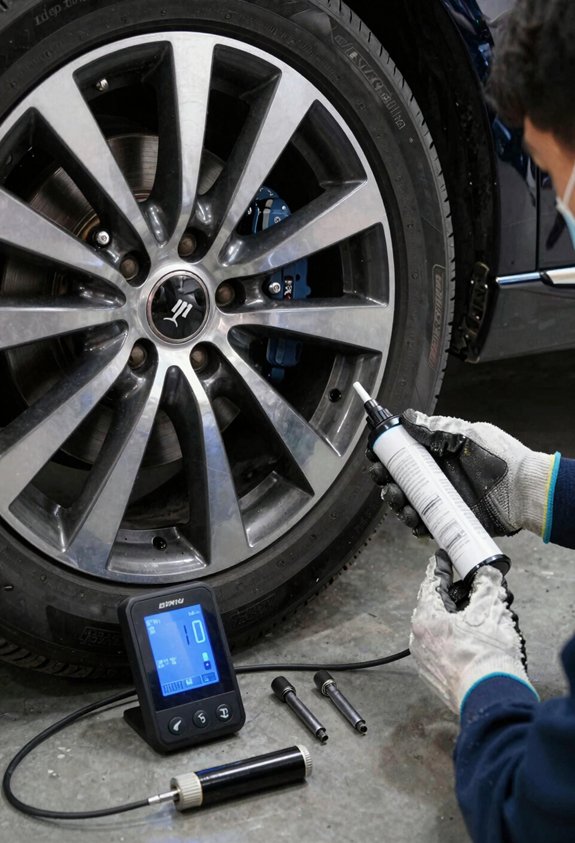
- Balancing ($10–$20 per tire) ensures even weight distribution, preventing vibration and premature wear.
- Valve stem replacement, sometimes bundled, sometimes itemized, seals the inflation system properly.
- TPMS resets ($0–$20) recalibrate your tire pressure monitoring system, which newer vehicles require post-repair.
- Specialty surcharges ($10–$20 extra) apply to run-flat, low-profile, or truck tires, reflecting labor complexity.
Local labor rates determine whether shops bundle these services or invoice separately, so I always ask upfront.
Tire Repair Prices by Region and Shop Type
I’ve noticed that where you live and where you take your tire can shift your repair bill significantly, since regional labor rates and local competition create measurable gaps between markets. Shop pricing diverges just as sharply, with independent garages often undercutting dealership service centers by $10–$15 on comparable patch-plug repairs, though you’ll want to verify they’re using certified patch-plug combinations rather than temporary plugs.
Understanding these layered variables, geographic cost indexing, facility overhead, and technician certification, lets you anticipate realistic estimates before you hand over your keys.
Regional Cost Variations
Where exactly you’ll need a tire repaired in 2026 matters nearly as much as the damage itself, since I’ve observed regional price spreads of $20–$50 for a standard inside patch with rebalancing, with metropolitan centers and dealership-adjacent shops consistently commanding the higher end of that spectrum. I’ve noticed places like Pritchett Tire keep costs modest, while urban balancing/TPMS services inflate your bill by $10–$20.
Regional pricing reflects labor disparities, warranty structures, and whether you’re near a dealership corridor versus independent tire repair shops. Sidewall damage, unrepairable per industry standards, forces replacement, amplifying cost gaps between regions with inexpensive patch options and those lacking them.
Key Regional Pricing Factors
- Metropolitan markup: Urban centers add 30–40% to base inside patch rates
- Labor rate zones: Coastal and mountain states carry higher hourly shop fees
- Warranty networks: Dealer-adjacent regions restrict affordable alternatives
- Damage prevalence: Areas with construction debris see more puncture volume, stabilizing competitive pricing
Shop Pricing Differences
I’ve analyzed tire repair costs across Jacksonville Southside, and the disparities reveal how shop type shapes price ranges. Standard shops charge $20, $50 for simple flat repairs, while large centers offer quick patches at $15, $25, barely covering proper labor.
An inside patch with inspection and rebalance runs $25, $45 at reputable establishments, though inner patch-plug repairs (including removal, resealing, remounting, and rebalance) hit similar regional pricing tiers. Watch for surcharges: low-profile, run-flat, or truck tires add $10, $20. These fluctuations reflect equipment quality and technician certification, not mere geography. You’re paying for expertise, not just rubber and glue.
How Long Does a Tire Repair Last?
- Proper patch-plug installation (tire off-rim, sealed interior) provides permanent results
- Puncture location in the central tread area enables safe, lasting repairs
- Sidewall or shoulder damage generally voids repair eligibility entirely
- Post-repair rebalancing; TPMS reset help maintain even wear and monitoring accuracy
Are Patched Tires Safe for Highway Driving?
A patch, applied inside the tire, not a plug shoved through from outside, creates a permanent, structural repair. Technicians remove the tire, inspect interior damage, apply sealant-backed patches, then remount and rebalance. This process, typically $20–$50, addresses tread punctures exclusively; sidewall or shoulder damage demands immediate replacement.
Highway-Specific Considerations
For sustained highway driving at elevated speeds, I consider inside-patched tires acceptably safe when puncture diameter stays under ¼-inch, repair location centers in the tread, and post-repair balancing and TPMS reset occur.
Never compromise on patch-plus-inspection quality; your highway safety depends on it.
Mobile Tire Repair: What On-Site Service Costs
Where convenience meets necessity, mobile tire repair brings the shop to your driveway, workplace, or roadside breakdown location. You’ll typically invest $20–$50 for a professional inside patch, plug, or combined patch-plug repair that includes inspection and rebalancing in most markets. Jacksonville Southside and comparable regions follow this pricing structure closely.
I appreciate the transparency in on-site service cost structures, though you’ll want to watch for these variables:
- Specialty tire surcharges: Run-flat or low-profile designs may add $5–$15 to your mobile tire repair bill
- Service bundling: Tire mounting/balancing / TPMS reset typically runs $10–$20 extra when required
- Repair limitations: Bead damage or sidewall compromise means replacement, not patch-plug repair
- Value proposition: DIY kits cost $2–$17, yet professional service guarantees proper sealing, safety verification, and balancing
You’re joining discerning drivers who prioritize certified workmanship over uncertain shortcuts.
What Tire Warranties Actually Cover
While mobile repair costs are straightforward, your out-of-pocket expense might drop markedly depending on what’s written in your warranty paperwork. I want you to understand what tire warranties actually include before you’re stranded roadside.
Tire Warranties: Core Components
| Coverage Type | What’s Included | Typical Limitations |
|---|---|---|
| Road-hazard | Nails, glass, pothole damage | Sidewall punctures, off-road abuse |
| Repair coverage | Patching, plugging labor | Delayed reporting, improper inflation |
| Prorated credits | Partial replacement cost | Tread depth below 2/32″, age thresholds |
| Maintenance requirements | Free rotation inspections | Missed service intervals void claims |
Most manufacturers structure repair coverage by tire category, standard, run-flat, or high-performance, each carrying distinct terms. I’ve noticed shops often waive patching fees entirely when you purchased from them, effectively extending road-hazard protection at no charge.
Your eligibility depends on documented maintenance: rotations, pressure checks, and prompt damage reports. Ignore these requirements, and prorated credits disappear when you need them most.
Should You Repair One Tire or Two?
How urgently you need to stop driving depends on whether that puncture sits in the tread’s repairable zone or has crept into the sidewall; once I’ve inspected the damage, I’m weighing whether your vehicle demands a single patch-plug service or a paired replacement to maintain safe handling.
When One Tire Repair Suffices
A solitary patch-plug repair, costing $25–$45 in most Jacksonville shops, works when your tread damage is central, clean, and sidewalls remain intact. This method, combining interior patching with exterior plugging, delivers permanence plug-only fixes ($5–$10) cannot match.
When Two Becomes Necessary
Sidewall damage or shoulder punctures force replacement, and I’m advising paired installation to stop uneven wear and handling instability.
- Tread depth differential: Exceeding 2/32″ between axles risks differential strain.
- Drivetrain configuration: AWD systems demand tighter tolerance, often 4/32″ maximum variance.
- Tire age: Mismatched rubber compounds accelerate degradation.
- Shop credits: Prorated warranties often offset second-tire costs.
Finding Same-Day Tire Repair Near You
I’ll locate nearby shops by checking online directories and calling ahead to confirm same-day availability, since many locations fill their service bays quickly, especially for labor-intensive repairs like inside patches with rebalancing.
I’ve found that mobile repair options offer convenient alternatives, though they typically charge $60–$100 for call-out fees on top of standard repair costs, and they cannot address sidewall damage requiring full replacement.
When scheduling same-day service, I always ask whether the shop handles TPMS resets and surcharges for specialty tires, as these factors affect both total cost and whether the repair can actually be completed within hours.
Locating Nearby Shops
- Verify their price range upfront: standard inside patches typically run $20–$50, though quick plug options at large centers sometimes hit $15–$25.
- Confirm they offer true same-day service, not next-day scheduling disguised as urgency.
- Ask about surcharges ($10–$20) for low-profile, run-flat, or truck tires before arriving.
- Assess repairability boundaries immediately; bead or sidewall damage usually voids patch options, forcing replacement and disrupting your timeline.
Regional consistency around $20–$25 for inside-patch repairs gives me negotiating confidence, yet I always cross-check whether TPMS resets or rebalancing inflate quoted figures beyond base rates.
Same-Day Availability
| Repair Type | Typical Same-Day Cost |
|---|---|
| Quick patch or plug | $15–$25 |
| Inside patch with rebalance | $20–$50 |
| TPMS reset add-on | $10–$20 |
| Large truck/low-profile surcharge | +$10–$20 |
| Sidewall damage (replacement) | $80–$200+ |
Most tread punctures qualify for 25-minute patch-plug repairs, but sidewall damage means you’re buying new rubber, no exceptions.
Mobile Repair Options
- Verify patch quality: insist on interior patches with the tire dismounted, not exterior plugs
- Confirm full service: rebalance and TPMS reset should accompany repairs
- Understand limitations: bead or sidewall damage requires replacement, not field repair
- Compare value bundles: some waive patch fees with tire purchases
Research multiple local providers before committing, as coverage areas and equipment vary notably.
Repair or Replace: Full Cost Comparison
When you’re staring at a punctured tire, the first question that crosses your mind is whether you can patch it or if you’re facing a full replacement bill, and I’m here to walk you through the financial reality of that decision.
A proper patch repair runs you $20–$50, with budget chains offering $15–$25 temporary fixes, though I recommend the inside patch method. It’s permanent, requires tire removal, resealing, remounting, and rebalancing, but it keeps you safely on the road.
Compare that to replacement at $191–$203 per tire, including parts, labor, balancing, stems, and disposal fees.
Here’s where we need to be smart together: sidewall or shoulder damage demands replacement, no exceptions, while tread punctures qualify for repair. Remember, replacing tires in pairs protects your handling and wear patterns, potentially doubling your cost but safeguarding your ride.