
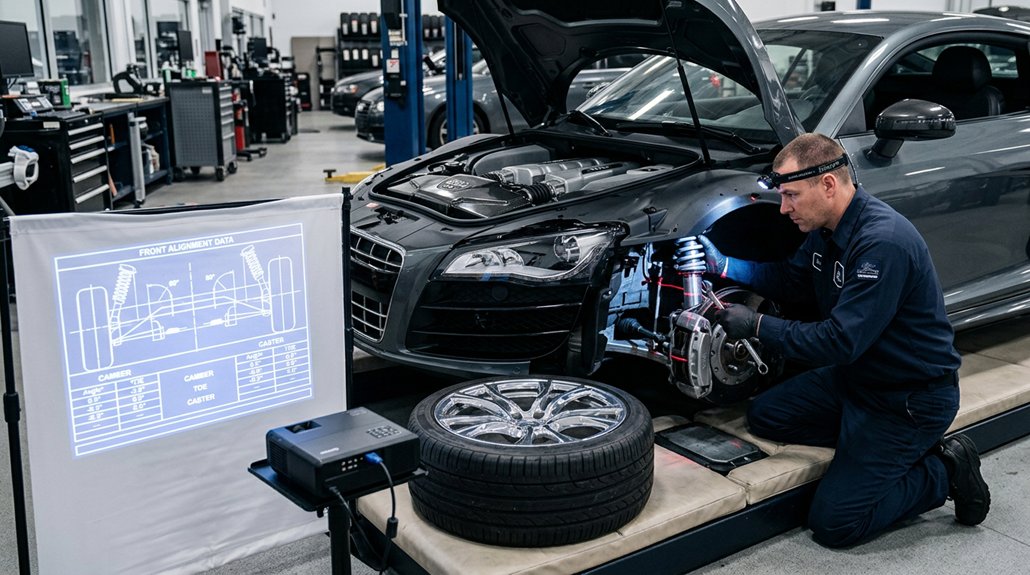
Coincidentally, I had just finished explaining alignment timing to a fleet manager when your question arrived. Most drivers underestimate the process; it’s rarely the “quick service” they’d expect. I’ll break down exactly what determines your wait, but first you’ll need to understand which type of alignment your vehicle actually requires.
How Long Does a Wheel Alignment Take?
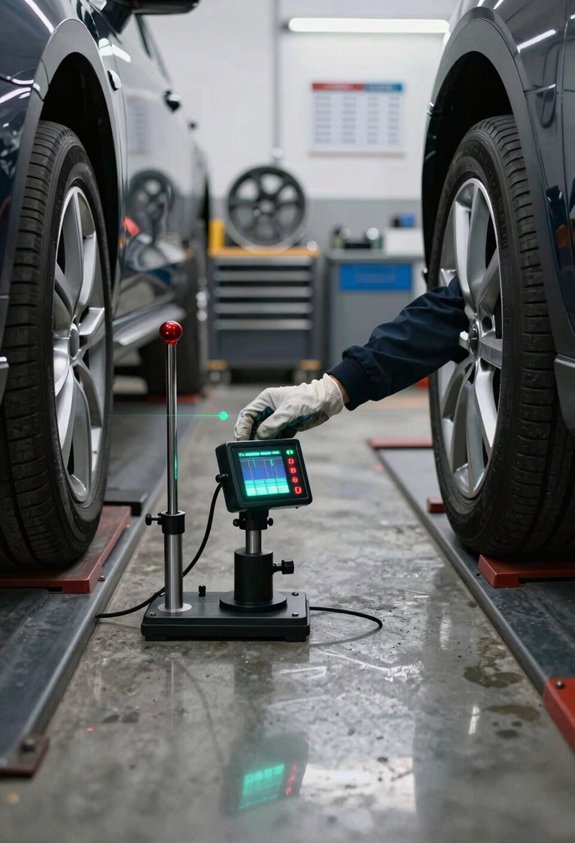
I’ll always recommend scheduling extra time, particularly for four-wheel alignment procedures, since rear angle verification and thrust angle correction demand additional precision. Following adjustment, a brief test drive confirms steering response and straight-line tracking, making sure your investment delivers measurable safety and tire longevity benefits.
Front-End vs. Four-Wheel Alignment: What’s the Time Difference?

While standard alignment procedures follow predictable patterns, the scope of work expands considerably depending on whether you’re addressing just the front wheels or the entire vehicle geometry. I’ve broken down what you can expect so you’ll feel confident walking into any shop.
| Alignment Type | Typical Duration |
|---|---|
| Front-end alignment | 30–60 minutes |
| Four-wheel alignment | 60–90 minutes |
| With worn suspension condition | Adds 15–30+ minutes |
A front-end alignment handles steering angles on drive wheels, while four-wheel alignment adjusts rear geometry too, essential for vehicles with independent rear suspensions. Computerized equipment streamlines measurements, though your suspension condition ultimately dictates actual time. Shops using modern systems complete alignments faster than manual methods, but corroded bolts or seized adjusters extend the process regardless of technology.
What Slows Down a Wheel Alignment?
I’ve seen alignments stretch well past the standard 30–90 minute window when Vehicle Condition Issues and Alignment Complexity Factors come into play, and these delays often catch owners off guard. Worn suspension components, rusted fasteners on older vehicles, or the need to correct uneven tire wear before adjustments can begin will add significant time. Aftermarket modifications or stubborn hardware that refuses to cooperate will also extend the process.
Alignment Complexity Factors introduce additional challenges. Four-wheel systems requiring thrust angle verification, advanced adaptive suspension, or larger trucks with intricate geometry compound the technician’s workload. Digital recalibration that extends beyond basic mechanical adjustment adds further time to the job.
Vehicle Condition Issues
Because your vehicle’s underlying condition directly shapes how smoothly an alignment proceeds, I need to examine several mechanical factors that commonly extend service time beyond standard estimates.
Mechanical Factors Extending Alignment Time
- Suspension issues involving damaged or worn components prevent completion until repairs or replacements occur, directly increasing alignment time.
- Corrosion on rusted or seized fasteners demands additional labor to loosen or treat during setup.
- Worn components in older, high-mileage vehicles, including bent parts, create adjustment difficulties that complicate the process.
- Complex suspension systems, such as independent rear configurations with multiple control arms, inherently require more extensive calibration.
Addressing severe tire wear patterns beforehand adds necessary steps. Honest assessment of your vehicle’s condition helps us set realistic expectations together.
Alignment Complexity Factors
Several distinct variables govern how long your alignment will take, and I’ve found that understanding these complexity factors upfront helps you plan appropriately.
Alignment Type
A two-wheel alignment (30–60 minutes) adjusts only your front wheels, while a four-wheel alignment demands 60–90 minutes because it corrects both axles and verifies thrust angle for complete geometry.
Suspension Complexity
Advanced suspension systems, including independent rear configurations and multi-link setups in sports and luxury vehicles, complicate adjustments and extend alignment time beyond baseline estimates.
Equipment and Condition
Wear or damage requiring repairs delays completion significantly. However, computerized alignment systems accelerate the process through rapid, precise measurements compared to manual methods, though complex underlying issues still constrain overall speed.
How Do You Know Your Car Needs an Alignment?
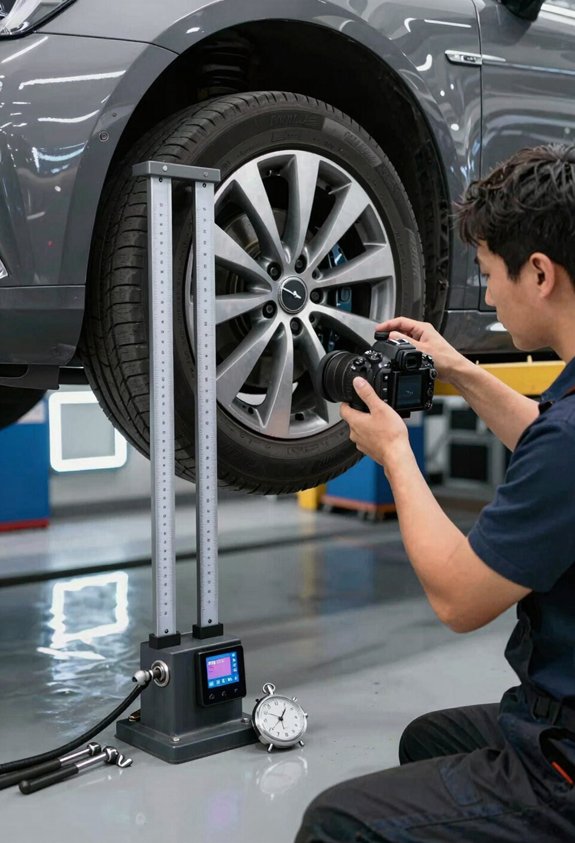
How can you tell when your vehicle’s suspension geometry has drifted from manufacturer specifications? I notice the warning signs before they escalate into costly repairs, and you should too. Your car communicates distress through specific symptoms that demand attention.
Watch for these indicators:
- Pulling to one side when driving straight, forcing constant correction
- Uneven tire wear patterns across tread surfaces, indicating camber or toe misalignment
- Steering wheel sitting off-center when traveling forward, revealing caster deviation
- New vibrations at speed and reduced fuel efficiency from increased rolling resistance
After hitting a curb, replacing tires, or completing suspension work, I always recheck alignment status. A four-wheel alignment addresses full geometry, while two-wheel service handles front-end adjustments. Don’t ignore tire screech or delayed return-to-center steering, as these demand prompt professional evaluation to prevent accelerated component degradation.
What Happens During a Wheel Alignment?
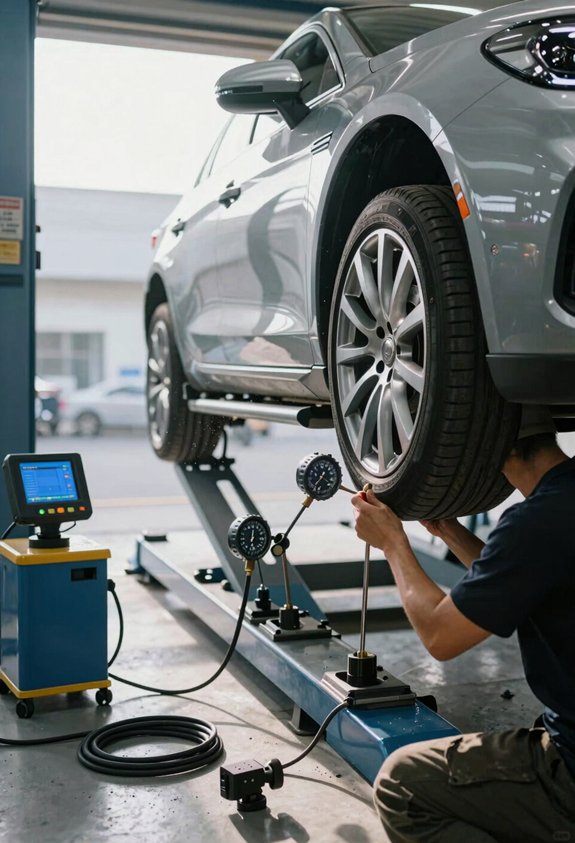
I want to walk you through exactly what technicians do during a wheel alignment, starting with the Initial Inspection Process. Here they’ll check your suspension, steering components, tire pressure, and tread wear for damage that could compromise the adjustment.
Next comes Angle Adjustments Explained, which covers how they use computerized sensors on an alignment rack to measure and correct your camber, toe, and caster angles to manufacturer specifications (typically between 0.5–2.0 degrees, depending on vehicle make). Then they verify the repair with test drives to confirm your steering wheel centers and your vehicle tracks straight.
Initial Inspection Process
- Suspension bushings, ball joints, and tie rod ends for excess play or damage
- Tire pressure readings and tread wear patterns indicating problems
- Steering wheel position relative to straight-ahead vehicle travel
- Computed angle measurements against OEM tolerance ranges
Angle Adjustments Explained
Once the initial inspection confirms your suspension and steering components are serviceable, I’ll begin the actual angle adjustments using a computerized alignment machine that measures your wheels’ precise positioning against manufacturer specifications. Camber, the inward or outward tilt of your wheels when viewed from the front, gets corrected first, typically requiring adjustment of the upper control arm or strut mounting bolts to bring readings within ±0.5° of factory tolerance (excessive positive camber causes outer tire wear, while negative camber reduces stability).
Next, I address caster, the forward or backward tilt of your steering axis, which affects straight-line stability and steering return; most vehicles require positive caster between 2° and 5°, adjusted via strut rod or control arm positioning.
Finally, toe, the inward or outward angle of your tires when viewed from above, receives precise calibration, since even minor deviations (as little as 0.1°) accelerate tire wear dramatically. Throughout your wheel alignment, each adjustment follows strict sequential protocols, so your suspension inspection findings translate into measurable, road-ready geometry.
What Does Wheel Alignment Cost?
How much wheel alignment costs depends on several interrelated factors, though I can provide you with reliable benchmarks based on industry standards and regional variations. Your wheel alignment cost typically ranges from $50 to $75 for a front-end alignment to $100 to $150 for a four-wheel alignment, though regional labor rates and shop prestige create meaningful variation. I’ve noticed alignment duration directly influences pricing, as extended diagnostic time for compromised suspension condition demands additional technician hours.
Labor rates in metropolitan areas often exceed rural counterparts by 30 to 50 percent. Vehicle complexity, particularly advanced adaptive suspensions, necessitates specialized equipment. Damage assessment prior to alignment adds diagnostic fees when worn components require replacement. Package deals bundling alignment with tire purchases frequently reduce per-service costs.
Suspension condition critically impacts final pricing, as pre-existing damage must be remedied before proper adjustment becomes achievable.
Should You Get an Alignment With New Tires?
When you invest in new tires, you’ll want to maximize their lifespan and performance, which is why I always recommend considering alignment timing alongside your purchase. Installing fresh rubber onto misaligned suspension components can accelerate uneven wear patterns, effectively nullifying the warranty protection and tread longevity you’ve just paid for.
Getting an alignment with new tires means your wheels are properly calibrated to manufacturer specifications, safeguarding your investment while optimizing handling characteristics and fuel efficiency.
Alignment Timing Considerations
- Larger vehicles require extended service windows
- Computerized systems accelerate measurement precision
- Corroded hardware necessitates additional extraction effort
- Every service concludes with a mandatory post-alignment test drive
Your vehicle’s condition ultimately dictates the clock, so I recommend budgeting flexibility when corrosion or damage demands unexpected attention.
Tire Protection Benefits
Anyone investing in new tires should recognize that alignment isn’t merely an optional add-on: it’s a protective measure that directly safeguards that investment.
Preventing Premature Tire Wear
I’ve seen countless drivers replace tires prematurely due to preventable alignment issues. When your wheels aren’t properly positioned, uneven tire wear accelerates dramatically, shredding tread life and forcing repeat purchases.
Alignment Duration and Protection
The alignment duration, typically 30–60 minutes for front-end service, or 60–90 minutes for four-wheel alignment, is minimal compared to replacement costs. Your suspension condition directly impacts this timeframe; worn components require replacement first, extending service but providing lasting results.
Making the Investment
Computerized alignment offers precision that manual methods can’t match, properly adjusting thrust angles and camber to factory specifications. You’re joining informed vehicle owners who understand that protecting new tires through immediate alignment isn’t expensive; it’s smart prevention that preserves performance, safety, and your wallet.
How Long Does Wheel Alignment Last?
The duration a wheel alignment lasts depends heavily on your driving conditions, maintenance habits, and the quality of the original service, though most manufacturers and technicians generally recommend scheduling a check every 6,000 to 12,000 miles, or roughly once per year, whichever comes first.
Your wheel alignment duration stretches when I’ve helped you understand what protects it:
- Smooth highways preserve adjustments longer than potholed streets
- Conservative driving reduces strain on aligned components you’ll appreciate
- Prompt repairs, we’re talking suspension condition checks, extend reliability between services
- Quality initial work, especially computerized alignment precision, sets your baseline
When alignment time factors tip toward four-wheel alignment complexity, remember that’s thoroughness working for your vehicle’s longevity. Our shared commitment to responsible ownership means tracking these intervals together, so you feel confident in your car’s performance and your place among informed drivers.
What Happens If You Skip Wheel Alignment?
Why risk accelerated tire deterioration and compromised vehicle control when I’ve outlined the precise consequences of deferred alignment maintenance?
Misalignment creates uneven tire wear, forcing premature replacement and draining your wallet faster than necessary tread consumption ever should. Your vehicle pulls left or right, the steering wheel sits crooked, and you’re constantly fighting the road, an exhausting, dangerous battle no driver deserves.
Fuel economy plummets because misaligned wheels generate rolling resistance, demanding more engine effort and burning extra gasoline with every mile.
Suspension wear accelerates as stressed components absorb forces they’re engineered to distribute evenly, transforming minor adjustments into major repairs costing hundreds beyond a simple alignment fee.
Protect your investment, your safety, and your tire lifespan, join responsible owners who refuse to gamble on deferred maintenance.
Alignment vs. Balancing: Which One Do You Need?
I’ve outlined the steep price you’ll pay for ignoring alignment, but before you schedule service, you’ll need to know exactly what you’re paying for, because I’ve seen too many drivers request the wrong procedure entirely.
Misalignment symptoms, pulling, uneven tire wear, off-center steering, damage suspension systems through constant stress, requiring the wheel alignment process to correct camber, caster, and toe angles. Four-wheel alignment takes 60–90 minutes, adjusting all wheels and thrust angle, while balancing merely corrects weight distribution at 15–30 minutes.
Consider which service matches your symptoms:
- Pulling or steering drift indicates you need alignment, not balancing
- Steering wheel vibration suggests balancing, though misalignment symptoms may coexist
- Uneven tread wear requires four-wheel alignment inspection of suspension systems
- Recent curb impacts demand immediate alignment regardless of duration concerns
Why Wheel Alignment Improves Fuel Economy
Your tires experience uneven wear without proper positioning, scrubbing against the road surface and demanding more engine power to maintain speed. Suspension components, when properly calibrated, allow tires to roll true rather than fighting friction. After I complete your alignment, factors like road conditions and driving style still matter, but your vehicle operates at its engineered efficiency baseline.
Regular alignments, especially after tire replacements or suspension service, protect both your fuel budget and tire longevity.
When to Schedule Your Next Alignment Check
Understanding how alignments improve fuel economy leads to the practical question of timing, since I can’t perform this service for you without an appointment, and you shouldn’t wait until uneven wear becomes visible or handling feels compromised. I recommend you schedule alignment check appointments proactively, because tire alignments preserve your investment and your safety.
Consider these timing indicators for your next service:
- Every 6,000–10,000 miles or at oil change intervals, whichever comes first
- After impact events including potholes, curbs, or collisions that may affect suspension condition
- When installing new tires to maximize tread life through proper positioning
- Following suspension repairs where components were replaced or adjusted
Remember that four-wheel alignment alignment duration typically runs 60–90 minutes versus 30–60 minutes for front-end only, with rust, wear, or complexity extending this window.