

I’ve seen too many drivers ruin perfectly good wheels because they didn’t know when to stop. You might think you can limp to the nearest shop, but that decision depends entirely on what you’re driving on, and how much you’re willing to risk. Let me break down exactly what your limits are.
Why You Shouldn’t Drive on a Flat Tire (And the Only Exception)
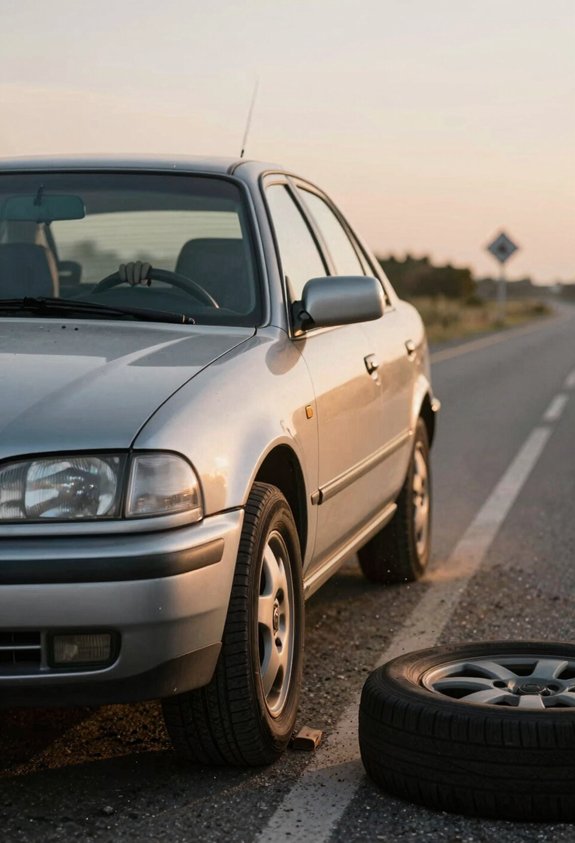
Although you might feel tempted to push through to the next exit when your tire goes flat, doing so transforms a manageable roadside issue into a potentially catastrophic mechanical and safety failure. I’ve seen how a flat tire destroys your vehicle’s handling and braking capacity, particularly at highway velocities where control evaporates within seconds.
When you’re stranded, your safest path involves maintaining a safe driving speed below 20 mph, covering no more than 1.5 miles to reach a level, visible location. The sole exception permitting any flat tire movement: relocating to immediate safety or accessing roadside assistance.
Standard tires disintegrate rapidly under load, propagating destruction through wheels, brakes, and suspension components. Run-flat alternatives tolerate limited distances, but conventional constructions demand immediate cessation. Your mechanical integrity and physical security outweigh every destination urgency.
What Happens to Your Tire and Wheel When You Drive Flat
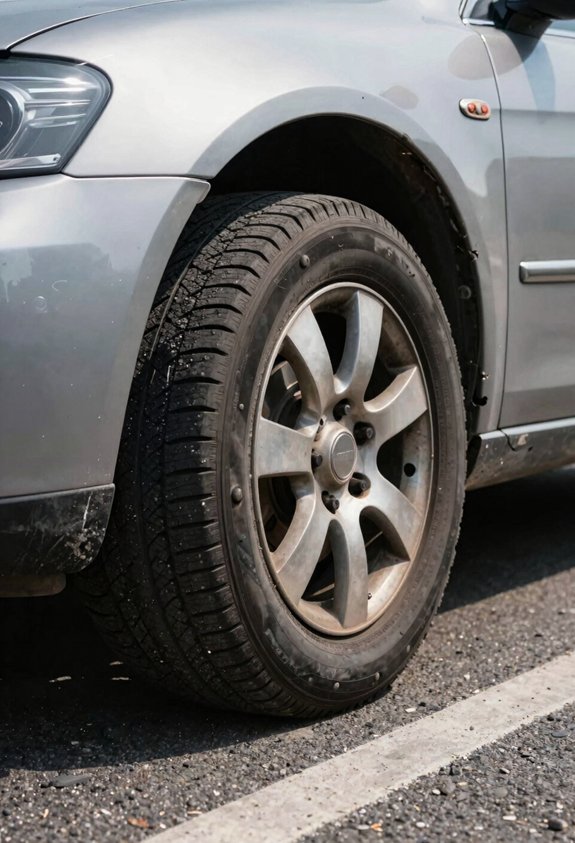
When you drive on a flat, your tire’s structure can’t support the vehicle’s weight, which leads to Tire Structure Failure as the sidewalls collapse and the internal layers separate from overheating and excessive flexing. Within fractions of a mile, the deflated rubber folds beneath the rim, creating Rim Road Contact that grinds metal against asphalt; bending, warping, or cracking the wheel and sending vibrations through your suspension.
These failures compound into Component Damage Risk, where abnormal loads stress brake lines, wheel bearings, and suspension geometry while compromised handling extends stopping distances by 30-50% or more, depending on speed and road conditions.
Tire Structure Failure
Key failures include:
- Sidewall rupture from repeated flexing
- Cords separating from rubber compounds
- Complete structural disintegration
Stop immediately. Every rotation causes irreversible damage.
Rim Road Contact
How quickly does a deflated tire escalate from inconvenience to costly wheel destruction? I’ll walk you through what happens when your tire pressure drops and the rim meets the road.
The Mechanics of Rim-to-Road Contact
As tire pressure plummets, your sidewalls collapse under the vehicle’s weight. I’m talking about a cascade failure: the deflated tire can no longer cushion the wheel, forcing direct rim-to-road contact. That metal rim, designed for precision balance, now grinds against asphalt or concrete.
Progressive Damage Patterns
Once road contact begins, your rim faces immediate threats. The wheel bends, warps, or cracks as it absorbs impacts meant for inflated rubber. Heat from steel belts transfers directly to the rim, compounding structural stress.
Meanwhile, the tire bead separates from the wheel, accelerating air loss and deepening wheel injury.
Critical Warning
I’ve seen this progression destroy wheels within mere miles.
Component Damage Risk
Most critically, vehicle control deteriorates through destabilized steering response and lateral drift. At highway speeds, overheating can trigger catastrophic blowouts, eliminating directional authority entirely. I’ve seen drivers lose control within seconds of ignoring these warnings, don’t let that be us.
How Far Can You Drive on a Regular Flat Tire?
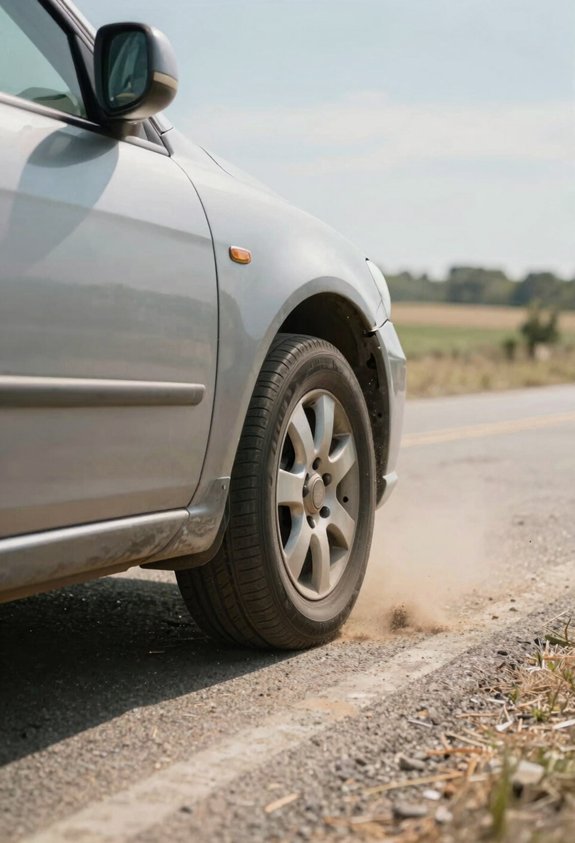
When you’re dealing with a regular flat tire, I recommend limiting your driving to no more than 1 mile (1.6 km) at speeds under 20 mph (32 km/h) to reach a safe stopping point, because exceeding this distance or speed markedly increases your risk of irreversible tire destruction and wheel rim failure.
I’ll break down exactly why these limitations matter, how damage progresses with every additional foot traveled, and what specific factors determine whether you’re facing a simple repair or a complete wheel replacement.
Maximum Safe Distance
On conventional rubber, driving beyond a short coast to safety invites rim damage, sidewall destruction, and potential loss of vehicle control. The rubber isn’t designed for zero-pressure operation; it collapses quickly under load.
Run-Flat Exceptions
Run-flat technology extends your range dramatically, typically 50 to 100 miles at controlled speeds, though manufacturer specifications vary considerably based on load and ambient conditions.
If you’ve exhausted these options, you’ll need to drive on a spare or arrange roadside assistance. Distance limitations on temporary spares (typically 50 miles at 50 mph) present their own constraints worth understanding before you need them.
Speed Limitations Apply
How quickly can a routine drive turn hazardous? I want you to understand that when you’re dealing with a flat tire, speed limits aren’t suggestions; they’re critical safety thresholds that can mean the difference between controlled movement and catastrophic failure.
I always tell fellow drivers that standard flat tires demand speeds at or below 20 mph, and even then, you’re pushing your luck beyond 1.5 miles. Your flat tire’s structural integrity deteriorates exponentially with velocity, generating destructive heat and friction. You’ll feel the vehicle pull, vibrate, and resist steering inputs. I’ve seen too many people ignore these speed limits, thinking they can make it home safely.
| Speed (mph) | Consequence |
|---|---|
| 0-15 | Moderate heat buildup, slower deterioration |
| 15-20 | Maximum advisable for standard tires, increasing deformation |
| 20-30 | Rapid structural breakdown, loss of vehicle control probable |
| 30-45 | Imminent blowout risk, wheel rim damage unavoidable |
| 45+ | Extreme hazard, high probability of accident |
Damage Escalation Risk
Why push your luck beyond what’s absolutely necessary? I’ve seen how quickly tire damage compounds when you ignore the one-mile threshold, and I’m telling you, it’s not worth the gamble.
Beyond that distance, your sidewalls collapse, the rubber shreds, and heat buildup from friction turns your wheel into a grinding stone against asphalt. You’re not just risking a ruined tire; you’re inviting rim damage that’ll cost hundreds, sometimes thousands, to repair.
The tire’s internal structure fails, steel belts separate, and that shredded rubber wraps around your brake lines, your suspension components, everything. On curves or interstates, control evaporates.
Keep it under 20 mph, stay on smooth ground, and stop before that flat becomes a cascade of mechanical failures you’ll regret.
What Speed Is Safe for Driving on a Flat Tire?

When you’re forced to drive on a flat tire, speed becomes your most critical variable for minimizing damage and maintaining control. I keep my speed at about 20 mph, knowing that every additional mile per hour amplifies spoilage risk exponentially. The safe speed isn’t negotiable; it’s a hard ceiling I’ve learned to respect through understanding how quickly standard tires deteriorate under load.
Why Speed Matters
- Faster driving generates destructive heat, accelerating internal breakdown
- Rim-to-road contact intensifies, threatening wheel integrity
- Control degrades nonlinearly above 25 mph
I aim for safe, level ground within 1.5 miles, though less distance always proves better. Aggressive maneuvers, hard braking, sharp turns, compound the danger. When I must move, I drive slowly, cautiously, treating the vehicle as compromised. Your flat tire demands patience; haste transforms inconvenience into costly failure.
Run-Flat Exception: When Your Tire Lets You Drive Further

Run-flat tires fundamentally alter what I can expect when punctures occur, transforming an immediate roadside emergency into a manageable, limited-range driving scenario. These specialized tires rely on reinforced sidewalls that support my vehicle’s weight even when completely deflated, allowing controlled operation to reach a safe location without immediate roadside tire changes.
Understanding Run-Flat Capabilities
Most run-flat tires enable driving approximately 50 miles (80 km) at reduced speeds near 50 mph (80 km/h), though I must consult my owner manual since distance limits vary significantly by manufacturer and tire brand. These specifications aren’t suggestions; they’re engineered boundaries I shouldn’t exceed.
Critical Operational Constraints
Even with run-flat technology, I avoid aggressive acceleration, hard braking, and high-speed travel that could compromise structural integrity. After reaching my destination, I prioritize immediate tire replacement or professional evaluation, as internal damage may not be visible.
How to Drive on a Flat Tire to Reach Safety
While run-flat technology offers engineered solutions for limited mobility after puncture, most drivers face conventional tires that provide no such buffer, forcing immediate decisions about whether, and how, to move a vehicle with zero inflation pressure.
Immediate Actions and Limitations
If you must proceed, I recommend traveling no more than 1.5 miles at speeds under 20 mph. Turn on your hazard lights immediately, then proceed cautiously toward the nearest safety location, a level, well-lit area away from traffic curves and hills. Avoid sharp turns, heavy braking, and高速 routes entirely.
If you must proceed with a flat tire, travel less than 1.5 miles under 20 mph, hazards on, choosing smooth, level roads away from traffic.
Consequences of Extended Driving
The longer you drive, the greater the damage: tire destruction, wheel rim deformation, brake compromise, suspension stress, and potential body component damage. Your spare tire becomes essential once stopped, but only after reaching that secure position. Smooth surfaces minimize additional risk during this limited transit.
Stop Now or Keep Going? How to Decide in 10 Seconds
Where exactly are you when that warning light illuminates or you hear the telltale thump of a deflating tire? I need you to decide within ten seconds whether stopping now or continuing briefly is the safer choice.
Immediate Assessment Protocol:
Location matters: shoulder available, or middle lane?
Traffic density: can you merge safely, or will stopping create greater safety risk?
Tire type: run-flat or standard?
The Decision Framework:
If you’re on a standard tire, I’ve got to warn you: every additional foot increases damage exponentially. The acceptable drive distance compresses to roughly 1.5 miles maximum, below 20 mph, with most experts urging far less.
Run-flats extend your window considerably, 50 to 100 miles at reduced speeds, but I’m still urging immediate, controlled stopping to assess.
Spinning wheels on a flat tire generate rim cuts and internal damage rapidly. Your ten-second window demands prioritizing human safety over mechanical preservation, though both align when you stop promptly.
Spare Tire Limits: How Far and Fast You Can Actually Go
Distance ceiling: 50–70 miles maximum before structural degradation accelerates. I’ve learned the hard way that spare tire limits aren’t suggestions, they’re hard boundaries for our safety. When you mount that compact spare, you’re trading durability for convenience, and understanding these constraints keeps us all moving responsibly.
Speed Restrictions
I never exceed 50 mph on a donut spare, regardless of how tempting the open road appears.
Critical Parameters
- Distance: Strict 50–70 mile maximum before replacement becomes mandatory
- Speed: Absolute 50 mph ceiling to prevent catastrophic failure
- Differential Protection: Extended use risks damaging your drivetrain’s gear ratios
These smaller tires alter your vehicle’s handling characteristics significantly, reducing stability and responsiveness. I check my spare’s inflation pressure monthly, because discovering a flat spare when you need it most strands everyone in our community.
Your differential compensates for circumference differences, but prolonged driving accelerates wear beyond economical repair.
5 Signs Your Flat Tire Is About to Fail Completely
Even the most disciplined adherence to spare tire limits won’t protect you if your flat tire gives out before you reach safety, which is why I monitor every flat for warning signs of imminent failure.
Critical Warning Signs of Complete Tire Failure
- Escalating vibration or rhythmic thumping, indicates internal structural breakdown, often preceding sudden air loss.
- Dragging sensation or steering pull, signals sidewall collapse, where tire pressure has dropped below sustainable thresholds.
- Audible hissing or popping, denotes active air escape, accelerating deflation.
- TPMS illumination with rapid flashing, confirms severe tire pressure loss exceeding safe operational parameters.
- Metal-on-road contact sounds, reveals rim exposure, indicating imminent wheel damage and complete traction failure.
Recognizing these indicators preserves driving safety. I pull over immediately upon detecting any combination, as continued operation risks catastrophic blowout, suspension damage, and total loss of vehicle control.
How to Prevent Flat Tires With Simple Monthly Checks
Why risk a roadside emergency when a few minutes of inspection each month can dramatically reduce your likelihood of experiencing tire failure? I’ve learned that preventive maintenance beats any roadside repair, and here’s how we keep our vehicles road-ready together.
Your Three-Step Monthly Tire Check
- Measure tread depth using a quarter test (inserted upside down) or a dedicated gauge, replacing tires when they reach 2/32″ minimum, though I recommend replacement at 4/32″ for wet-weather safety.
- Check pressure with a reliable tire pressure gauge, verifying against your door-jamb sticker while tires are cold, since underinflation generates destructive heat and premature failure.
- Verify spare tire safety by confirming inflation pressure and condition, because discovering a flat spare during an emergency compounds an already dangerous situation unnecessarily.
These habits protect our investment, and our fellow travelers.