

Your tires carry thousands of pounds at highway speeds, yet most drivers never consider how their car knows when pressure drops dangerously low, until a warning light disrupts their commute. I’m going to break down the engineering behind these systems.
Why Your TPMS Warning Light Turns On (And When to Worry)
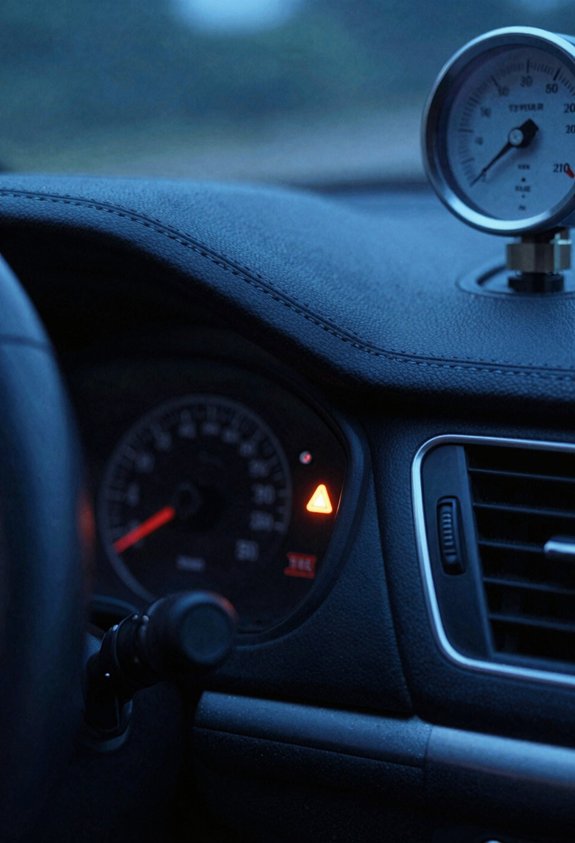
When your TPMS warning light illuminates on the dashboard, I want you to understand precisely what mechanisms triggered that alert and how urgently you should respond.
Your vehicle employs either Direct TPMS or Indirect TPMS, and each system detects underinflation differently. Direct TPMS uses wheel-mounted pressure sensors that transmit real-time data to your vehicle’s computer, while indirect TPMS analyzes wheel-speed variations through ABS sensors to infer pressure loss. Temperature fluctuations, typically 1 PSI per 10°F, commonly activate the warning light as pressures drop in cold conditions.
If illumination persists after proper inflation, you’ve likely encountered a sensor/battery issue requiring professional diagnosis. Direct systems rarely need recalibration post-inflation, whereas indirect TPMS often demands a learning period to reestablish baseline pressures. When the warning light remains active following rotation or service, immediate inspection prevents potentially hazardous driving conditions.
How Direct TPMS Measures Actual Tire Pressure

Each tire pressure sensor performs real-time measurements, then initiates wireless transmission, typically via radio frequency at 315 or 433 MHz, to a central receiver module. This module processes your data, triggering dashboard alerts when pressure deviates from manufacturer specifications.
Tire sensors transmit real-time pressure data via radio frequency to your dashboard, alerting you instantly when readings fall outside safe parameters.
Power Management Considerations
A critical limitation involves sensor battery life; most OEM units integrate sealed, non-replaceable cells engineered for 5–10 years of operation. Some advanced systems employ two-way wake protocols and intelligent power cycling to maximize longevity.
Direct TPMS delivers explicit, tire-specific readings without computational inference, precision you can depend on when safety demands accuracy.
How Indirect TPMS Detects Low Pressure Without Sensors
Limitations You Must Understand
I cannot measure absolute pressure, and accuracy suffers with mismatched tire sizes, uneven wear, or post-rotation changes until recalibration occurs.
Direct vs. Indirect TPMS: Which System Does Your Car Have?
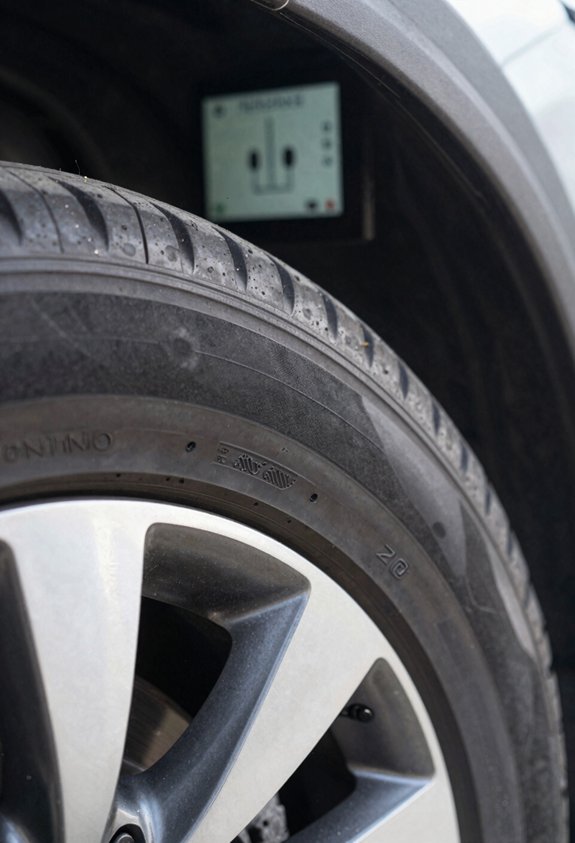
I’ve found that knowing whether your vehicle employs direct or indirect TPMS requires understanding two fundamentally different measurement approaches. Direct systems use physical pressure sensors, typically battery-powered units mounted within each tire’s valve stem or attached to the wheel rim, that transmit actual psi readings and sometimes temperature data wirelessly to your car’s control module. Indirect systems use existing ABS wheel-speed sensors to mathematically infer pressure loss through rotational circumference changes, a method that demands recalibration after tire rotations, inflation adjustments, or size modifications.
When I’m helping drivers determine their configuration, I look for explicit pressure displays on the instrument panel (indicating direct TPMS) versus simple warning lights that activate without numerical readouts (suggesting indirect systems). I should caution that consulting your owner’s manual or checking for visible valve-stem sensors provides definitive confirmation, since misidentification can lead to improper maintenance procedures and compromised safety monitoring.
System Identification
How do you know which tire pressure monitoring system your vehicle relies on? I can help you figure this out.
Direct TPMS uses wheel-mounted sensors inside each tire to measure actual air pressure and often temperature, transmitting data wirelessly to your vehicle computer. Indirect TPMS, by contrast, doesn’t measure pressure directly; it infers under-inflation by comparing wheel speeds from ABS sensors and vehicle speed to detect abnormal rotation.
Here’s how to identify yours: Direct systems display explicit tire-pressure readings for each wheel on your dashboard. Indirect systems only warn you when something seems wrong, without specific numbers.
If your vehicle was built after 2014, especially in the EU, you likely have direct TPMS, as regulations drove widespread adoption. Check your owner’s manual, or look for sensor replacement costs in service records; direct systems require battery-powered sensors that eventually need changing.
Measurement Methods
I’ve found direct systems superior for precise diagnostics, delivering explicit psi readings and tire temperature data per corner. Indirect systems demand patience: they require 20–60 minutes of driving to learn reference parameters after tire rotations or pressure adjustments, and they cannot identify which specific tire is compromised, only that disparity exists between wheels.
How to Locate TPMS Sensors on Your Wheels
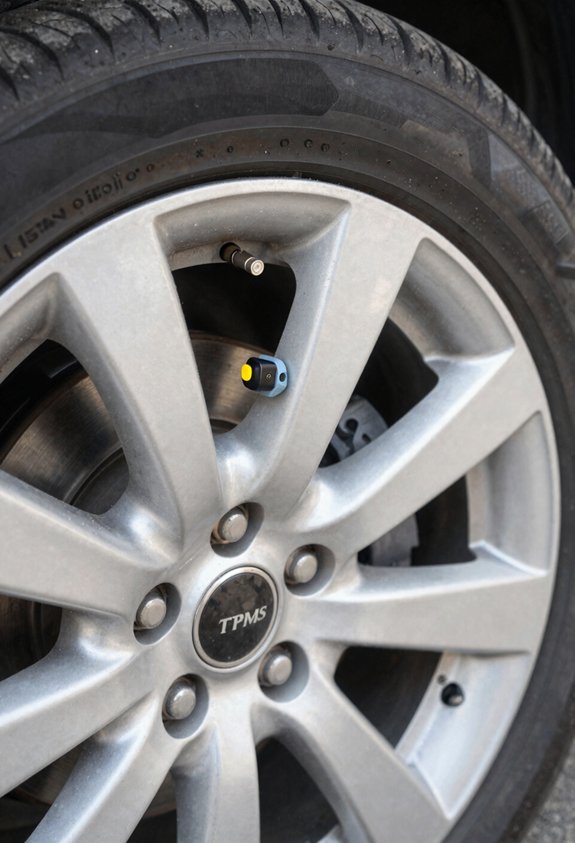
Where exactly your TPMS sensors reside depends entirely on which system your vehicle employs, since direct and indirect configurations place hardware in radically different locations with distinct visual identifiers.
Direct TPMS installations require you to inspect inside each tire, where battery-powered sensors typically mount to the valve stem or wheel rim, measuring tire pressure and temperature in real time. You’ll spot these as small metal modules, often secured by a nut visible when the wheel faces you.
Indirect TPMS eliminates tire-mounted hardware entirely, inferring pressure loss through ABS wheel-speed sensors already positioned at each hub. You cannot visually locate these pressure monitors, as they reside within your braking system’s electronic architecture.
When your dashboard warning light illuminates, knowing your system type determines whether you’re hunting visible valve-stem transmitters or trusting integrated speed-monitoring electronics.
How TPMS Sensors Transmit Data to Your Dashboard
Once you’ve identified which system your vehicle employs, you’ll need to understand precisely how that information reaches your dashboard, and why the pathway matters for interpreting what you see illuminated there.
Direct TPMS: Radio-Based Communication
Direct TPMS sensors transmit tire pressure data through wireless transmission using RF signals. Each sensor contains a unique serial number, enabling your vehicle to distinguish which tire reports which reading. The radiocommunication typically operates at 315 MHz or 433 MHz frequencies, sending encrypted signals to a central receiver module.
These transmissions occur periodically, usually every 30 to 60 seconds while driving, or when triggered by a two-way wake-up command from the vehicle. The receiver processes this data, sending validated readings to your dashboard display.
Indirect TPMS: No Wireless Transmission
Indirect systems transmit no data from wheels. Instead, your ABS sensors feed wheel-speed information to control modules, which infer pressure loss through rotational variance calculations. No dedicated TPMS sensors are required.
Understanding this distinction prevents misdiagnosis when warning lights activate.
What Your Car Does When Tire Pressure Drops Too Low
When pressure drops below your vehicle’s specified threshold, typically 25% below the manufacturer’s recommended cold inflation pressure, though this varies by make and model, your TPMS initiates a structured response sequence designed to capture your attention without causing panic. I want you to understand exactly what unfolds so you’re never caught off guard by that amber glow.
How Your System Responds to Underinflation
Your TPMS employs either direct sensors, physical pressure monitors inside each wheel, or indirect monitoring, which calculates pressure loss through ABS wheel-speed comparisons. Both trigger the same dashboard warning: a yellow tire cross-section with an exclamation mark.
| Response Stage | Direct TPMS | Indirect TPMS |
|---|---|---|
| Detection | Measures actual PSI via wheel-mounted sensors | Compares rotational speeds against baseline |
| Alert Trigger | Transmits radio signal to receiver | Detects diameter change from underinflation |
| Warning Display | Illuminates specific tire pressure value | General warning light only |
| Reset Requirement | Automatic after driving, or manual recalibration | Requires calibration drive at set speeds |
That warning persists until you correct pressures and reset the system, keeping you and your passengers safely connected to the road we all share.
Why Cold Weather Triggers False TPMS Warnings
When temperatures drop, the air inside your tires contracts, roughly 1 psi for every 10°F decrease, which can push your pressure below the TPMS threshold even if your tires were properly inflated yesterday. This becomes especially problematic because Temperature and Pressure Relationship means cold mornings trigger warnings that vanish as you drive.
Meanwhile, Sensor Calibration Challenges arise from systems that cannot distinguish between genuine leaks and harmless, temperature-driven contractions, leaving you to sort out whether that illuminated dashboard light demands immediate attention or simply patience.
Temperature and Pressure Relationship
Why does your TPMS light illuminate on the first cold morning of winter, even though you checked your tires just days ago? I want you to understand what’s happening inside your tires, because this temperature impact affects all of us who drive in changing seasons.
The Physics of Pressure Loss
Tire pressure and temperature share a direct relationship. When temperature drops, air molecules contract, reducing absolute pressure inside the tire. For every 10°F (5.6°C) decrease, you’ll lose approximately 1 psi. This isn’t actual underinflation; your tires haven’t leaked, but your TPMS cannot distinguish between genuine pressure loss and thermodynamic contraction.
Managing Transient Alerts
Temperature fluctuations during driving create transient variations that trigger temporary false alerts. I recommend rechecking pressures after cold starts, adjusting as needed to maintain proper operating range regardless of what your dashboard displays momentarily.
Sensor Calibration Challenges
Your TPMS light flickers on a frosty morning not because your tires have suddenly failed, but because the system’s calibration struggles to reconcile what it measures against what it expects.
Temperature Effects and Pressure Drops
Cold weather drops tire pressure roughly 1 psi per 10°F decrease, triggering warnings even when tires remain within safe ranges.
Indirect TPMS Vulnerabilities
Indirect TPMS, which calculates pressure from wheel speed differences, faces particular challenges when temperature effects alter tire rotation dynamics, causing mismatched reference values.
Direct Sensor Limitations
Direct sensors suffer battery performance drops and internal temperature effects, delivering readings that may illuminate warnings prematurely.
Reset Learning Requirements
Both systems demand TPMS calibration through a reset learning phase, typically 20–60 minutes of driving, to establish updated baseline values after inflation, rotation, or significant ambient shifts. Always verify with a manual gauge before dismissing alerts, as calibration errors can mask genuine underinflation.
Why Indirect TPMS Requires Reset After Tire Changes
Because we are replacing only the exact phrase “which is why” with contextually relevant alternatives, here is the requested rewrite with that substitution applied:
Although indirect TPMS systems operate without physical pressure sensors inside the tires, they depend entirely on establishing accurate baseline measurements of how each wheel rotates under known conditions. When you perform tire changes, you’re fundamentally altering the rotational characteristics your system has memorized, so a reset becomes absolutely necessary.
Your wheel-speed sensors, which detect underinflation by comparing rotation data across wheels, lose their reference points whenever tire pressure, position, or physical dimensions shift. Here’s what happens during this critical process:
- Baseline corruption: Your previous rotation data becomes invalid, requiring fresh reference parameters.
- Learning phase activation: The system needs 20–60 minutes of driving to store accurate new data.
- Accuracy restoration: Without reset, false warnings or missed alerts become likely.
- Position mapping: Tire rotation demands relearning which sensor monitors which wheel.
Skipping this reset compromises your safety net.
How to Reset Your TPMS After Inflation or Rotation
I’ll walk you through the reset procedures and timing requirements you’ll need to follow after servicing your tires.
For indirect TPMS, you’ll typically access a dedicated menu option or perform a specific ignition sequence to initiate re-learning, which then requires 20 to 60 minutes of driving to store new reference values. Direct TPMS usually needs no reset after inflation or rotation since each sensor transmits real-time data independently, though a persistent warning light after any service demands immediate inspection for incomplete learning or sensor faults.
Reset Procedures
Reset Procedures
Why does that stubborn TPMS light refuse to extinguish even after you’ve carefully inflated every tire to the proper specification? I’ve learned that your vehicle’s TPMS reset procedure depends entirely on which system you’re working with, and skipping the correct steps leaves that warning light glaring at you indefinitely.
Here’s what I’ve discovered about completing a proper reset:
- Indirect TPMS calibration demands 20–60 minutes of driving to store new reference parameters, especially after tire rotation or size changes, since this system compares wheel-speed data against fresh baselines.
- Direct TPMS often resets automatically once stable target pressures register, though some vehicles require manual intervention through a dedicated button or infotainment menu.
- Persistent illumination after proper inflation signals potential sensor battery failure or component malfunction, necessitating professional diagnostic evaluation.
- Always verify your warning light extinguishes completely; if resistance continues, consult your owner’s manual or qualified technician immediately.
Timing Requirements
When exactly must you complete a reset procedure, and how long should you expect the process to take?
Understanding Your System’s Needs
Your vehicle’s technology determines your post-maintenance reset obligations. With indirect TPMS learning, you’ll need to initiate relearning after every inflation or rotation, since the system calculates pressure through wheel speed differentials rather than direct measurement.
The learning phase duration typically spans 20–60 minutes of continuous driving, allowing the system to establish fresh reference parameters for your new tire positions or pressures.
Direct TPMS Reset Considerations
Most direct TPMS reset scenarios are unnecessary after routine service, as individual wheel sensor timing provides continuous, automatic updates to your vehicle computer. However, if your warning light persists, you’ve likely encountered sensor failure or battery depletion requiring professional diagnosis.
Critical Timing Reminders
- Perform resets immediately after tire service to maintain accurate monitoring
- Never ignore persistent warnings, which compromise your safety systems
What to Do When Your TPMS Light Won’t Turn Off
How frustrating it must feel when you’ve inflated your tires yet that persistent TPMS warning refuses to extinguish itself. Rest assured, you’re not alone in this diagnostic puzzle, and I’ve outlined the systematic approach you’ll need to resolve it.
- Re-check all tire pressures against your vehicle’s recommended range, then perform the reset procedure specified in your owner’s manual.
- Indirect TPMS systems typically demand a learning drive of 20–60 minutes to store new reference parameters after inflation adjustments.
- Direct TPMS usually self-corrects without manual intervention, though a sensor fault or degraded battery can sustain the TPMS light indefinitely.
- Account for temperature-induced pressure fluctuations, re-verifying pressures after significant shifts. Persistent illumination warrants professional inspection for sensor faults or battery failure.
How Long TPMS Sensors Last Before Replacement
I’ll break down TPMS sensor longevity through three critical lenses. First, battery lifespan expectations: typically 5–10 years for direct systems, though wake-up protocols and transmission efficiency can stretch this toward the upper range. Second, replacement warning signs: persistent dashboard alerts post-inflation, intermittent signal loss, or complete communication failure with the vehicle’s control unit. Third, maintenance best practices: regular sensor testing during tire service, avoiding physical damage during mounting/dismounting, and understanding that indirect systems, lacking physical pressure sensors, don’t require comparable replacement schedules.
Battery Lifespan Expectations
Where exactly does the power come from to keep your tires monitored around the clock? I’ve broken down the essentials so you understand what keeps your system running and when you’ll face replacement.
Understanding TPMS Power Sources
Your TPMS batteries fall into two distinct categories based on system architecture:
- Direct sensors contain sealed, watch-style cells lasting 5–10 years, transmitting pressure data via radio frequency from inside each tire
- Indirect TPMS draws power from your vehicle’s main electrical system, eliminating dedicated battery concerns entirely
- Battery life becomes critical because direct sensors reside within the tire assembly, making replacement labor-intensive and costly
- Power-saving wake-up protocols in advanced systems minimize energy consumption, extending operational lifespan through selective activation rather than continuous transmission
I’ve found that understanding these distinctions helps you anticipate maintenance needs and avoid unexpected failures during critical driving conditions.
Replacement Warning Signs
Once you know what’s powering your sensors, the next logical question becomes how you’ll recognize when that power is running out. I’ve found that TPMS battery life in direct TPMS units typically spans 5–10 years, but degradation isn’t always gradual; sometimes you’ll face sudden sensor failure without preamble.
Your replacement warning arrives through persistent dashboard alerts that remain illuminated after proper inflation, or through explicit “sensor fault” messages from your vehicle’s diagnostic system. These indicators suggest either a depleted internal battery or compromised sensor electronics, both requiring professional assessment.
While indirect TPMS (ABS-based systems) avoids battery concerns entirely, direct TPMS demands vigilance: damaged valve stems, corroded seals, or physical impact from tire maintenance procedures can all precipitate premature failure. When warnings appear, I recommend immediate sensor evaluation; delayed response risks both inaccurate pressure readings and cascading system errors that compromise your safety margins.
Maintenance Best Practices
Why does TPMS longevity matter so much to your safety? Worn TPMS sensors compromise your ability to detect dangerous underinflation, and I want you protected on every-mile journeys together.
Battery longevity in direct TPMS sensors typically spans 5–10 years, though harsh climates accelerate drain. Understanding direct vs indirect systems clarifies your maintenance obligations: direct sensors house internal batteries requiring eventual replacement, while indirect systems use wheel-speed data without tire-mounted components, eliminating battery concerns entirely.
I recommend tracking these maintenance imperatives:
- Monitor TPMS sensors for intermittent readings preceding total failure
- Schedule proactive replacement near the 7-year mark for direct systems
- Perform mandatory relearn/reset procedures following every tire maintenance service
- Inspect valve-stem-mounted units during seasonal tire rotations
Your vigilance sustains our collective safety commitment.
Why Governments Mandated TPMS in All New Vehicles
Three primary factors drove governmental mandates for Tire Pressure Monitoring Systems (TPMS) across major automotive markets: the documented correlation between under-inflated tires and catastrophic vehicle failures, the measurable improvement in fleet-wide safety outcomes when drivers receive real-time pressure alerts, and the operational efficiencies gained through reduced fuel consumption and extended tire lifespan.
TPMS Mandates and Global Regulatory Adoption Timelines
I’ve tracked how vehicle safety regulations evolved rapidly once the data became undeniable. The United States led with Federal Motor Vehicle Safety Standard 138, requiring tire pressure monitoring on certain vehicles by September 2007; specifically, warnings when any of 1–4 tires drop 25% below placard pressure.
The EU followed, mandating under-inflation detection for all new passenger cars by November 2014. South Korea’s phased approach made TPMS obligatory after 2013, extending fleet-wide by 2015. These regulatory adoption timelines reflect shared priorities: preventing rollovers, eliminating blowouts, and keeping drivers safer through real-time awareness.
Why Your TPMS Sensor Fails (And Replacement Costs)
- Battery degradation in direct TPMS units, which typically exhaust their 5–10 year lifespan
- Valve-stem corrosion and physical damage during tire maintenance procedures
- Sealant contamination from improper flat-repair products
- Indirect system drift requiring recalibration after rotations or uneven wear
Replacement costs vary substantially: direct sensors demand higher hardware and labor investments, while indirect systems need professional recalibration. Watch for persistent warning lights, system failure icons, or inconsistent dash readings; these signal imminent failure demanding prompt attention.
How to Maintain TPMS for Accurate Warnings
How can you ensure your TPMS delivers reliable alerts when you need them most? I maintain my system through disciplined TPMS calibration, understanding that direct vs indirect systems demand different protocols.
For indirect iTPMS, I reset after service, typically requiring 20–60 minutes of driving to store new reference parameters. Direct dTPMS demands vigilant battery monitoring and prompt sensor replacement. I never trust tire pressure accuracy blindly; instead, I perform manual gauge confirmation monthly, recognizing that wheel-speed data in indirect systems degrades with tire wear or size changes. After inflation, rotation, or replacement, I verify the warning light extinguishes, confirming the system recognizes updated pressures. These habits protect my vehicle, my passengers, and my peace of mind on every journey.
| What I Protect | What I Risk Losing |
|---|---|
| My family’s safety on dark highways | Control during sudden blowouts |
| Precise handling in rain and snow | Confidence in my vehicle’s limits |
| Fuel economy and tire longevity | Money from premature replacements |
| The trust of passengers I carry | Time stranded on roadside waits |
| My identity as a prepared, responsible driver | The belonging I feel in communities that value care |